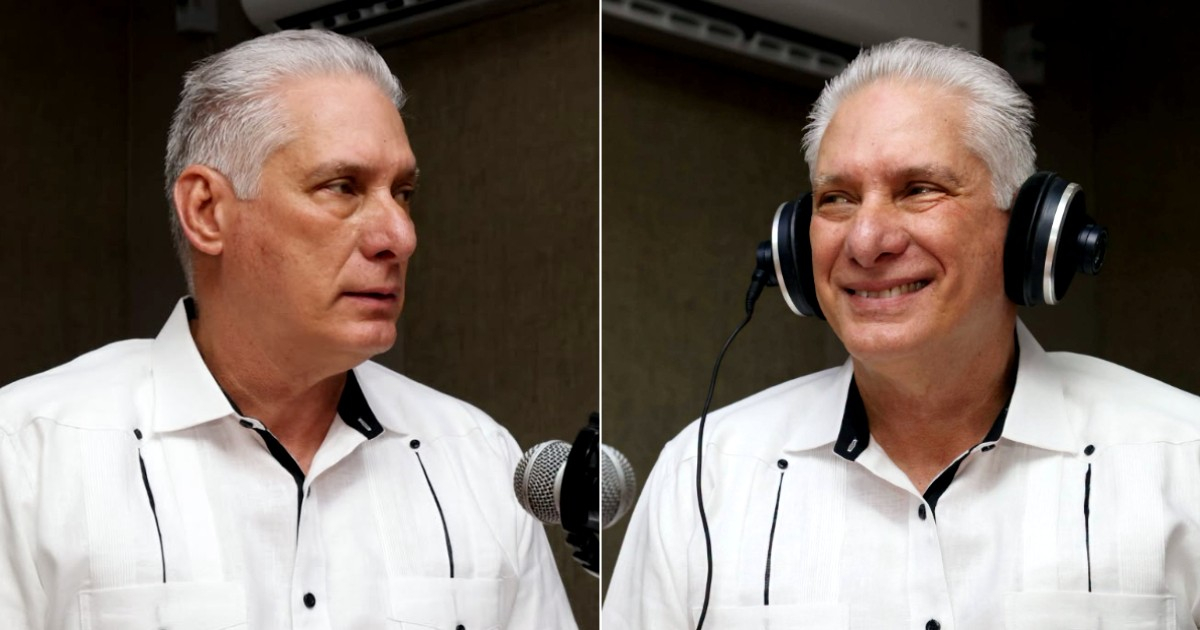
An anonymous listener issued the most uncomfortable warning during the premiere of "Criterio Compartido," the new radio program by Miguel Díaz-Canel on Radio Rebelde: “In trying to safeguard the achievements of socialism, we could fall into the most ruthless and cruel capitalism. Be careful.”
The program, hosted alongside journalist Bárbara Betancourt under the slogan "every voice in Cuba matters," aired on Wednesday, September 23, and will be broadcast biweekly on alternate Wednesdays.
For 55 minutes, the leader listened to complaints about prices, pensions, and bureaucracy, but his responses focused on defending the 176 economic and social transformations approved by the National Assembly in June 2026 and attributing the crisis to the U.S. embargo.
Another listener was even more direct in the "vox populi" segment: "The economy is increasingly in the hands of the private sector. They speculate, hoard, evade taxes, set prices, and raise prices without any justification".
Díaz-Canel responded emphatically: "There is no return to capitalism. These transformations are not a shift towards capitalism nor are they a process of capitalist restoration; they are the updating of our economic and social model in a socialist framework that must also be innovative."
It is not the first time that the leader has reiterated this position. Since the approval of the 176 measures, he has insisted that the reforms do not imply renouncing socialism, and in July he admitted his fear of the growth of private capital, although he emphasized that everything will remain under the control of the Communist Party.
To support its position, the program played a clip of the dictator Fidel Castro from the 1990s in which the historical leader justified the introduction of market mechanisms during the Special Period: «More elements of private property, capitalism, and market will necessarily be introduced. It must be done. But with the strength of the revolution, we should not fear that».
While the leader defended the model, the testimonies of the listeners painted a very different reality.
Pedro Rodríguez Martínez, a resident of Contramaestre, in Santiago de Cuba, reported that the price of oil ranges between 3,600 and 5,000 pesos and that “the salaries and the budget do not suffice to live.” Juana Pérez, an 88-year-old retiree from Havana with a pension of 2,000 pesos, requested that the measures take into account the elderly; Díaz-Canel spoke of differentiated subsidies but did not specify amounts or deadlines.
The ruler himself read data from his "dashboard" that confirms the gravity of the situation: an energy deficit of more than 2,020 megawatts, over 3.6 million people affected by water issues, 890 out of 1,600 bakeries unable to produce bread due to a lack of flour, and urban transportation operating at 1.6% across the country.
Regarding fuel, Díaz-Canel stated that Cuba has been "nine months without receiving a fuel ship," a statement that contradicts the facts: the Russian tanker Anatoli Kolodkin arrived at the port of Matanzas on March 31, 2026, with about 100,000 tons of crude oil—equivalent to 740,000 barrels—and the unloading was completed on April 4, according to CUPET itself. The leader also did not mention the fuel imports made by the private sector.
The listeners' interventions were recorded in advance, so none were able to ask follow-up questions or confront the leader's responses live, and the broadcaster did not explain the criteria for selecting calls.
"Criterio Compartido" is the second attempt by Díaz-Canel to establish a direct channel of communication with the citizens: in March 2024, he launched the podcast "Desde la Presidencia," which reached 32 episodes and was discontinued without a public announcement, with its last installment dedicated to the controversial price increase by ETECSA.
At the end of the program, the leader promised that all calls received, even those that did not air, would be "transcribed, organized, and delivered for attention and follow-up."
Related videos:
Filed under: