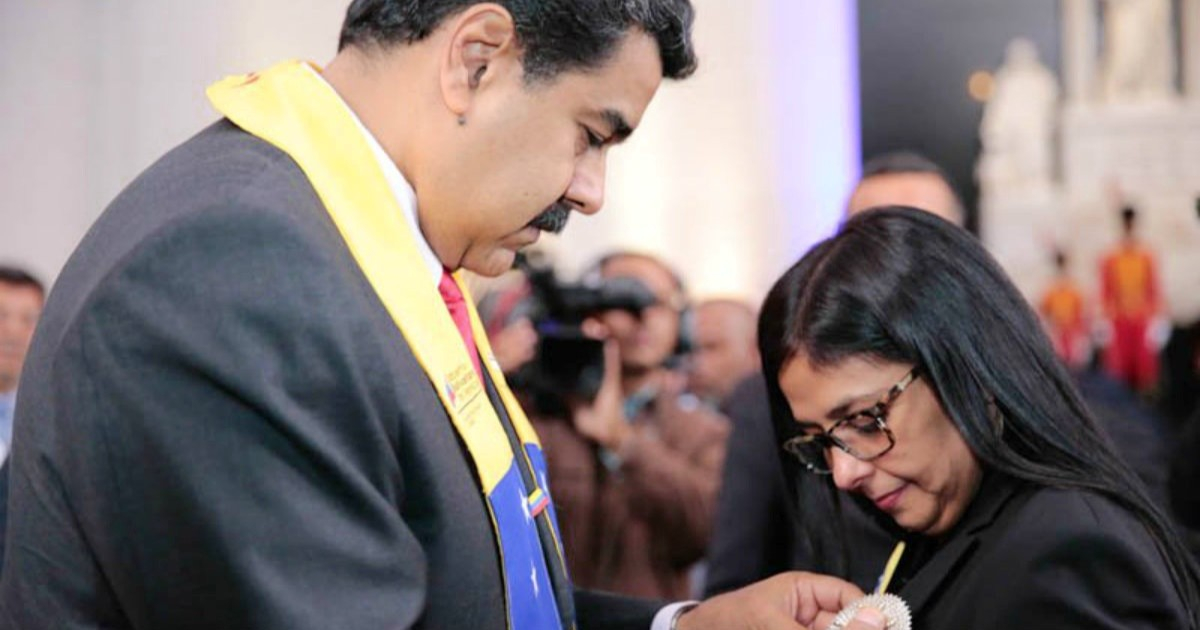
Delcy Rodríguez, the acting president of Venezuela, formally requested the National Assembly for a partial reform of the Constitutional Law against Hatred, for Peaceful Coexistence and Tolerance, a regulation she enthusiastically defended in 2017 when she was the president of the Chavista National Constituent Assembly.
The request was recorded in a letter on presidential letterhead dated Monday and addressed to the deputy Jorge Rodríguez Gómez, president of the parliament and brother of Delcy.
This Tuesday, the interim president posted on her X account with the message: “We continue to take steps towards a new phase of civic coexistence in Venezuela.”
The content of the letter
In the letter, Rodríguez argues that "the requested reform aims to advance the decriminalization of the behaviors stipulated in the aforementioned regulatory instrument, as part of the actions taken by the National Government to transform the criminal justice system of our country and promote democratic reconciliation and coexistence."
He also requested that the initiative be addressed "as a matter of urgency" and pointed out that the reform will generate "a positive impact on rebuilding trust in the institutions and revitalizing the democratic life of the Nation."
The petition does not call for the total repeal of the law, but rather a “partial reform”, a proposal that has been challenged by organizations demanding the complete repeal of the regulation.
A law passed amidst repression
The Constitutional Law Against Hatred was approved on November 8, 2017, by the chavista National Constituent Assembly, during the height of the political crisis following the anti-government protests of that year, which resulted in around 125 fatalities.
It was Nicolás Maduro himself who introduced the project, declaring that the time had come to "punish hate crimes, intolerance in all its forms of expression."
The law, criticized from its inception by opponents and organizations defending human rights and freedom of expression as a tool of censorship, establishes penalties of up to 20 years in prison for inciting hatred or violence, requires the removal of social media messages within six hours under penalty of fine, and empowers the State to shut down media outlets and revoke the registration of political parties.
Delcy Rodríguez herself, then president of the Constituent Assembly, was one of its main defenders.
“Promotion is prohibited; messages that promote hatred, war, or intolerance must be removed within six hours. Otherwise, they will be subject to sanctions,” he declared at that time.
The turn following Maduro's capture
After Maduro's capture by U.S. forces on January 3, 2026, the Venezuelan government was led by Rodríguez.
In February, during the approval of the Amnesty Law, Jorge Rodríguez had already acknowledged that there were "situations of misuse" of the regulation, and indicated that it was "very likely" that it would be subject to reform.
It wasn't until this Monday that the Executive formalized that request.
The request comes days after Delcy Rodríguez met with Donald Trump in New York at a meeting that she herself described as "historic," and after she pledged before the UN a "systematic legal reform" and a "democratic transformation" in Venezuela.
Organizations demand more than just a reform
The figures recorded by human rights organizations contrast with the official narrative. Provea documented at least 40 judicial charges, 36 arbitrary detentions, and three sentences of more than 10 years for opinion-related offenses under this law between January 2024 and October 2025.
Amnesty International warned that the mechanisms of repression "have not changed" structurally, with between 379 and 500 people detained for political reasons and 64 new cases of documented torture since January 2026.
The National Union of Press Workers demanded the total repeal of the regulation, rather than a mere partial reform, in order to halt what the organization considers the criminalization of journalism in Venezuela.
Related videos:
Filed under: