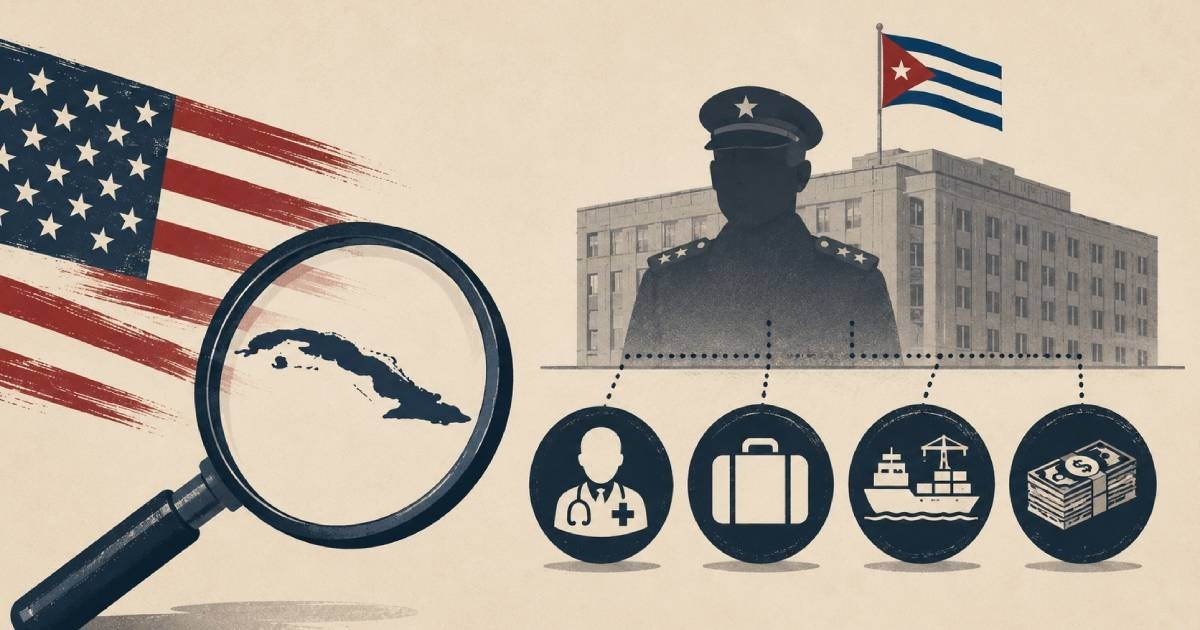
The Office of Foreign Assets Control (OFAC) of the United States Department of the Treasury published an official alert with a package of new sanctions and restrictions against Cuba that will take effect on Wednesday, September 30.
The measures combine the amendment to the Cuban Assets Control Regulations (CACR) —in effect since 1963— and the issuance of the new Cuba Sanctions Regulations (CSR), which implement Executive Order 14404 signed by President Donald Trump on May 1, 2026, titled "Imposing sanctions on those responsible for repression in Cuba and threats to national security and foreign policy of the United States."
End of "U-Turn" bank transactions
Starting this Wednesday, banks subject to U.S. jurisdiction can no longer process the so-called "U-Turn" transactions: operations in which Cuba or a Cuban national has an interest and that originate and conclude outside the United States. Banking institutions are only authorized to reject them.
In parallel, banks will also not be able to open or maintain accounts for independent private Cuban entrepreneurs. Existing funds in those accounts must be frozen and reported to OFAC immediately, and any access will require a specific license.
Expanded prohibition with Cuba's Restricted List
Another key measure extends the prohibition on financial transactions with entities on the Cuba Restricted List (CRL) to now also include indirect operations, not just direct ones.
An indirect transaction occurs when a person acts as an intermediary in a transfer of funds whose origin or final destination is an entity on that list, which consists of entities linked to the military, intelligence, and security services of the Cuban regime.
The alert also warns that foreign financial institutions facilitating significant transactions with individuals blocked under EO 14404 could also face sanctions, extending the pressure beyond the U.S. financial system.
Travel restrictions: professional meetings and educational tourism
The new regulations eliminate the general license that allowed individuals subject to U.S. jurisdiction to attend or organize professional meetings or conferences in Cuba. Those who were already on the island under that authorization have a 30-day wind-down period, until October 30, 2026, to conclude their activities.
Educational trips are also restricted: they must be conducted under the auspices of an organization subject to U.S. jurisdiction, and almost all travelers must be accompanied by a representative of the sponsoring organization. Additionally, the previously authorized "people-to-people group educational travel" under the CACR has been eliminated.
Those who have already completed at least one travel transaction —such as purchasing a flight— before September 30th will be able to continue with that specific trip.
Sanctioning framework and humanitarian protection
The new CRS creates an additional framework with the ability to block the assets of foreign individuals operating in strategic Cuban sectors such as energy, defense, mining, financial services, and security.
The escalation is part of a maximum pressure policy that began on January 29, 2026, when Trump declared a national emergency due to threats from the Cuban regime, and has included successive rounds of sanctions against its military apparatus and other repressive bodies, as well as the energy, financial, metallurgy, and mining sectors.
The measures, however, maintain humanitarian authorizations: General License 1 continues to permit family remittances and the delivery of food, medicines, and medical devices to Cuba, activities that are expressly excluded from the new prohibitions.
The regulations are signed by Bradley T. Smith, director of OFAC, and will officially take effect on Wednesday, September 30, 2026.
Related videos:
Filed under: