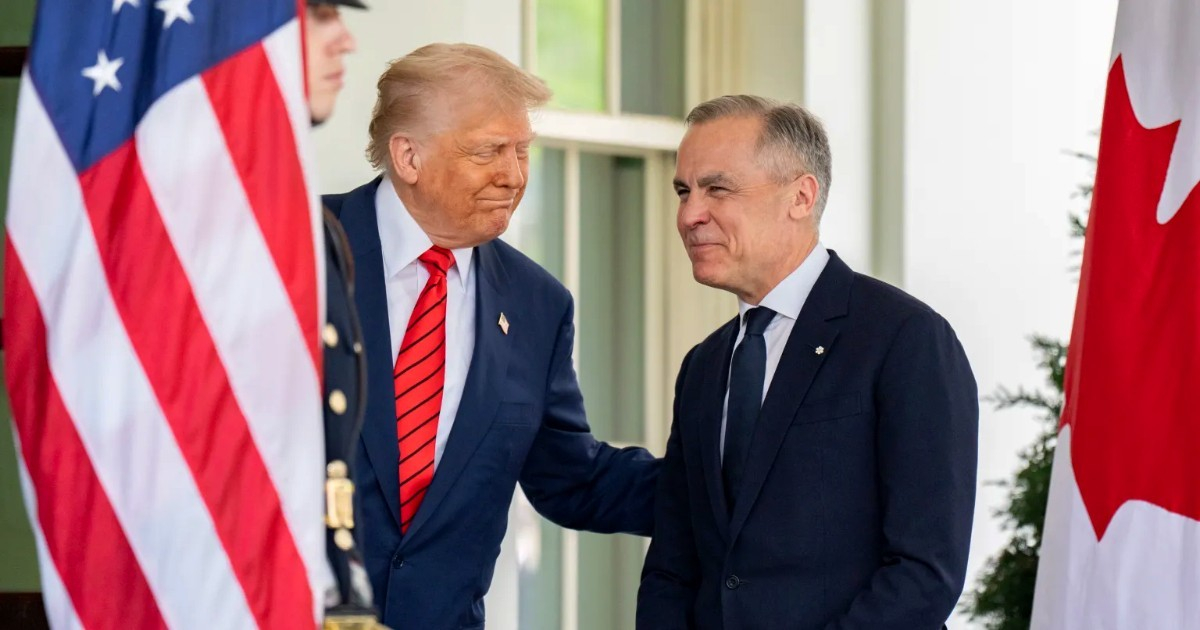
United States activated on Tuesday a ban on Canadian imports valued at nearly 1 billion dollars that includes alcoholic beverages, dairy products, and motorcycles, marking a new escalation in the trade war between the two neighboring countries, reported the channel Telemundo.
According to calculations by Jacob Jensen, director of trade policy at the American Action Forum, the ban affects 967 million dollars in Canadian imports, based on figures from 2025. 87% of that amount corresponds to alcoholic beverages, a category that Washington targeted as a direct retaliation after several Canadian provinces banned American alcohol from their shelves.
The measure was signed by President Donald Trump on September 8 under Section 338 of the Tariff Act of 1930, a regulation enacted during the Great Depression, and it marks the first time that the U.S. has resorted to this mechanism to impose total import bans against Canada.
Among the banned products are also some dairy items, including whey, and motorcycles. Bombardier Recreational Products (BRP), based in Quebec, confirmed that its Can-Am Spyder and Canyon models "will be excluded from importation to the United States," although it specified that the immediate financial impact will be limited since it has already completed most of the production and shipments for the current season.
The overall economic impact is projected to be modest. Commercial attorney Patrick Childress, a partner at Holland & Knight and former U.S. trade official, explained that "for many of these products, the 50% was already acting as a de facto ban by making imports from Canada to the United States unprofitable," referring to the tariffs imposed by Trump in July 2026 on approximately $20 billion in Canadian imports. Nevertheless, Childress warned that the ban "will certainly do nothing to help ease trade tensions" between the two countries.
The dispute intensified over the summer when Canada responded to those tariffs with dollar-for-dollar retaliation of 15%, 25%, and 50% on approximately C$27.6 billion in U.S. goods, including steel, aluminum, appliances, and clothing. Trump then decided to punish Ottawa with the veto that took effect this Tuesday.
The Canadian Prime Minister Mark Carney, who came to power in 2025 promising to stand up to Washington, has promoted an unprecedented trade diversification strategy. "There is now a price to pay for access to the U.S. market," he stated earlier this month. Carney aims to double trade with countries other than the U.S. over the next decade, welcomed the European Union's proposal to make Canada its first associated member, and is progressing in trade negotiations with India ahead of the G20 summit in December.
From Ottawa, Gabriel Brunet, spokesperson for Minister of Trade Dominic LeBlanc, stated that "our top priority remains to protect and support Canadian workers, farmers, families, and businesses in the face of these unjustified measures."
The stalemate also jeopardizes the renewal of the United States-Mexico-Canada Agreement, the North American trade pact negotiated by Trump during his first term, which allowed for the free movement of goods among the three countries. Jensen warned that the ban "marks another escalation in the trade war that may lead to further retaliatory measures from Canada."
Trump, for his part, appeared confident on Monday before reporters: “They will come and say: ‘Sir, we’re sorry.’ They have treated the United States very, very poorly. I believe an agreement will be reached.” The annual bilateral trade between the two countries amounts to 880 billion dollars.
Related videos:
Filed under: