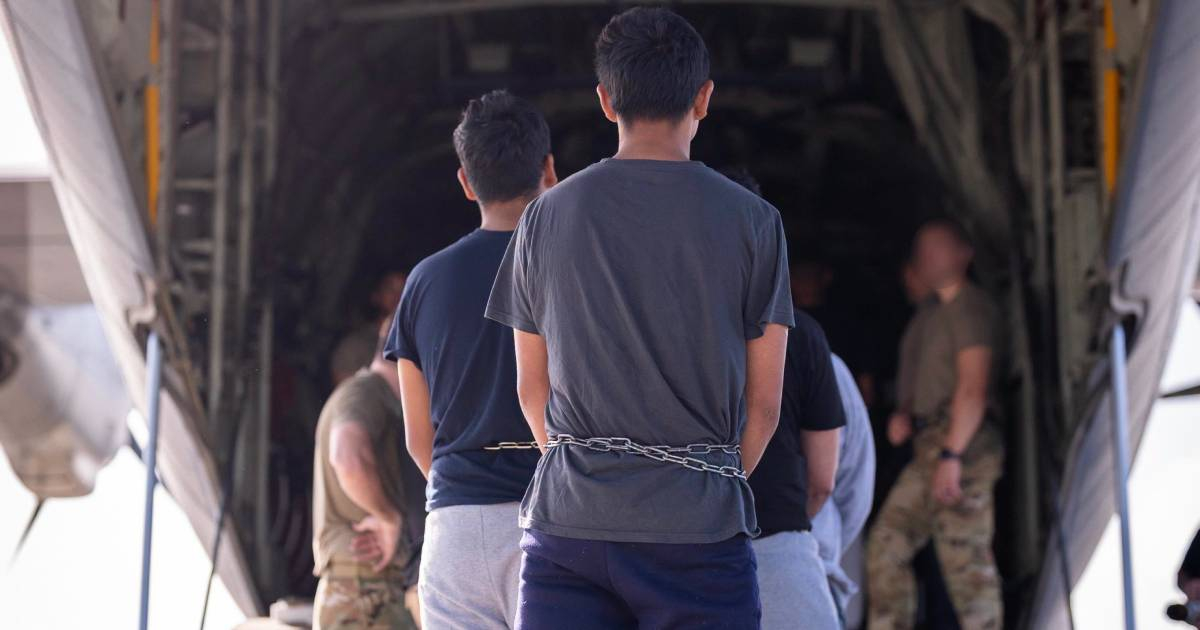
The U.S. Supreme Court allowed President Donald Trump's administration on Tuesday to continue, at least temporarily, with the expedited deportations of immigrants to countries other than their own, while the justices review the legality of a policy that has already impacted thousands of people, including Cuban citizens.
According to the agency Associated Press, the decision temporarily suspends the effects of lower court rulings that required providing immigrants with a meaningful opportunity to contest before being sent to a country with which they have no ties.
The Supreme Court also agreed to examine the merits of the case, Department of Homeland Security et al. v. D.V.D. et al., and scheduled the arguments for December. Therefore, the ruling on Tuesday does not definitively determine that the policy is legal, but rather allows the government to maintain it while the litigation continues.
The dispute returned to the highest court after the Trump administration requested an emergency intervention last week. The government stated that the restrictions imposed by lower courts had forced the cancellation of a deportation flight carrying about 70 people to three countries.
Among the issues that the judges will need to resolve is whether the courts had the authority to intervene in the claims of migrants and whether the guidelines used by the government for deportations to third countries comply with federal law, due process, and the protections related to the Convention Against Torture.
A policy that has already affected Cubans
The decision is particularly significant for Cuban immigrants. The Trump administration had turned to the Supreme Court after the First Circuit Court of Appeals questioned the procedure used for these expulsions, deeming it essential for migrants to receive prior notice and a meaningful opportunity to challenge the country of destination.
Cubans are now among the people sent by the United States to nations with which they had no prior connections.
In July 2025, the Supreme Court allowed the relocation to South Sudan of a group of immigrants, including two Cuban citizens.
Other Cubans were later sent to African countries such as Eswatini. One of them, Juan Carlos Font Agüero, reported from the Matsapha Maximum Security Correctional Center that he had been detained for months without charges or a release date after being deported from the United States in November 2025.
More recently, four Cubans were among the first immigrants deported by the United States to Guyana under an agreement that allows the South American country to accept nationals from third countries. The six members of that group —four Cubans and two Afghans— arrived on September 4, and according to the records cited at that time, none had a criminal background.
Politics has also led to judicial decisions against the government. This month, a federal judge in Colorado ordered the return of Honduran Bryan Omar Sánchez to the United States, who was deported to the Central African Republic despite having a pending asylum request and being protected under the Convention Against Torture.
According to data cited by Associated Press, the policy of third countries has been used to carry out around 25,000 deportations to more than two dozen countries, although the majority of these expulsions were directed towards Mexico.
The legal battle, however, is far from over. With Tuesday's decision, the Trump administration will be able to continue, for now, with deportations to third countries, while the Supreme Court prepares to hear arguments in December regarding the legality of the procedure.
Related videos:
Filed under: