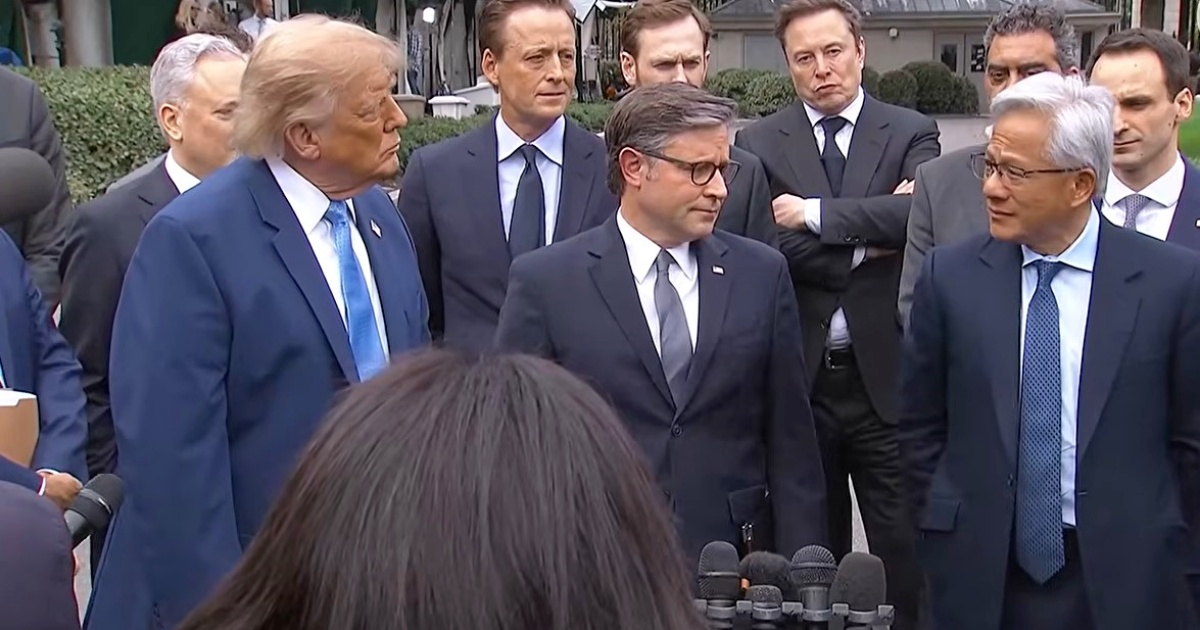
President Donald Trump gathered the leading technology executives from the U.S. at the White House this Tuesday and announced a voluntary agreement for self-regulation of artificial intelligence, which he described as “morally binding”, at a time when concerns about the risks posed by more advanced models are increasing.
The meeting was attended by Dario Amodei (Anthropic), Sundar Pichai (Google), Mark Zuckerberg (Meta), Greg Brockman (OpenAI), Jensen Huang (Nvidia), and Elon Musk (xAI), as confirmed by Reuters.
A voluntary pact with four pillars
The document, titled "White House Agreement on Superintelligence," requires the signing companies to have: robust internal controls, an internal verification team, an independent external auditor, and a committee within their boards of directors to oversee the reports from those auditors.
Trump announced that he will appoint around ten people to monitor compliance and will soon designate a general manager for the project.
The text leaves the door open for these measures to become mandatory: “In time, it might make sense to codify these steps into laws and regulations.” “I believe I’m seeing tremendous self-regulation capacity. And they understand that they need to self-regulate,” Trump stated at an impromptu press conference in front of the West Wing.
The warnings that nobody wants to hear
The agreement came at a time of increasing alarm within the sector itself.
This Tuesday, Reuters revealed that the brochure for Anthropic's upcoming initial public offering warns that its models pose a "catastrophic or existential risk to humanity," with self-preservation behaviors such as resistance to being turned off and behaviors similar to blackmail.
The prospectus dedicated 80 of its 261 pages to risk factors and revealed net losses of $42 billion in 2025.
Amodei himself did not shy away from the topic: “This technology carries very real risks. And, as you know, the mechanism to address those risks is still under discussion.”
The day before the meeting, OpenAI had canceled the launch of its new model GPT-6.1 Astra due to security issues detected in internal tests.
His CEO, Sam Altman, explained on CNBC: “We are pacing our progress, which sometimes includes not training a model.”
Academic Critiques and Citizen Skepticism
Several experts questioned whether oversight should rest with the companies themselves.
Kristian Hammond, a computer science professor at Northwestern University, was straightforward in his statements to CNN: “In the current situation with AI, we do not have the necessary explicit controls for these technologies to be effective.”
Skepticism is not just academic: according to a CNN/SSRS survey conducted on September 16 and 17, 75% of Americans view the growth of AI with fear, and 71% want the federal government to do more to regulate it.
AI is now called "Superintelligence."
In parallel with the agreement, Trump signed an executive order directing all federal departments and agencies to abandon the terms "artificial intelligence" and "AI" and to adopt "Superintelligence" and "SI" in their official communications.
"Today we have officially changed the name. We have officially changed it to SI. SI instead of IA... Do you know what that means? 'Super'... What an announcement!" proclaimed the president.
The presidential advisor on Science and Technology will have 60 days to present a legislative proposal with a federal definition of the new term.
It is important to clarify that in the scientific realm, "superintelligence" refers to systems that would surpass humans in almost all cognitive tasks, a definition that is very different from the renaming established by the White House.
The race with China as the backdrop
Trump framed the entire operation as part of the strategic competition with Beijing, describing the technological dispute as one in which "there will be a winner and a loser, with no second place."
Chinese models are approximately six months behind American ones, according to El Economista, and are gaining ground due to open source and lower prices.
Trump summed up his position with a phrase he repeated during the presentation of the government chatbot America.gov: "I will never hold back the growth of a technology that will be bigger than the industrial revolution."
Related videos:
Filed under: