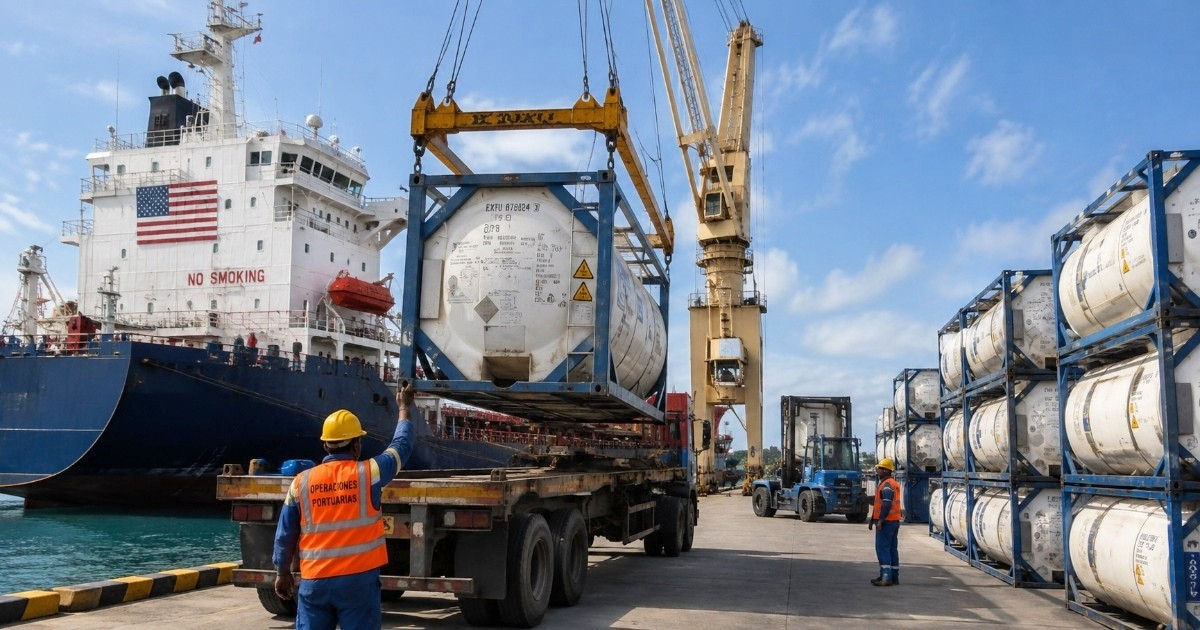
In just seven months, U.S. exports of petroleum products to Cuba experienced an extraordinary surge: they went from being virtually non-existent to reaching a historic high.
According to data from the Energy Information Administration (EIA) published on September 30, the total from January to July 2026 reached nearly 4.9 million barrels, with an average of 103,900 barrels per day in July.
The magnitude of the change is better appreciated when comparing the extremes: the United States went from exporting just about 30 barrels a day to Cuba in January to nearly 104,000 in July.
The volume for that month far exceeds the shipments that Venezuela was sending to the island in 2025.
Julio breaks all records
The month of July marked an unprecedented turning point.
U.S. exports to Cuba soared their fuel purchases to 103,900 barrels per day, more than four times the level of June.
Only that month, the value of exports rose to 61.1 million dollars, bringing the total from January to July to 156.8 million dollars, according to the U.S.-Cuba Trade and Economic Council (UCTEC).
The cut in Venezuelan oil changed the landscape
The starting point of this shift was the abrupt cut in Venezuelan supply. Following the capture of Nicolás Maduro by U.S. forces on January 3, 2026, Reuters confirmed that there were no Venezuelan exports to Cuba that month, marking the end of decades of subsidized oil.
In 2025, Venezuela was sending between 27,000 and 30,000 barrels daily, according to estimates from Reuters with data from PDVSA and expert Jorge Piñón from the University of Texas, who specified that this flow covered 50% of Cuba's energy deficit.
January and February: a nearly symbolic drip
In January 2026, U.S. exports to Cuba barely reached 30 barrels per day—a volume that was practically negligible—given the void left by Venezuelan cuts.
In 2024 and 2025, those shipments had been virtually nonexistent.
February saw a slight improvement, with around 700 barrels per day, but the scale remained marginal.
Cuba needs between 100,000 and 110,000 barrels daily to meet its total demand and produces about 40% of that amount internally.
March: the rule change that accelerated the flow
The real leap came in March, when shipments reached approximately 6,100 barrels per day.
The trigger was the publication, on February 25, of the license exemption “Support for the Cuban People” (SCP) by the Department of Commerce, which authorized the export of refined products to private Cuban entities without the need for specific authorization from OFAC.
The framework explicitly excluded the Cuban government, the Armed Forces, and sanctioned state entities.
In parallel, the regime authorized small and medium-sized enterprises to import fuel, although with mandatory mediation from QUIMIMPORT or MAPRINTER and a CUPET rate that raised the final cost to more than $2.50 per liter.
April remained at similar levels, with about 7,000 barrels per day.
May and June: the curve rises
May marked a new milestone with 15,400 barrels per day.
June nearly doubled that figure: 25,900 daily barrels, already approaching the range that Venezuela contributed in 2025.
It was also that month when Washington sanctioned CUPET, the Cuban state oil company.
At the end of July, sanctions were extended to CEINPET, ENERSA, and EINARBO, tightening the grip over the entire energy chain of the regime.
From 30 to 103,900 barrels per day in seven months
The evolution shows the speed of change: about 30 barrels daily in January; 700 in February; 6,100 in March; around 7,000 in April; 15,400 in May; 25,900 in June; and finally 103,900 in July.
The increase is particularly significant because the volume recorded in July not only multiplied by more than 3,000 times the level in January but also far exceeded the 27,000 to 30,000 barrels per day that Venezuela supplied to Cuba during 2025.
What do these data measure, and what do they not measure?
It is important to clarify the scope of these figures.
The EIA registers refined products—gasoline, diesel, kerosene, lubricating oils, propane—not crude oil. These are exports reported at U.S. ports, not confirmed arrivals in Cuba.
The shipments depart from Houston-Galveston, Miami, New Orleans, and Tampa, and arrive at the port of Mariel in ISO tanks transported on container ships.
Growth is occurring amidst a severe energy crisis on the island.
The Minister of Energy and Mines, Vicente de la O Levy, admitted in May that Cuba had "absolutely no fuel, no diesel, only accompanying gas."
The data for August 2026 will be published on October 30, which will allow us to verify whether the record from July was a one-time peak or the beginning of a new trend.
Related videos:
Filed under: