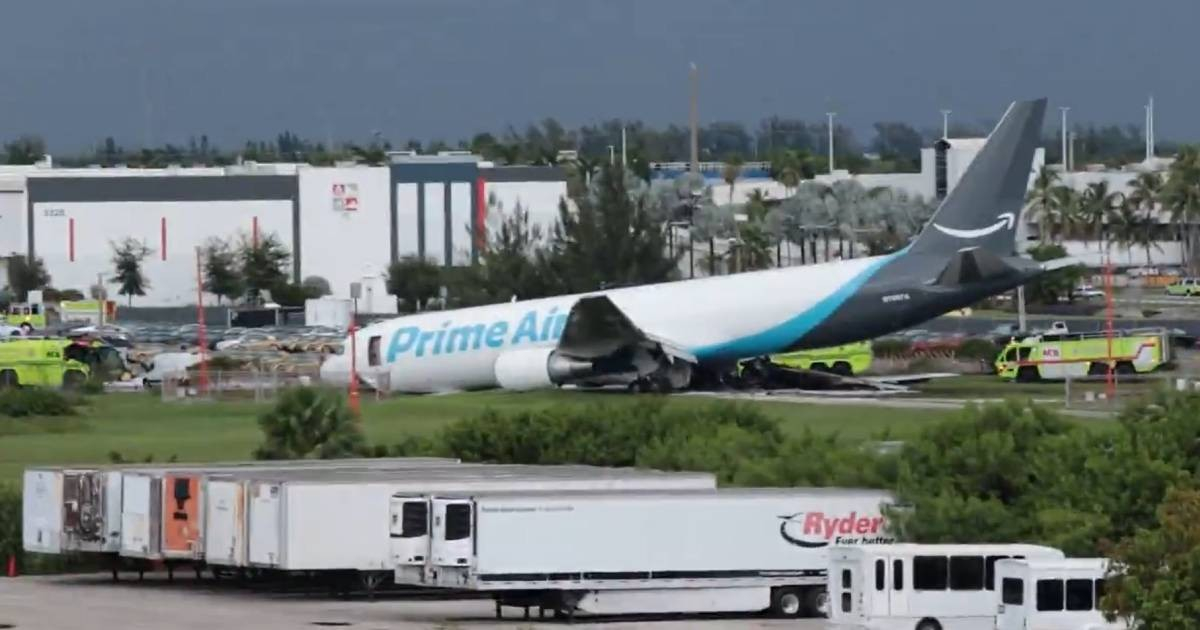
The National Transportation Safety Board (NTSB) released its preliminary report this Thursday on the cargo Boeing 767 accident that occurred on September 6 at Miami International Airport, a tragedy that resulted in five fatalities and revealed a series of warnings during the final seconds of the approach and landing.
The NTSB preliminary report reconstructs the last minutes of the flight 7598 of 21 Air, which was operating for Amazon using data from the black boxes, after having departed from Luis Muñoz Marín International Airport in San Juan, Puerto Rico, en route to Miami.
According to the investigation, the Boeing 767-33A crossed the threshold of runway 30 at approximately 177 knots of ground speed and touched down about 3,750 feet after the threshold, still at around 160 knots. The aircraft continued to roll, exited the end of the runway at 113 knots, and ended up crossing the airport perimeter.
One of the most significant elements of the report appears in the reconstruction of the cockpit voice recorder (CVR).
With one minute and 42 seconds left in the recording, the captain ordered the flaps to be set to 20 degrees, and the first officer pointed out that the plane was going too fast. According to the NTSB, the co-pilot subsequently made more remarks regarding the excessive speed throughout the remainder of the recording, without a consistent verbal response to those warnings.
During the approach, the aircraft's automatic alarms were also triggered repeatedly.
First, warnings of “sink rate” were heard, alerting about a high rate of descent. Subsequently, the system issued the warning “too low terrain” several times, related to the aircraft's proximity to the ground.
The recorded sequence shows a first alert of “too low terrain” about 48 seconds before the end of the recording, repeated four times, followed by another similar warning a few seconds later.
At about 31 seconds before the end of the recording, sounds consistent with the moment the plane touched down were heard. However, 16 seconds later, the captain requested to perform a “go-around”, the maneuver used to abort a landing to raise the aircraft again and attempt a new approach.
The air brakes and reversers did not deploy
The flight data recorder (FDR) provides another relevant element.
The NTSB determined that the air brakes remained retracted and the thrust reversers did not deploy during landing and the subsequent runway roll.
The wheel brakes were manually applied while the aircraft was still traveling at 146 knots. About eight seconds later, they were released, and the power levers were moved to settings corresponding to an attempt to go around, with approximately 930 feet of runway remaining.
Four seconds later, the engine power returned to idle and the brakes were applied again, but by then there were barely 415 feet of runway left. The Boeing finally left the paved surface at about 113 knots.
The tower did not provide information about the wind
The report also includes details about communications with air traffic control.
The Miami tower authorized flight 7598 to land on runway 30, but the controller did not provide information about the wind. The NTSB notes that Federal Aviation Administration (FAA) regulations stipulate that wind direction and speed must be communicated when there is a tailwind component.
About four minutes before authorizing the landing, the same controller had informed another aircraft that the winds were from 190 degrees at 19 knots, with gusts of 22 knots. At that moment, however, flight 7598 was still not on that radio frequency.
The weather observations made around the time of the accident recorded storms in the vicinity and winds with gusts of up to 26 knots.
The NTSB does not currently attribute the accident to any of these factors and emphasized that the investigation remains open, with the information presented being preliminary and subject to change.
Five Cubans died in the tragedy
The Boeing ended up crashing into two vehicles after crossing a public road near the airport.
A Ford Econoline carrying seven people was struck before the aircraft crossed NW 67th Avenue. Five of its occupants died and two others suffered serious injuries. Subsequently, the plane collided with a Toyota Corolla Cross, whose sole occupant was also severely injured. The two crew members of the Boeing sustained minor injuries.
Later, it was confirmed that the five fatal victims were Cuban: Yoel Rodríguez Naranjo, Rolando Alemán León, Julio C. Pineda, Carlos Acosta Fajardo, and Javierkys Reyes Quevedo, employees of an airport services company who were traveling in one of the vehicles struck by the plane.
After the tragedy, Amazon suspended its operations with 21 Air, while the federal investigation and related legal actions surrounding the accident continued.
The report published now significantly expands the technical reconstruction of what occurred, but it does not yet determine the likely cause of the incident. That conclusion will belong to a later stage of the NTSB's investigation.
Related videos:
Filed under: