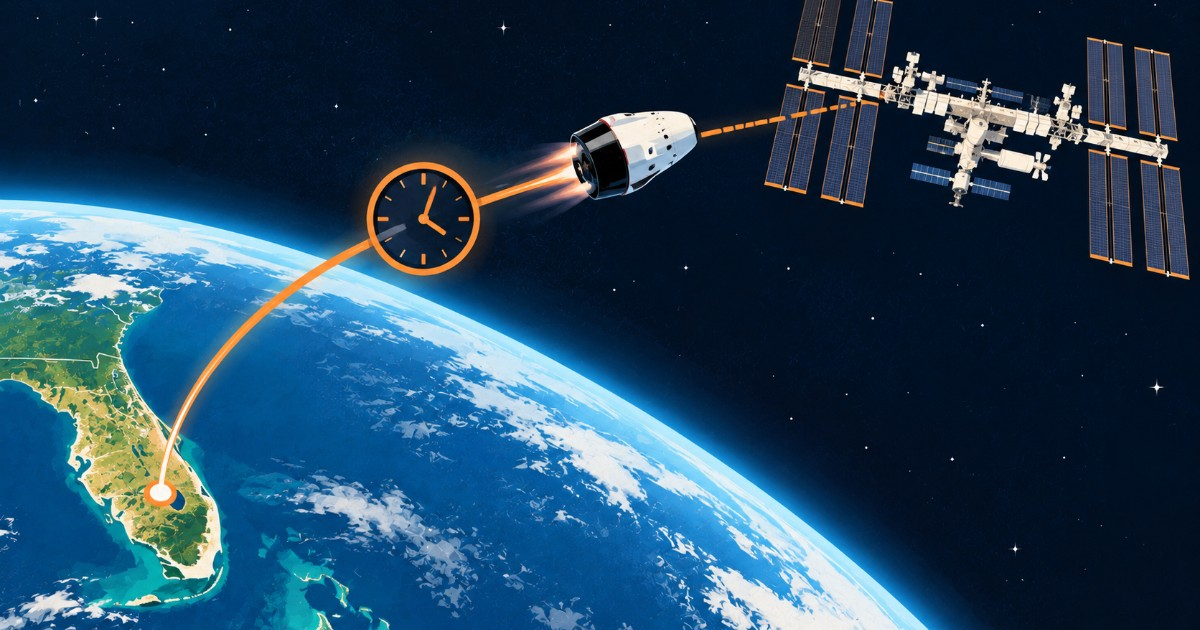
A manned mission that launched from Florida took less than eight hours to reach the International Space Station. The Dragon spacecraft from SpaceX Crew-13 completed the journey from launch to docking in 7 hours and 55 minutes, setting a new record for an American spacecraft in the history of the orbital station.
The NASA Crew-13 mission launched on Thursday, October 1, at 11:10 AM Eastern Daylight Time, from Launch Complex 40 of the Cape Canaveral Space Force Station in Florida.
At 7:05 p.m. on the same day, the Dragon capsule docked with the forward port of the Harmony module of the International Space Station.
The NASA confirmed after the docking that the 7 hours and 55 minutes elapsed since liftoff represents the fastest journey from launch to docking ever made by an American spacecraft in the history of the International Space Station.
Who traveled on Crew-13?
The mission transported four crew members from three space agencies.
The NASA astronaut Jessica Watkins is the commander of Crew-13, while her partner Luke Delaney serves as the pilot.
The crew is completed by the Canadian astronaut Joshua Kutryk from the Canadian Space Agency, and the Russian cosmonaut Sergey Teteryatnikov from Roscosmos, both serving as mission specialists.
For Delaney, Kutryk, and Teteryatnikov, this is their first spaceflight. In contrast, Watkins had already spent 170 days in space during the Crew-4 mission in 2022.
With this new journey, Watkins also becomes the first NASA astronaut to launch twice aboard a SpaceX Dragon spacecraft, according to the official crew information.
How is it possible to arrive at the station in such a short time?
Reaching the International Space Station quickly does not solely depend on the speed of the spacecraft. The launch must occur within a very precise window for Dragon's trajectory to align with the station's position as both move around the Earth.
After reaching orbit, Dragon performs a series of maneuvers to progressively adjust its altitude and trajectory until it approaches the station.
The capsule is designed to carry out the coupling autonomously, although both the astronauts aboard the Dragon and the station crew monitor the entire process.
In this case, the spacecraft approached the front port of the Harmony module and automatically completed the docking. NASA had planned a trajectory of approximately seven hours and 50 minutes before the launch; it ultimately took five minutes longer.
The crew is already inside the Space Station
After the coupling, the pressure and leak tests between the two vessels began.
The hatch opened at 9:19 p.m. and Watkins, Delaney, Kutryk, and Teteryatnikov entered the International Space Station to join Expedition 75.
Crew-13 will conduct a long-duration scientific mission, with its return to Earth planned for 2027.
What will they investigate during the mission?
The speed record to the station is just the beginning of a mission primarily focused on scientific research, maintenance, and preparation for future space explorations.
Among the projects announced by NASA for Crew-13 is the use of tissues derived from human stem cells to study diseases and enhance methods of personalized medicine and pharmaceutical testing.
The research has potential applications in diseases such as cardiovascular conditions and Parkinson's disease.
The crew will also work with a new partially autonomous system to study plant cultivation in space, an important technology for future long-duration missions to destinations further away from Earth.
Other experiments will investigate alterations in blood flow caused by microgravity and will test new diagnostic devices capable of monitoring the health of astronauts during flight.
The thirteenth rotation of SpaceX for NASA
Crew-13 is the thirteenth crew rotation mission by SpaceX to the International Space Station under NASA's Commercial Crew Program.
The agency also considers it the fourteenth crewed flight of a Dragon with NASA astronauts to the station, if Demo-2, the crewed test mission that inaugurated this stage of the program, is included.
The record journey on Thursday demonstrates just how much transit times have been reduced from Florida to the orbital laboratory: less than eight hours after leaving Cape Canaveral, the four Crew-13 members were already docked at the International Space Station.
Related videos:
Filed under: