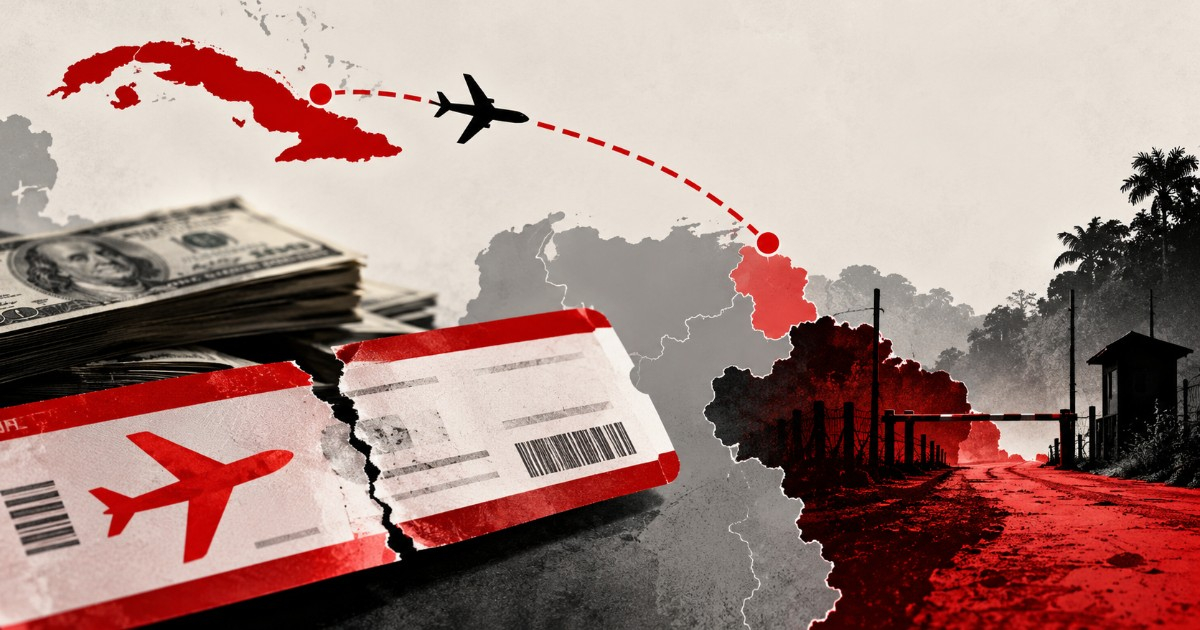
Several Cuban families claim to have lost thousands of dollars, experienced successive changes in dates, new charges, and even threats after booking trips to Brazil with an agency known as La Reina del Sur, according to an investigation published by elTOQUE.
The testimonies describe a business that goes well beyond selling a plane ticket: it includes flights from Cuba, accommodation and transportation in Guyana, land transfers to the Brazilian border, and coordination with individuals responsible for continuing the journey to Brazil.
The investigation by elTOQUE identifies María del Mar Ojeda Fuentes, known as Marimar, as the person promoting and managing these services from Cuba.
The commercial name La Reina del Sur corresponds to Travelsa LTDA, a travel agency registered in Brazil in October 2025, with Anaysi Fuentes Petrolanda, mother of Ojeda Fuentes, listed as the registered manager, according to business records consulted by the media.
Payments of thousands of dollars and changing dates
One of the testimonies comes from Lisi Velásquez, a Cuban resident in Brazil, who shared that her family booked the trip in May and paid in person in Minas, Camagüey.
According to their account, the departure was initially scheduled for July 4, 2026. It was later moved to the 18th and finally to July 26, this time from Havana, even though the family had paid a higher fee to leave from Camagüey.
The relatives managed to travel to Georgetown, Guyana, but Velásquez claims that no one was waiting for them at the airport, even though the pickup and accommodation were included in the contracted service.
Days later, they arrived at the border area with Brazil. There, according to their testimony, the individuals in charge of the next segment stated that they had not received the payment for the transport.
The affected individuals ended up gathering another 1,850 dollars to continue. Velásquez maintains that this service had already been paid for previously.
The investigation includes other cases. A mother from Camagüey reported having handed over 4,200 dollars to travel with her two daughters. She asserted that the tickets never arrived on the agreed date and that she ended up spending more than 700 additional dollars while waiting in Havana.
Yulia Barrios claimed to have paid 4,050 dollars for packages for six family members. She and her two children managed to leave Cuba, but, according to her complaint, three other family members remain on the island without the contracted tickets.
Another affected individual, Miguel Orlando Montero, stated that he had handed over 6,000 dollars to travel with his wife and two children. According to his account, the dates were postponed repeatedly without the family being able to finalize the trip.
Reports of threats and unresolved claims
Several of the interviewees also described intimidating responses when they began to demand the money.
Velásquez recounted that his mother personally went to the home from where the trips in Minas were organized. According to his testimony, during the meeting she received expressions that he interpreted as threats.
The woman claims that afterward she tried to file a complaint with the local police, but the officers determined that there was not enough evidence to proceed.
Montero also stated that he went to the police after demanding the return of his 6,000 dollars and claimed that an officer threatened to detain him if he caused a "scene."
These statements correspond to the testimonies collected by elTOQUE. So far, there is no public judicial resolution that establishes that La Reina del Sur or its representatives committed a crime in relation to these cases.
What did María del Mar Ojeda respond?
elTOQUE gained access to a recording of nearly an hour of a conversation between María del Mar Ojeda and a client who came to make a personal claim in August.
According to the outlet, the identity of the voice was compared with public recordings of Ojeda on the networks of La Reina del Sur.
During that conversation, Ojeda stated that the agency does not refund the money for promotional tickets and described them as a sort of waiting list.
He also denied participating in human trafficking and stated that the travelers he manages enter Brazil with documentation from the Federal Police.
When elTOQUE later contacted her to request her formal version regarding the allegations, her role within the agency, and the services offered, Ojeda Fuentes replied that she would not make any statements.
A route under investigation in Brazil
The reports emerge at a time when Brazilian authorities are ramping up operations against networks that facilitate irregular crossings on the country's northern border.
The Federal Police of Brazil officially announced that on July 23, it launched the Trapaceiros Operation to investigate an alleged scheme promoting irregular migration between Lethem, in Guyana, and Bonfim, in the state of Roraima.
The Brazilian investigation began after the arrest of individuals transporting foreigners who had entered the country illegally. Investigators also reported signs of forgery of public documents and criminal association for economic purposes.
The communication from the Federal Police does not publicly identify La Reina del Sur, Travelsa LTDA, or María del Mar Ojeda as part of that investigation.
CiberCuba had already reported on the Federal Police's offensive against networks that transport Cuban migrants through this border corridor.
In other operations, Brazilian authorities have discovered groups of Cubans being transported in vehicles after crossing the border. In June, 39 Cuban migrants were found in Roraima, including children, a pregnant woman, and seniors.
The business of organizing the entire trip
The scheme described by the Brazilian authorities has general similarities to the type of service reported by some customers of La Reina del Sur: payments for packages that cover different stages of the journey, including transporters, accommodations, and intermediaries.
That, by itself, does not prove that the agency investigated by elTOQUE is part of the networks targeted by the Federal Police.
Brazilian legislation classifies as a crime the promotion of illegal migration when someone facilitates by any means the irregular entry of a foreigner with the aim of obtaining an economic advantage. The prescribed penalty is two to five years of imprisonment, in addition to a fine.
The authorities distinguish this crime from human trafficking, which also involves the exploitation of victims.
Guyana: a migration fact that changed
The route commonly taken by Cuban migrants begins with a flight to Georgetown and continues by road to Lethem, across from the Brazilian town of Bonfim.
However, there is a significant change regarding information previously disseminated about the entry of Cubans into Guyana.
The current list from the Ministry of Foreign Affairs of Guyana only includes Cuban citizens traveling with diplomatic, official, or service passports as exempt from visa requirements.
Holders of ordinary passports need migration authorization. Guyana has a visa-on-arrival system for travelers from countries subject to visa requirements, but it is necessary to obtain an approval letter prior to boarding the flight.
Brazil gains weight as a destination for Cubans
The growth of these routes coincides with a significant increase in Cuban migration to Brazil.
The official data from the International Migration Observatory of the Brazilian Ministry of Justice shows that during 2026 Cubans have established themselves as one of the leading nationalities seeking protection in the country, with Boa Vista in Roraima becoming one of the main registration points.
The combination of migration demand, thousands of dollars contributed by families inside and outside of Cuba, and a journey that requires multiple intermediaries has created a fertile ground for businesses that are difficult to supervise and for networks that Brazilian authorities are trying to dismantle.
In the case of La Reina del Sur, what currently exists is a collection of public complaints and customer testimonies, a journalistic investigation documenting how trips were paid for and organized, along with unanswered questions about the fate of the money from those who claim they did not receive the contracted services.
Related videos:
Filed under: