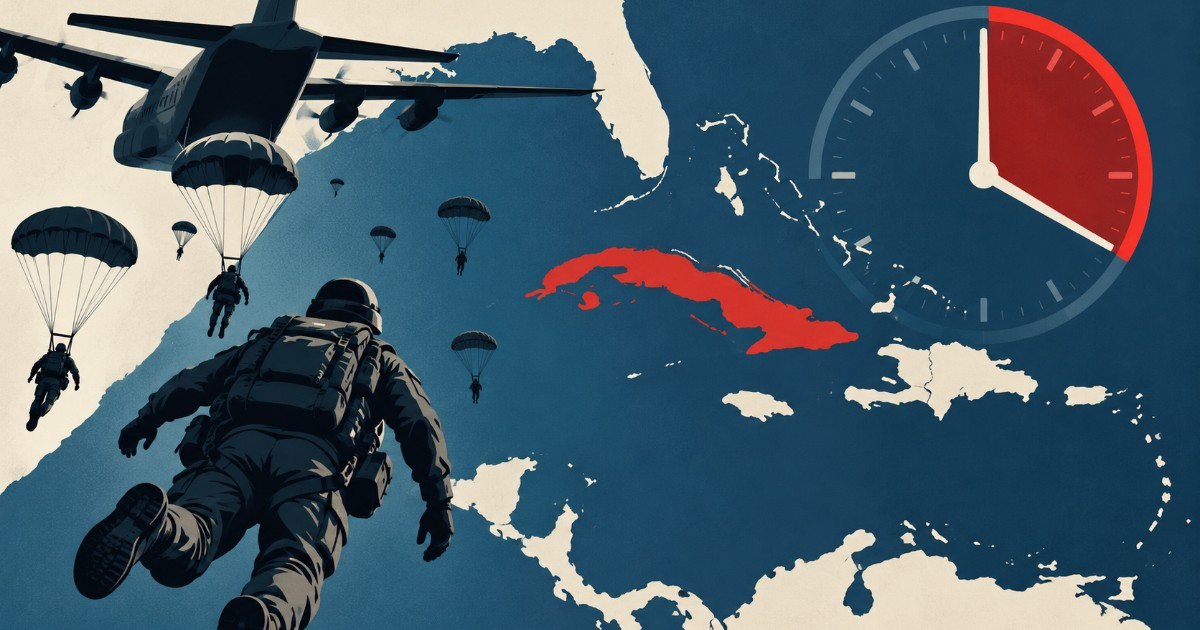
The United States Southern Command (SOUTHCOM) has once again highlighted one of the most well-known rapid response military capabilities of the U.S. Army: the ability to mobilize elements of the 82nd Airborne Division within 18 hours of an order.
«18 hours notice. Anywhere in the world» —18 hours notice, anywhere in the world— was the phrase with which SOUTHCOM opened the message published on October 1 on its official X account.
The command added that the 82nd can be rapidly deployed, conduct parachute assaults for forced entry, and secure strategic objectives to facilitate subsequent military operations.
The message is particularly striking for Cuba because the island is officially part of SOUTHCOM's area of responsibility, which encompasses 31 countries in Latin America and the Caribbean.
However, there is a fundamental difference between highlighting a military capability and announcing an operation: the message does not mention Cuba, does not reveal an order to deploy to the island, and does not identify a specific military target.
What do the 18 hours really mean?
The figure did not appear for the first time this week.
The official mission of the 82nd Airborne Division, based at Fort Bragg, North Carolina, has long established that the unit must be capable of strategically deploying within 18 hours of notification, conducting a forced-entry parachute assault, and securing objectives that allow for the arrival of additional forces.
It is a mission of continuous availability and constitutes one of the main characteristics of the division, regarded as the Army's airborne immediate response force.
But the 18 hours should not be interpreted as the time required to move an entire division to any country, complete a military operation, and control the territory.
A real example helps to understand the difference.
On December 31, 2019, amid rising tensions with Iran, the United States activated the 82nd Airborne Division's immediate response force.
According to an official publication from the Army Legal Center, the first elements left Fort Bragg within 18 hours of the order. In total, nearly 3,500 paratroopers were later deployed to the Middle East.
In other words, the 18-hour timeframe primarily describes the ability to quickly deploy the first tier of a military force that has been prepped for a contingency.
The Army also speaks of 96 hours
Another official publication from the Army provides a detail that helps to better gauge that capability.
During a preparedness exercise conducted in 2023, the 82nd itself explained that it could carry out an initial airborne insertion within 18 hours and concentrate forces on a larger scale within a period of 96 hours.
The division is not a single formation that simultaneously raises several aircraft. It is composed of three combat brigades, in addition to aviation, artillery, support, and command units.
The deployment of a force of that size requires air transport, logistics, ammunition, fuel, medical care, communications, and coordination with other branches of the Armed Forces.
What is a "forced entry"?
The expression used by SOUTHCOM may also lead to a broader interpretation than what is present in U.S. military doctrine.
The doctrine of the Army defines a forcible entry operation as the seizure and maintenance of a military position in the face of armed resistance.
One of the classic scenarios is the capture of an airfield or another strategic point from which troops, vehicles, supplies, and heavier equipment can subsequently enter.
The purpose of an airborne unit is not necessarily to carry out an entire military campaign on its own, but to open a pathway and secure the ground needed for the forces arriving behind.
Therefore, stating that the 82nd can conduct a forced entry as part of its rapid response mission does not automatically mean it can "invade an entire country in 18 hours."
So, why did SOUTHCOM publish the message?
The publication is significant because it was not only disseminated by the 82nd Division but also by the military command responsible for Latin America and the Caribbean.
In its official description of the area of responsibility, SOUTHCOM expressly includes Cuba among the 31 countries within its geographic scope.
The message from October 1 highlighted the capability of the 82nd as a demonstration of the range and speed of response available throughout the region.
This turns the message into a public signal of military readiness, but it does not allow us to conclude on its own that there is a mission assigned against Cuba.
In fact, the relationship between the 82nd and SOUTHCOM didn't start now either.
In 2024, paratroopers from the division participated alongside the Colombian Army in exercise HYDRA III, which was specifically designed to demonstrate the U.S. capability to rapidly deploy airborne forces within the area of responsibility of Southern Command.
Cuba appears in a broader military context
The message arrives, however, at a time of increased U.S. military activity in the Caribbean.
CiberCuba reported this Friday that SOUTHCOM announced that the Guantanamo Naval Base will host the first training and support site for missions of the new SOUTHCOM Autonomous Warfare Command, dedicated to autonomous and unmanned systems.
That announcement, along with recent exercises, new technological capabilities, and the usual planning of military contingencies, explains why any message regarding the Army's rapid reaction force attracts special attention when analyzed from Cuba.
But those events do not automatically turn the publication about the 82nd into an operational order against the island.
What can be affirmed and what cannot
What is confirmed is that the United States maintains an airborne division designed to react with very little notice, and that SOUTHCOM has chosen to publicly highlight that capability within its area of responsibility.
It is also confirmed that Cuba is located within that area and that the 82nd is trained to conduct forcible entry operations aimed at securing strategic objectives.
What has not been announced is a mobilization of the division to Cuba, an order for intervention, a number of troops assigned to the island, or a timeframe of 18 hours to carry out an operation against Cuban territory.
The difference is important: the 18 hours describe a permanent military readiness, not a countdown.
Related videos:
Filed under: