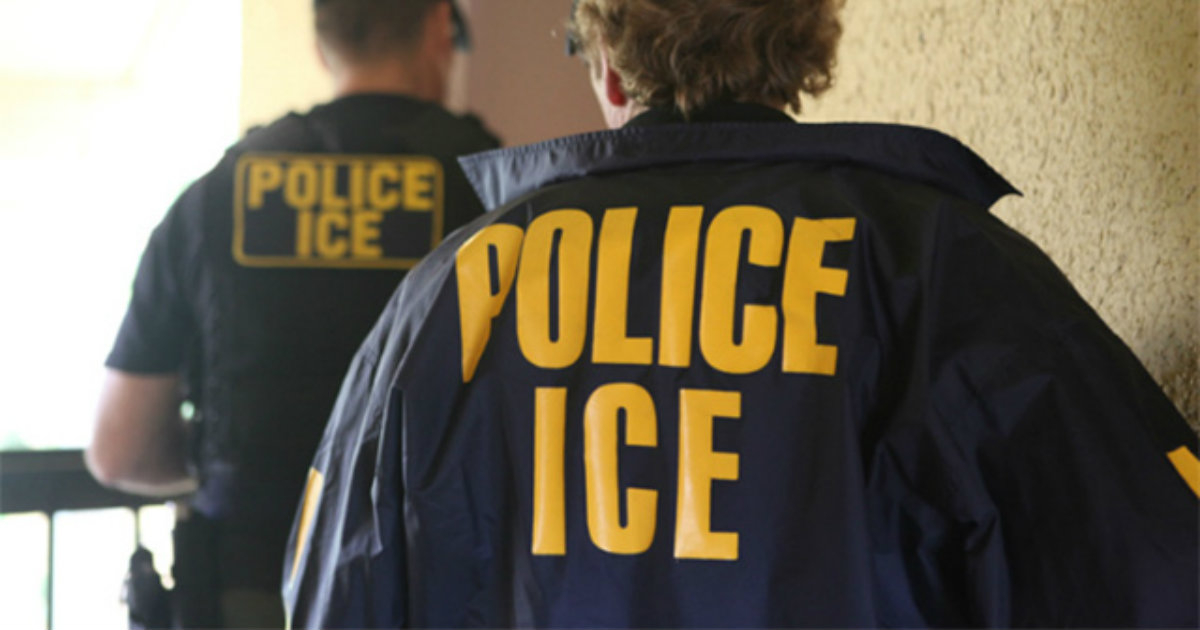
The possibility of encountering immigration agents near a polling center has raised concerns among Latino communities in the United States, including the Cuban community, just weeks before the legislative elections on November 3rd.
However, the Government of Donald Trump claims that it has no plans to deploy ICE agents on a widespread basis to patrol or monitor polling places.
The Department of Homeland Security (DHS) reported that Immigration and Customs Enforcement (ICE) "is not planning operations aimed at polling places" and that its actions are specific and based on intelligence information.
However, that does not mean that the Government has completely ruled out any presence of immigration agents in those areas.
The Secretary of Homeland Security, Markwayne Mullin, stated in September that ICE will not generally "patrol" polling places, but noted that they could intervene in specific circumstances, for example, if agents were executing a warrant against a person they were already tracking or responding to a threat against the location.
DHS has labeled as "alarmism" the claims suggesting a massive deployment of immigration agents during the elections and maintains that individuals who are legally present in the United States "have nothing to fear."
The discussion intensified following statements from various officials and allies of the president. The Attorney General Todd Blanche had publicly asked: “Why is there an objection to sending ICE agents to polling places? Illegal immigrants cannot vote”, although so far the administration has not announced any operation of that nature.
Trump has not publicly ordered ICE to be sent to polling places either. When asked in May about a possible presence of immigration agents or the National Guard, he responded that he would “do whatever it takes” to ensure, in his words, fair elections.
More recently, when specifically asked about an ICE deployment, he replied that he hadn't thought about it.
However, federal law also imposes significant limits on the presence of armed federal personnel in places where elections are taking place.
The article 592 of Title 18 of the United States Code, a regulation with roots dating back to the period following the Civil War, prohibits federal officials from bringing or maintaining "troops or armed men" at a location where an election is being held, unless it is necessary to repel armed enemies of the United States.
The offense may result in fines, up to five years of imprisonment, and disqualification from holding federal positions.
Electoral experts cited by AP believe that this provision also applies to armed federal civilian bodies such as ICE.
Some specialists even argue that an operation to execute an arrest warrant within an electoral center could pose serious legal issues.
Federal legislation also prohibits intimidating, threatening, or coercing a person with the intent to interfere with their voting rights.
The possibility of agents being near, but not inside an electoral center presents a more complex scenario. Experts cited by AP indicate that these circumstances would need to be assessed on a case-by-case basis, and other federal and state laws against voter intimidation may come into play.
The concern is not purely theoretical. During earlier electoral processes this year, federal agents were reported near some polling places in California, New York, and Texas, although there is no evidence of a national operation aimed at monitoring voters.
In some of those cases, the agents remained in parking lots or went for specific investigations.
In Florida, election officials from Broward and Palm Beach told PolitiFact that voters and civic organizations had already inquired about the possibility of finding ICE agents at polling places.
Broward's election supervisor, Joe Scott, was blunt: "All our voters are U.S. citizens; there is no reason for ICE to be there."
Organizations representing Latino, African American, and Asian American communities argue that the primary concern is that even a minimal presence of federal agents can deter U.S. citizens from voting, particularly in families where individuals with varying immigration statuses live together.
The League of United Latin American Citizens (LULAC) and other organizations have begun informational campaigns and legal preparations in anticipation of that possibility.
Their concern, as they explained to AP, is that a photograph or a video of immigration agents near a single polling center could quickly spread on social media and instill fear in other communities.
What should Cuban Americans know?
The issue is particularly relevant in South Florida, where there is a large Cuban-American community and many families combine naturalized American citizens with relatives who have open immigration processes, temporary permits, or other pending situations.
Being a naturalized citizen does not reduce or modify the right to vote. The Florida Division of Elections states that individuals who are U.S. citizens by birth, naturalization, or by law may register and vote, provided they meet the other state requirements.
In other words, a Cuban who has become a naturalized U.S. citizen has the same voting rights as any other citizen.
Moreover, the immigration status of their parents, children, partner, or other relatives does not affect their personal right to vote.
To participate in the elections on November 3 in Florida, voters must be properly registered and go to the appropriate polling place with a valid photo ID that includes their signature.
Among the accepted documents are the Florida driver's license, the state identification card, and the U.S. passport, among others.
If a voter does not bring an accepted form of identification, that does not automatically mean they lose their right to vote: Florida's rules allow for a provisional ballot to be issued.
This procedure may also be used if the voter's eligibility is challenged at the polling place.
In Miami-Dade, a crucial date is also approaching: this Monday is the deadline to register to vote in the general elections on November 3.
The Miami-Dade Office of the Supervisor of Elections confirmed that its main office in Doral will remain open until 11:59 p.m. on Monday to assist eligible citizens who still need to complete their registration. Early voting will begin on October 19 and continue until November 1.
Related videos:
Filed under: