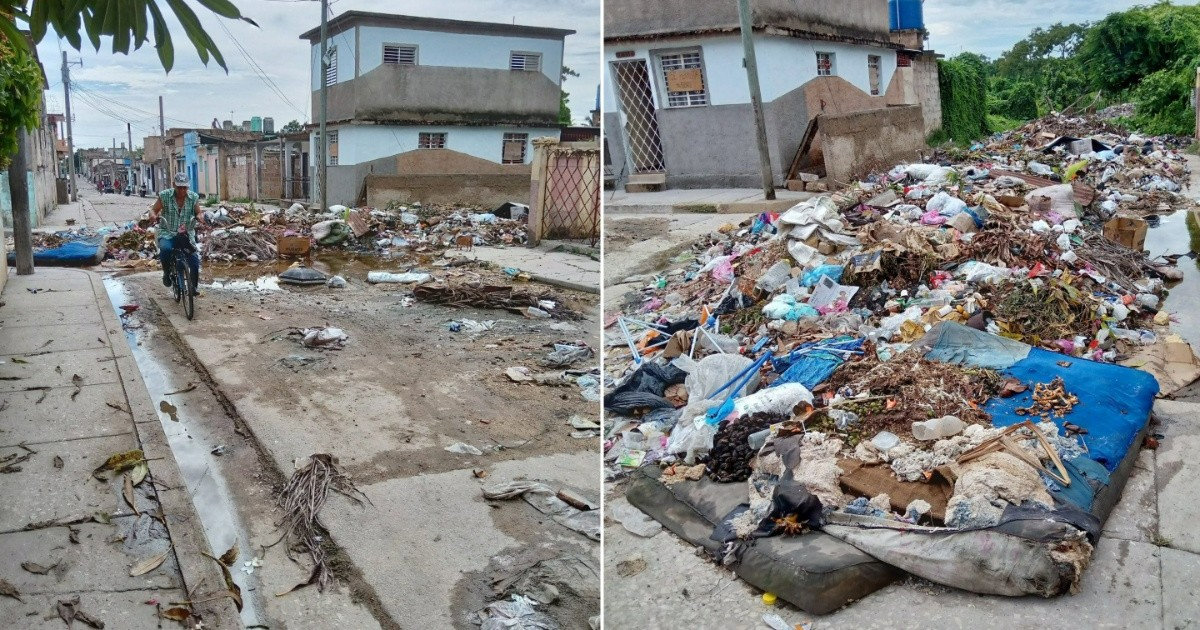
A resident of Matanzas reported this week on Facebook the massive accumulation of garbage at the corner of Embarcadero, Blanco, and Mujica, right in the city center, where the waste completely blocks vehicle passage and extends over more than 100 continuous meters along Mujica Street.
Emilio Prieto Núñez, the author of the publication, described the situation with bitter irony: “Look at this ‘splendor’ in our mistreated Matanzas. If you look closely, anyone coming down Embarcadero in a vehicle cannot proceed, as the road is completely blocked. As for Mujica, let's not even talk about it; over 100 meters of continuous garbage, and in the end, weeds are growing over the dump.”
The images accompanying the complaint show mounds of mattresses, plastics, debris, cardboard, and organic waste taking up much of the roadway, with puddles of stagnant water and dilapidated buildings in the background. A man on a bicycle is seen navigating through the debris among what remains of the street.
The root of the collapse is structural: the Municipal Communal Company of Matanzas operates with only 11 of its 24 collection trucks, which are stalled due to a shortage of diesel. The company receives between 300 and 550 liters of fuel daily, while it needs more than 2,700 liters to cover all its routes, according to news reports from May and August 2026.
This is not the first time that a corner of downtown Matanzas has turned into a makeshift garbage dump due to communal collapse. In April, a similar situation was documented at Levante and Solís, and in May, the official press itself portrayed the trash flooding the city, acknowledging the breakdown of services.
The health impact is serious and well-documented. Since April, provincial authorities have issued alerts for outbreaks of hepatitis A in municipalities such as Matanzas, Cárdenas, and Versalles; in June, seven new confirmed cases and 49 suspected cases were reported in just one week. That same month, the first two cases of dengue of the season were detected in the southern part of the territory. In August, it was documented that waste was flowing through the San Juan and Yumurí rivers, contaminating the bay, and in September, the blocked sewers worsened the flooding during the heavy rains that struck the historic center.
The comments on the post reflect an outrage that goes far beyond the garbage issue. Betty Gutiérrez was direct: "Shame. Hygiene and Epidemiology aren’t addressing this; no one from Municipal or Provincial Health, inspectors, all blind and mute, but cars going up and down. Meetings with air conditioning while the people are sick and without medicine." She concluded, "If you can't handle your responsibilities, step down from your positions."
From Brazil, Harold Martínez Alonso brought another dimension to the debate: "There is no doubt that the entire state apparatus in Cuba has failed, but for them to boast to the world that Cuba is an example is a total lack of respect for the Cuban people themselves." Martínez Alonso, who lives on the border between Brazil and Uruguay, added that "every day, buses full of Cubans arrive to seek admission and refuge" and that "it breaks your heart to see the faces and the conditions of the newcomers."
Prieto Núñez concluded his publication with a question that captures the sentiment of many residents of Matanzas: "Are our leaders blind? It's repulsive how they have degraded Matanzas."
Related videos:
Filed under: