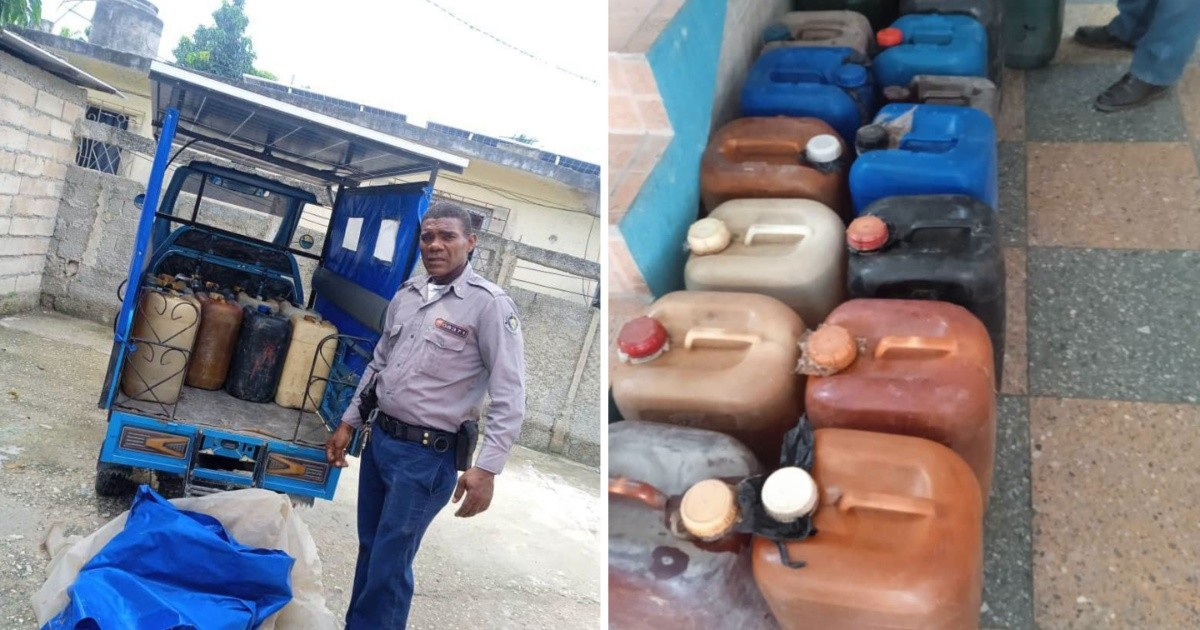
The police in the municipality of Regla, located in the east of Havana, seized 680 liters of gasoline distributed in 28 containers of 25 liters each, during an operation against fuel theft shared on the Facebook profile "Heroes in Blue in Cuba", from the Ministry of Interior (MININT).
According to the official statement, the incident has been "clarified, with authors apprehended and undergoing criminal proceedings." The images show a uniformed officer—badge number 08371—next to a blue motorbike loaded with plastic canisters of various colors and sizes, and dozens of containers lined up against a wall.
The MININT emphasized that it was the neighbors themselves who provided information and witnessed the operation, highlighting citizen participation as a central element of police success.
The information did not specify how many were detained nor did it disclose the identities of the alleged perpetrators.
The seizure occurs amidst the worst fuel crisis that Cuba has faced in decades.
Since late 2025, the island has been facing extreme shortages caused by the suspension of oil shipments from Venezuela and the interruption of supplies from Mexico on January 9.
Faced with the shortage, the regime eliminated the sale of gasoline in Cuban pesos in February, leaving only the dollarized channel with a limit of 20 liters per person and wait times of up to 26 hours in line.
The official price was set at $2.60 per liter as of May 15, while in the informal market it ranges between six and eight dollars.
That price gap has fueled the illegal theft and resale of fuel across the country. In February, a police operation in Santiago de Cuba seized gasoline containers from private homes.
In March, the police detained 16 people at Cupet service stations in the Havana municipalities of Playa and Plaza de la Revolución for illegal sale of queue positions and hoarding.
The Prime Minister Manuel Marrero Cruz demanded in April a "firm hand" against fuel theft, with zero tolerance for these crimes and for corruption.
The Cuban legal framework, through the Penal Code (Law 151 of 2022) and Opinion 475 of the People's Supreme Court, allows for the classification of the theft of state fuel as sabotage, with penalties of up to 12 years in prison.
An emblematic case illustrates the severity of sentences: a worker in Santiago de Cuba was sentenced to 12 years in prison for stealing over 5,700 liters of diesel intended for the generators of a hospital.
The municipality of Regla is a port and industrial area historically linked to the storage and distribution of fuels, making it a particularly sensitive point for this type of crime.
Legal risks are accompanied by physical ones: the Cuban firefighters warned on Wednesday about the fire hazard resulting from the storage of fuel in non-certified plastic containers, a practice that has become widespread due to the crisis.
Related videos:
Filed under: