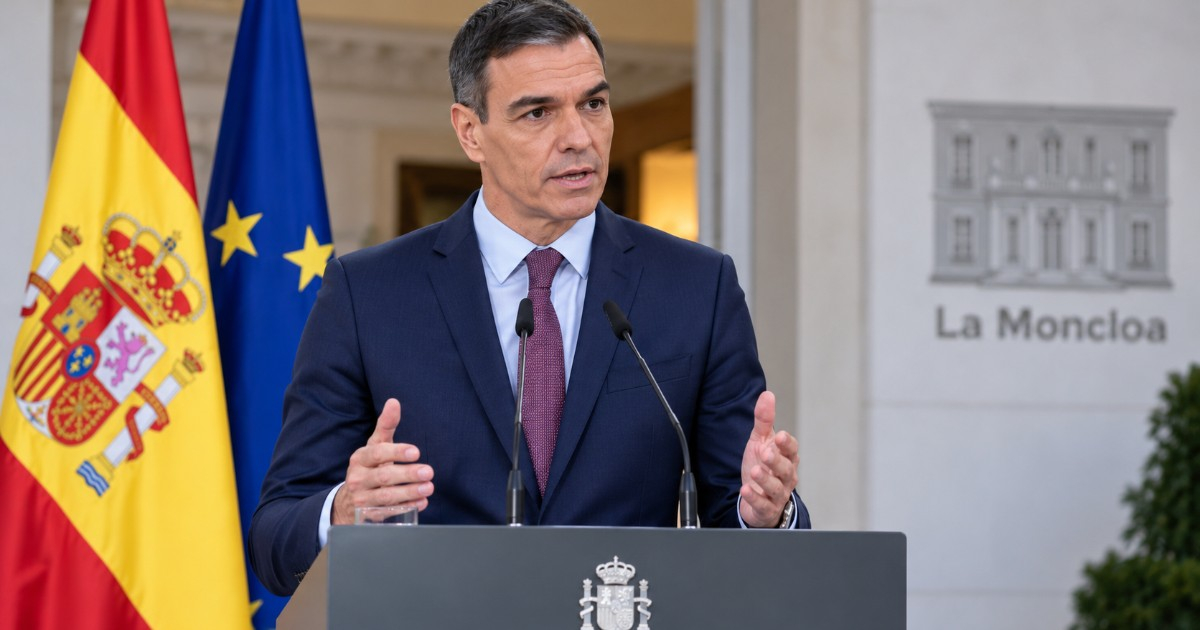
The President of the Government of Spain, Pedro Sánchez, announced this Monday the advancement of the general elections to Sunday, November 29, 2026, prematurely ending the current legislative term.
Sánchez announced the decision during an institutional statement from the Palacio de La Moncloa, scheduled for 9:00 in the morning and without questions from journalists.
The announcement comes just three days after Congress rejected two royal decree laws proposed by the Executive on housing, a parliamentary defeat that once again highlighted the Government's difficulties in gathering a sufficient majority in important votes.
CiberCuba reported on Friday that Sánchez had initiated a reflection period regarding a possible early election after PP, Vox, and Junts voted against the two housing measures.
The date that then appeared as the first legal possibility, November 29, is finally the one chosen by the president.
Why the elections will be on November 29th
The date is not arbitrary.
The Article 42 of the Organic Law on the General Electoral Regime (LOREG) stipulates that when the president exercises the authority to dissolve the Cortes early, elections must be held on the 54th day following the call.
The formalization must take place through a Royal Decree for dissolution and the calling of elections.
The Spanish Constitution establishes in its Article 115 that the President of the Government, following deliberation by the Council of Ministers and under their responsibility, can propose the dissolution of the Congress, the Senate, or both Chambers, which will be decreed by the king.
The electoral legislation itself also specifies that, in the case of early dissolution, the decree must include the call for new elections.
If the announcement is published in the Official State Bulletin on Tuesday, October 6, the 54 days stipulated by law lead exactly to Sunday, November 29, 2026.
The Royal Decree still needs to be published in the Official State Gazette
The political announcement made by Sánchez this Monday must be followed by the appropriate legal procedure.
In the ordinary summary of the Official State Gazette from October 5 consulted early this Monday, the Royal Decree dissolving the Cortes and calling for elections has not yet been published.
The LOREG stipulates that, in the case of an early dissolution, the call decree shall be published the day after its issuance and shall take effect on the same day as its publication.
Therefore, the official document will be the one that definitively confirms the dissolution of the Chambers, the call for elections, and all the formal details of the electoral process.
The Courts will be dissolved
The early call involves the dissolution of the Congress of Deputies and the Senate under the terms set forth by the Royal Decree.
During the electoral period, the Permanent Deputations of both Chambers will remain active to perform the functions assigned to them by the Constitution until the new Courts are established.
The Spanish will once again elect the representatives of the Congress and the Senate on November 29.
The key dates of the electoral calendar
Taking as a reference a call that comes into effect on October 6, the electoral legislation allows for the anticipation of several key dates, although they will need to be confirmed once the Royal Decree is published.
October 6: scheduled date for the publication and entry into force of the announcement.
From October 21 to 26: legal period for submitting candidacies to the electoral boards.
November 13: scheduled start of the electoral campaign.
November 27: last day of the campaign.
November 28: a day of reflection.
November 29: general elections.
The LOREG stipulates that candidacies must be submitted between the 15th and 20th days following the announcement, and that the electoral campaign begins on the 38th day after the announcement and lasts for 15 days.
A change from what Sánchez had promised four months ago
The call represents a shift from the position that Sánchez himself had defended until a few months ago.
In a control session held on June 10, the president assured the Congress that the legislature would complete its four years and that Spaniards would vote again in 2027.
The announced decision moves that timeline forward by several months and concludes a legislative session that began after the general elections held on July 23, 2023.
The rejection of the housing decrees preceded the announcement
The electoral advance comes after a week focused on housing.
The government had approved two royal decree-laws with new measures regarding rentals, contracts, and protection against certain evictions.
Both needed Congressional validation to remain in effect, but the Executive failed to gather the necessary votes.
PP, Vox and Junts voted against the regulations, resulting in their parliamentary rejection.
CiberCuba had previously explained the main measures included in the housing package and the challenges the Government faced in ensuring its ratification.
After the defeat on Friday, Sánchez began discussions with members of the Executive and leaders of the PSOE before announcing on Monday the decision to bring forward the elections.
Spain is heading back to early elections
This is not the first time that Sánchez has decided to call for elections before the end of a legislative term.
In May 2023, following the regional and municipal elections, the president unexpectedly announced the dissolution of the Parliament and called for general elections on July 23 of that year.
After those elections, the PSOE managed to secure a parliamentary majority alongside Sumar and with the support of several nationalist and independence parties to appoint Sánchez as president again in November 2023.
The majority, however, has not functioned as a stable block throughout the entire legislative term, and the Executive has had to negotiate numerous projects and decrees individually with its parliamentary partners.
The new Parliament will need to be established before Christmas
The Constitution establishes that the elected Congress must be convened within 25 days following the elections.
If the elections are finally held on November 29, the new Parliament must be established no later than December 24.
From that moment, the process to select the next president of the Government will begin.
The king will consult with the representatives appointed by the political groups and will subsequently propose a candidate for the presidency to undergo the investiture debate in Congress.
What does it mean for Spaniards living in Cuba?
The elections are also of direct interest to the growing community of Spanish citizens residing in Cuba.
Spaniards registered abroad have the right to participate in general elections in accordance with the rules of the electoral roll and overseas voting.
In recent years, tens of thousands of Cubans have acquired Spanish citizenship through the Law of Democratic Memory, commonly known as the Law of Grandchildren.
The situation of the overseas census has also recently been subject to legal disputes regarding certain registrations, an issue that gains new significance in light of the upcoming elections.
The electoral process begins now
The announcement from Sánchez opens a new political era in Spain, but the next step will be legal: the publication of the Royal Decree for the dissolution of the Cortes and the calling of elections in the BOE.
This document will officially set the date of November 29 and will initiate the electoral deadlines established by law.
Until its publication, the announcement made this Monday by the president constitutes the political decision to bring forward the elections; the Royal Decree will be the instrument that formalizes the call for them.
Related videos:
Filed under: