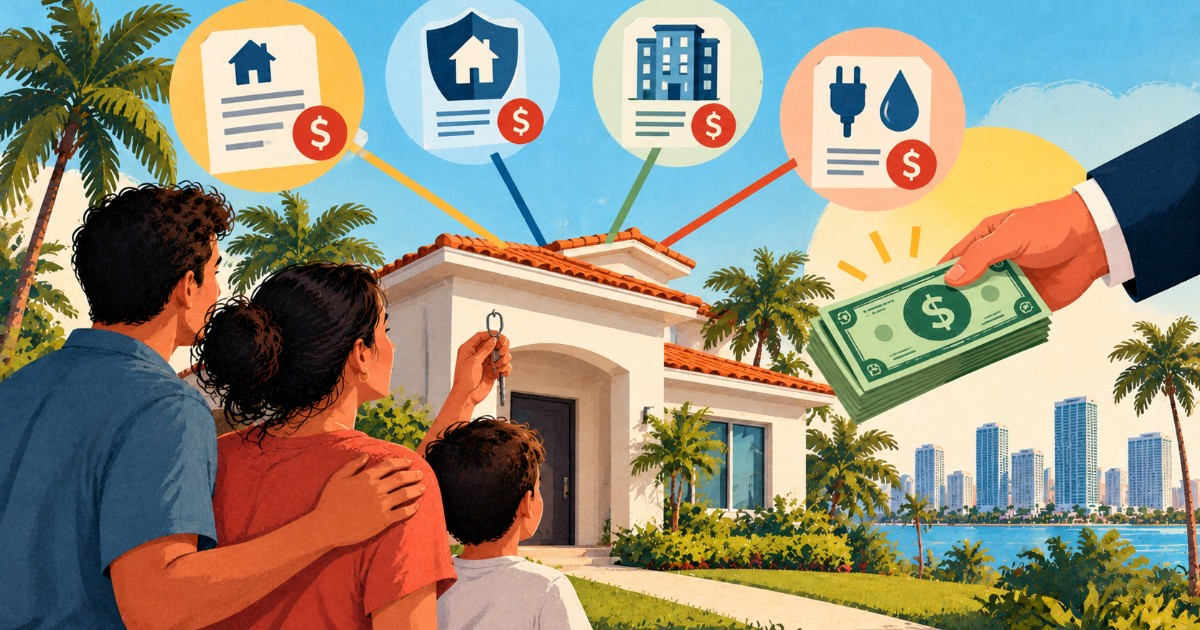
Homeowners in Miami-Dade facing financial difficulties can still apply for assistance of up to $3,500 per household to cover overdue housing payments.
The Mortgage Relief Program (MRP) of the county allows the use of assistance to cover overdue mortgages, late fees for homeowners' associations or condominiums, homeowners insurance, and certain electric or water bills.
The official Miami-Dade Mortgage Relief Program page currently has the online application available and sets the maximum benefit at $3,500 per household during the program's duration.
The assistance is specifically aimed at homeowners who are facing financial difficulties and use the property as their primary residence.
What expenses can the $3,500 help cover?
The program includes four major categories of housing-related expenses:
Late mortgage payments.
Past due HOA or condominium association fees.
Homeowners insurance.
Overdue utility bills, such as electricity or water.
The maximum of $3,500 does not mean that every applicant will automatically receive that amount.
The benefit depends on the specific situation of the household, the documented eligible expenses, compliance with the requirements, and the availability of funds.
It is also not about $3,500 independently for each category. The county establishes a maximum total per household during participation in the program.
Who can apply for the Mortgage Relief Program?
The first requirement is to be a property owner in Miami-Dade and to apply for assistance for that property as a primary residence.
In addition, the total household income cannot exceed 140% of the area median income, known as AMI.
The exact economic limit depends on the number of family members, so applicants should use the current table published by the county rather than a single figure for all households.
During the process, Miami-Dade requires verification of both income and home ownership, as well as the debt for which assistance is being requested.
Some households receive priority
The county identifies several groups that are given priority during the processing of the program.
Among them are:
Elderly people.
People with disabilities.
Families with children.
Households with a mortgage that is three to 12 months delinquent.
Being part of one of these groups does not imply automatic approval, but it may give priority to the application.
Similarly, not belonging to one of these categories does not necessarily mean that an owner cannot apply for assistance if they meet the other requirements.
What do you need if you owe the mortgage?
To request mortgage assistance, Miami-Dade requires a statement or account statement that clearly shows the past due balance.
A W-9 form from the mortgage company is also required, which the owner must request directly from their lender or mortgage servicer.
The mortgage document must reflect that there is an actual outstanding debt and not just the current monthly payment.
What documents are required for homeowners insurance?
Anyone needing assistance to pay for homeowners insurance must present the annual homeowners insurance bill.
You may also need a W-9 form from the insurer.
When insurance is included within the monthly mortgage payment through an escrow account, the county may also require the mortgage statement and corresponding documentation from the company managing the loan.
It also covers overdue HOA and condominium fees
Owners who are behind on the fees for an association may request assistance.
To do this, they must present a statement from the Homeowners Association (HOA) showing the overdue amount.
They should also request a W-9 form from the association.
This section may be especially relevant in Miami-Dade, where thousands of homes are part of condominiums or communities subject to periodic association fees.
Electricity and water can also be included in the program
The Mortgage Relief Program also allows some of the assistance to be used for overdue utility bills.
The documentation must show the overdue amount.
The county typically requests a W-9 from the service provider, although it expressly indicates an exception for Florida Power & Light (FPL).
This possibility makes the program an additional alternative for homeowners who are not only behind on their mortgage but also accumulating various obligations related to their home.
You need to demonstrate that you are the owner
In addition to the documents related to the debt, Miami-Dade requests proof of ownership.
Among the officially mentioned documents is the property tax card.
Identification and proof of household income must also be provided.
How to apply for the $3,500
Miami-Dade currently offers an option for online applications on the official Mortgage Relief Program page.
Those who need assistance with completing the application can visit the County Community Resource Centers during their regular hours, typically Monday through Friday between 8:00 a.m. and 4:00 p.m..
The county clarifies that assistance at the centers is not currently offered at the Stephen P. Clark Center for this program.
To receive specific support from staff of the Mortgage Relief Program, Miami-Dade also publishes the:
Culmer Community Resource Center
1600 NW 3rd Avenue
Miami, FL 33136
Telephone: 305-438-4161
Assistance for this type of service is provided on a first-come, first-served basis, and the county warns that wait times may occur.
What is advisable to bring to the center?
To avoid delays, a property owner should gather beforehand before attending:
Identification.
Proof of household income.
Proof of home ownership.
Mortgage statement, if you are requesting assistance with the mortgage.
Annual insurance bill, if you request assistance with the insurance.
HOA or condominium account statement, if there is any outstanding debt.
Overdue electricity or water bill, if you are requesting assistance for services.
The corresponding W-9 forms required by the program.
Submitting all the documentation from the outset can streamline the evaluation of the file.
The program is not the same as ERAP
It is important not to confuse the Mortgage Relief Program with the Emergency Rental Assistance Program (ERAP).
ERAP was mainly aimed at families struggling to pay rent and is currently closed to new applications, according to information published by Miami-Dade.
The MRP, on the other hand, is aimed at homeowners and currently continues to offer the option to submit applications online.
It is also not help for buying a house
The program should not be confused with assistance for first-time homebuyers, down payment loans, or other property access programs.
The Mortgage Relief Program is intended for individuals who are already homeowners and need assistance to maintain their homes or catch up on associated expenses.
Miami-Dade created the program as part of its response to the housing crisis
The Mortgage Relief Program is part of the initiatives promoted by Miami-Dade as part of its affordable housing strategy.
CiberCuba reported in 2022 on the $85 million plan announced by the county to address the housing crisis, which specifically included mortgage relief for struggling homeowners.
The program initially started with lower amounts, but the current maximum published by Miami-Dade is now $3,500 per household.
Buying may be easier, but maintaining a home still comes at a cost
Help also comes at a time when the real estate market in Miami-Dade is showing some more favorable signs for buyers, although the costs associated with homeownership remain high.
CiberCuba recently reported that Miami-Dade is currently functioning as a buyer's market, with greater negotiating power in several areas.
However, the cost of a home doesn't end with the mortgage.
Owners must also assume taxes, insurance, HOA or condominium fees, maintenance, and utilities, specifically several of the obligations contemplated by this assistance program.
Do not use old documents to verify the amount
There is an important detail for those seeking information about the program online.
Some old brochures and documents from Miami-Dade still display a maximum of $1,500, which was the original amount of the program.
The current operational information from the county states that eligible households can receive up to $3,500.
Therefore, applicants should consult the current page of the Mortgage Relief Program and not rely solely on downloaded documents or outdated versions of the plan.
Requesting does not mean automatically receiving $3,500
The announced maximum may seem appealing, but it is important to understand how it works.
Assistance is granted after reviewing eligibility, income, housing, documented debt, and other program requirements.
The county also does not guarantee that all applicants will receive the maximum.
Those who need assistance should submit their application while the portal remains open, gather documentation that proves each debt, and use only the official channels of Miami-Dade to avoid fraud or intermediaries that charge for a process that can be initiated directly with the county.
Related videos:
Filed under: