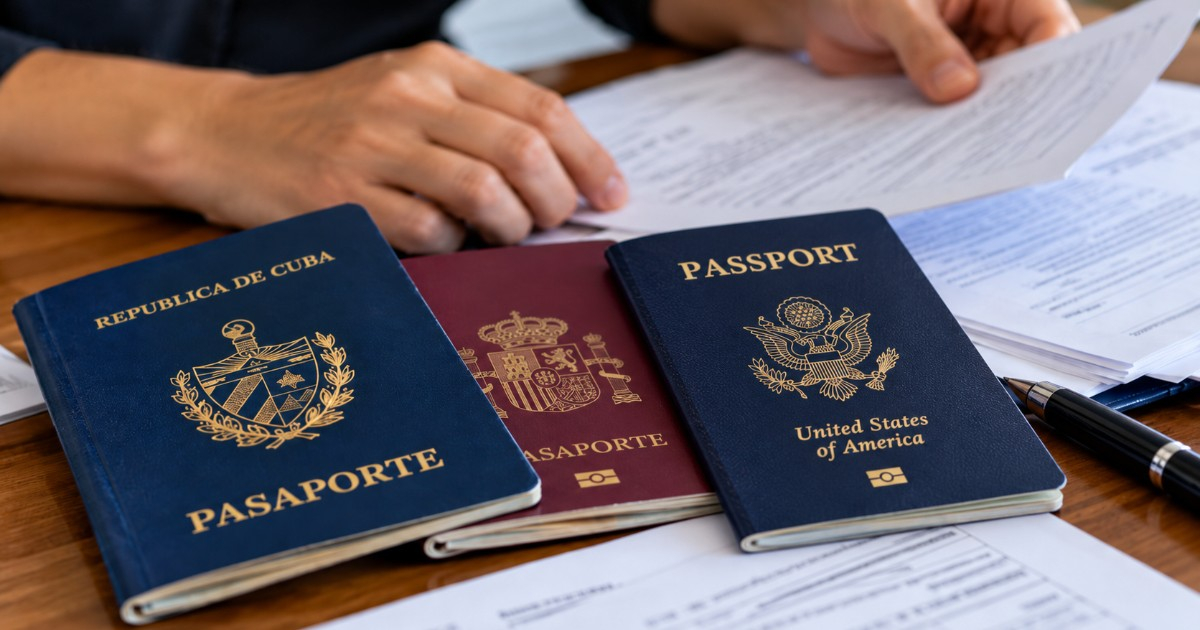
Starting from November 1, 2026, Cubans living outside the island will be able to take advantage of the new procedure established to formally apply for renunciation of Cuban citizenship.
The possibility is regulated in the , published on May 5th as part of the .
But renouncing will not be as simple as handing over the Cuban passport or proving that one has another nationality. The law requires meeting several criteria, providing specific documents, and waiting for a formal decision from the Cuban authorities.
Additionally, as of October 1st, a new consular fee schedule has taken effect, which establishes two related charges for the process: 500 dollars or euros for the application and another 500 for obtaining the waiver.
The measure is particularly significant for Cuban Americans, Cuban Spaniards, and other members of the diaspora who hold dual citizenship and wish to no longer be legally subject to the status of Cuban citizen.
CiberCuba recently explained the main immigration changes that will take effect on November 1st. Renouncing citizenship is one of the most important processes within this new framework.
Who can renounce Cuban citizenship?
Article 46 of Law 172 establishes five requirements that must be met to request resignation.
Must be over 18 years old.
To already possess another citizenship. The legislation does not allow for a person to become stateless as a result of the procedure.
Meeting abroad. The resignation is specifically designed as a procedure that must be initiated from outside of Cuba.
Not to have any monetary debts with the Cuban state or its institutions.
Not being subject to a criminal sentence of deprivation of liberty or a subsidiary sanction, nor being pursued for the commission of a crime in Cuba or abroad.
Therefore, having citizenship from the United States, Spain, or any other country is essential, but it is not enough on its own to cease being a Cuban citizen.
What documents need to be submitted?
Article 47 states that the application must be made in writing and accompanied by several documents.
The first is a sworn declaration given before a notary public in which the individual expressly states his or her intention to renounce Cuban citizenship and declares that there are no monetary debts owed to the State.
You must also provide a certification that verifies citizenship of another country, issued by the relevant authority.
A certificate of residence is also required in the country where the consulate to which the application is submitted is located.
Finally, criminal records from Cuba and from the country where the applicant is residing must be provided.
The written request must also identify the authority to which it is addressed, the personal details and address of the interested party, the facts and grounds of the petition, a way to communicate for receiving notifications, as well as the place, date, and signature.
Current consular regulations generally state that documents issued abroad that are intended to have effects in Cuba must comply with the corresponding legalization and certification formalities. When these documents are written in another language, translation into Spanish may also be required.
Where to submit the application
The Law 172 is specific on this point: the resignation request must be submitted from abroad to the Cuban consular office in the country where the applicant resides.
This means that the resignation procedure, unlike other citizenship processes, is not designed to be initiated while the person is residing in Cuba.
Before submitting the documentation, it is advisable to confirm with the relevant consulate the modalities for submission, payment, legalization, and receipt of documents that will be in effect when the new procedure begins to operate.
How much does it cost to renounce Cuban citizenship?
The new , effective from October 1, includes two different concepts.
Application for renunciation of Cuban citizenship: 500 dollars or euros.
Obtaining the renunciation of Cuban citizenship: 500 dollars or euros.
In the Eurozone countries, the tariff is applied in euros. In other countries, it is set in US dollars, although it can be charged in the official currency of the country where the consular office is located.
The two amounts total 1,000 dollars or euros. This figure corresponds to the specific fee for the application and obtaining the waiver and does not necessarily include other expenses that may arise from certifications, documents, translations, legalizations, or shipping.
CiberCuba reported in September on the implementation of these new consular fees.
Paying and submitting all documents does not constitute an automatic waiver
This is one of the fundamental aspects of the new law.
The article 50 states that the resignation only takes effect when it is accepted by the competent authority and there is a formal declaration.
Therefore, neither having another nationality, nor presenting the documentation, nor paying the fees automatically designates the individual as a foreigner before the Cuban authorities.
As long as there is no resolution or decree that accepts the resignation, the person remains legally a Cuban citizen.
The Law 172 itself also stipulates that decisions regarding citizenship must be reasonably justified.
The specific articles regarding resignation do not include an additional catalog of discretionary reasons to reject a request that meets all the requirements. However, the legislation reserves to the State the final act of acceptance: the individual will of the citizen alone does not extinguish citizenship.
Who decides if the resignation is accepted?
In most cases, it is the responsibility of the Interior Minister to accept the resignation through a resolution.
There is an exception for certain individuals who acquired Cuban citizenship through naturalization by a decision of the President of the Republic. When the original granting was made in the exercise of that presidential authority, the resignation must also be accepted through a presidential decree.
How long can the procedure take?
The final version of Law 172 does establish deadlines for different stages of the file.
Once the application has been properly submitted, the consulate has 20 business days to forward it to the citizenship department of the Directorate of Identification, Migration, Foreign Affairs, and Citizenship of the Ministry of the Interior.
The instruction of the file has a period of 90 working days.
That period may be extended by another 90 working days by the head of the Identification, Migration, Foreign Affairs, and Citizenship Department.
If the application is incomplete, the authorities may require the applicant to rectify the deficiencies. To do so, they have up to 15 calendar days. If they do not comply within that timeframe, it is considered that they have withdrawn, and the file will be archived by resolution.
When the decision falls to the Minister of the Interior, the resolution must be sent to the citizenship body within the stipulated period of 30 calendar days for notification to proceed.
Once the resolution is received, the consulate has 15 calendar days to notify the interested party or their representative. The communication can be carried out in person or through the electronic means provided in the application.
This means that the law sets deadlines for the different phases, but the entire process can extend for months, especially if the file review is prolonged or if it becomes necessary to correct documentation.
What happens while waiting for the decision
Until the resignation is accepted, the individual remains a Cuban citizen and is subject to the rules of the so-called effective citizenship.
Law 172 establishes that acquiring another nationality does not automatically result in the loss of Cuban citizenship.
While in Cuba, a Cuban citizen with another nationality must abide by their Cuban status and cannot use their foreign citizenship to produce legal effects before the authorities of the country.
The same rule of effective citizenship applies at Cuban diplomatic and consular representations abroad.
What changes after Cuba accepts the resignation?
Once a favorable decision is reached, the legal treatment changes significantly.
The establishes that anyone who has renounced their Cuban citizenship and whose renunciation has been accepted is considered a foreigner.
From that moment, they can no longer identify as a Cuban citizen in Cuba and, to enter and exit the country, they are subject to presenting their foreign passport, complying with the relevant visa requirements, and providing any other applicable travel documents.
If you hold more than one foreign citizenship, you must identify yourself and exit Cuba using the same foreign passport with which you entered.
The Citizenship Law also stipulates that the Ministry of the Interior or consular representatives shall cancel the documents that certify Cuban citizenship once the resignation is accepted.
The decision is also recorded in the Citizenship Registry.
Can an unfavorable decision be appealed?
Yes. Law 172 allows for the challenge of administrative decisions made in citizenship resignation procedures.
The first route is the resource of Reform and, subsequently, when applicable, the resource of Appeal.
When the decision has been made directly through a presidential decree, only the administrative appeal for reform is applicable.
The law stipulates that these resources must be resolved and notified within a period of 90 days from the date they are received by the competent authority.
Once the administrative route has been exhausted, the interested party may appeal to the competent court.
What is advisable to prepare before November 1st?
Anyone considering this procedure can begin by reviewing their documentation: verifying that they have a second citizenship, understanding their situation regarding any potential debts with Cuban institutions, locating the mechanisms to request criminal records, and consulting with the relevant Cuban consulate about the formalities applicable to notarial documents, certifications, translations, and legalizations.
It is also important not to confuse the renunciation of Cuban citizenship with a change in immigration status. A Cuban can reside permanently in the United States, Spain, or another country and still be a Cuban citizen. Renouncing means breaking that legal bond and, once the procedure is accepted, being treated as a foreigner by Cuba.
The new legislation for the first time creates a detailed procedure for this, but it maintains a decisive feature: citizenship does not disappear merely at the will of the individual; a state resolution formally accepting the resignation is necessary.
Related videos:
Filed under: