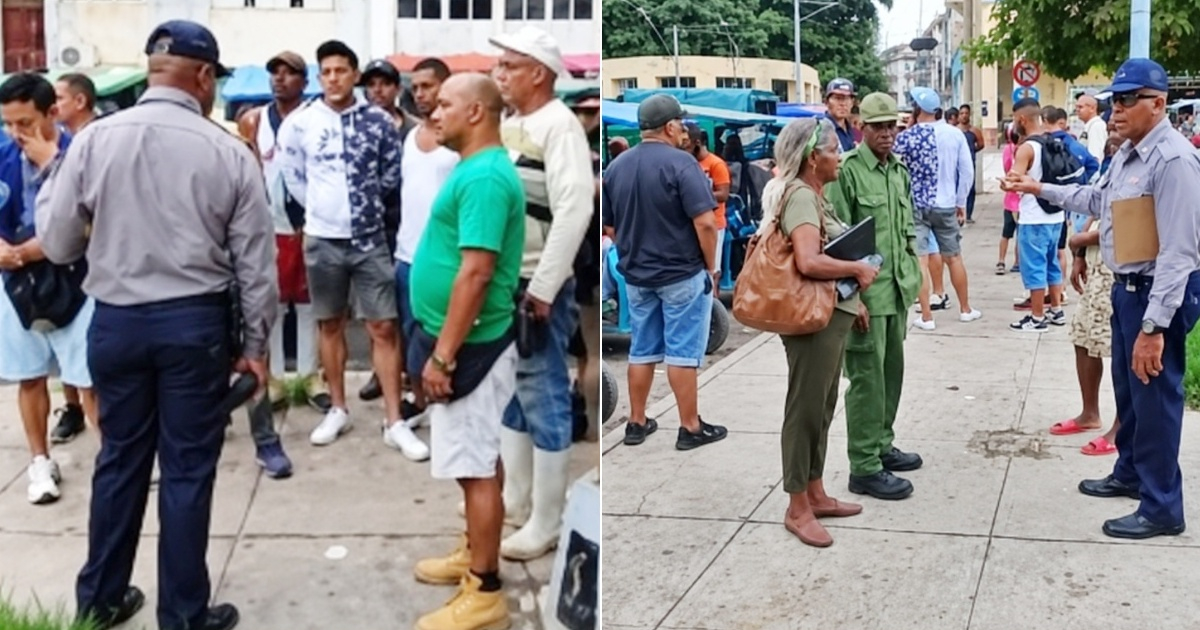
A police operation deployed in several areas of Havana resulted in the seizure of nearly 1.5 million pesos in cash and the issuance of 22 fines to drivers operating outside the law, according to a post on Facebook by “Héroes de Azul en Cuba”, an official profile close to the Ministry of the Interior (MININT).
The post went viral immediately and sparked a wide debate that, rather than celebrating the operation, exposed the accumulated frustration of many residents of Havana regarding the deterioration of public transport.
The operation: what happened and where?
Officers of the Revolutionary National Police of Centro Habana, along with members of the Technical Investigation Department, first acted at the intersection of Industria and Neptuno, where they detained individuals carrying the seized money.
From there, the actions extended to El Curita Park and its surroundings, to the so-called Piquera de Guanabacoa and Avenida Galiano with its boulevard, areas known for the concentration of informal transportation in the capital.
Drivers engaged in illegal "boteo" —charging above the authorized rates— were arrested, along with unlicensed bike taxi drivers and motorcyclists lacking the required documentation.
Three speakers with players and an exhaust pipe were also confiscated, which, according to the government publication, was under surveillance for noise pollution.
The figures from the operation
The official report, released with a triumphant tone, detailed the imposition of two fines under Article 7, section l), totaling 8,000 pesos; three fines under Decree 261, Article 1, section k), for 500 pesos; and another 17 fines under Decree 91, section c), amounting to 16,000 pesos.
The head of Traffic, Alain Blanch Aldana, and the deputy commissioner of Oversight also delivered two educational talks: one aimed at car drivers and the other at drivers of electric tricycles.
The reaction: irony, skepticism, and an unanswered question
The post generated hundreds of comments reflecting three dominant feelings: frustration, fear, and a demand for real solutions.
The prevailing current was one of ironic skepticism.
"And thus, the transportation problem was magically solved," wrote a user.
Others were more direct: "And where is the state transportation?" and "Who will guarantee the much-needed transport of passengers?".
One of the most frequently expressed fears among commentators is that the sanctions will further reduce an already insufficient mobility supply.
"Final result... less transportation," summarized one user.
Several anticipated even an opposite effect than intended: that, by reducing the number of available transporters, those who continue to operate would raise their rates even further.
A second viewpoint accepted the need to control illegal activities, but it conditioned that support on the requirement that oversight be accompanied by concrete alternatives for passengers.
"The problem is not to eliminate the carriers who are so needed," noted a commentator.
Another person posed the question that best summarizes that position: "How many state public transport routes were added?"
Even among those who applauded the operation, a recurring demand emerged.
"Let it not be the action of just one day," a commentator demanded.
Another opinion summarized it: "Everything that is done for the well-being of the people is well done. But it should not be something temporary; consistency will be the key to success."
Sarcasm also served as a thermometer for the overall mood.
Phrases like "tomorrow we have buses every 15 minutes" or "the buses will be coming soon to fill the gap" did not celebrate any improvement; rather, they mocked the idea that fines could replace a transportation policy that the Cuban state has struggled to maintain efficiently for years.
Several users described the operation as a "circus" or a "distraction."
The context that the operation does not resolve
The decline of state passenger transport in Cuba has reached critical levels. According to previously released data, state passenger transport plummeted by 93% between January and September 2025.
The crisis reached such a level that, in February 2026, the official page Transportación Habana reported that none of the available urban routes in the capital were in operation due to a fuel shortage.
The deterioration has resulted in scenes that illustrate the extent of the problem. People from Havana crossed the bay tunnel on foot, which is 733 meters long, after waiting more than seven hours for a bus that never arrived.
In the midst of that void, the boteros, bicitaxistas, and electric tricycles have become some of the main mobility alternatives for many Cubans, although with increasingly higher rates.
The rise in fuel prices is also placing pressure on transport costs. In March 2026, prices were reported at around 4,000 pesos per liter of gasoline in the informal market of Havana, a figure that helps explain the increase in operating expenses and its impact on ticket prices.
In response to the crisis, Cuban authorities have implemented measures that combine the inclusion of new participants with increased regulation. On one hand, they have relaxed requirements for obtaining licenses through Instruction No. 1 of the Ministry of Transport and authorized 1,912 individuals with electric vehicles as of the end of July 2026. On the other hand, they have intensified operations, fines, and confiscations against those who work without a license or charge fees deemed excessive by the authorities.
The operation thus brings to light a contradiction that directly affects citizens: the State demands compliance with regulations from private transporters while failing to ensure a sufficient public offer to meet the population's mobility needs.
A commentator summarized it this way: "What has been done in this operation is reasonable; we all must adhere to the laws, but it's just a matter of figuring out who will solve the transportation problem for the Cuban people."
Related videos:
Filed under: