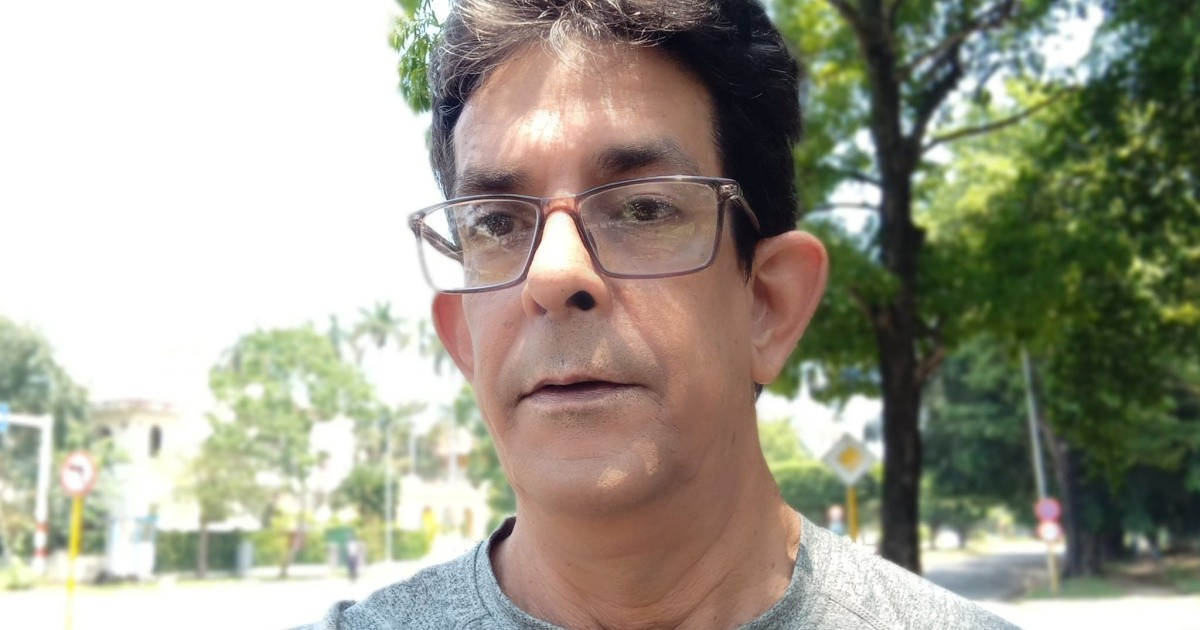
Ulises Toirac sat down with actor Jorge Martínez on the podcast «Todos Hablan» (Cubamastv) and shared some of the most powerful statements he has made about Cuban reality: his firm refusal to normalize precariousness and his philosophy of not giving up in what he himself called a "sixth world" country.
"I don't want to get used to a sixth-world country."
When Martínez asked him what still gives him hope, Toirac responded with a litany that abruptly summed up daily life on the island:
"I don’t want to get used to being without electricity for 20 hours a day. I don’t want to get used to living in precarious conditions. I don’t want to get used to traveling by riquimbili. I don’t want to get used to having to walk to avoid spending money. I don’t want to get used to a country in the sixth world."
The comedian clarified that his refusal does not stem from desperation, but from a conscious decision: "I don't want to get used to it because when I can live in a normal country, I don't want to have to acclimate to that."
She summarized that stance with a phrase she has repeated in various forums: "I refuse to merely survive. That’s why I refuse to let existence be a sum of negativities."
Cuban television, a medium that no longer exists
The creator of "Do You Swear to Tell the Truth?" was emphatic about the current state of television on the island: "In Cuba, talking about television is futile because there is neither electricity to watch it, nor electricity to make it, nor conditions to produce it."
That impossibility drove him to seek refuge in writing.
His second book, "Locos de barrio. Segundo round," was entirely written on his mobile phone due to the lack of a computer and frequent power outages. The volume is available on Amazon.
The battle for his vision
Toirac revealed that he is going through a health process that he described as "quite tough": he suffers from macular degeneration, a disease that affects the center of the retina and has already damaged the central vision in one eye.
"I am a person who constantly lives with the threat of becoming partially blind or, as I would put it, functionally blind, because it would make it impossible for me to read, it would make it impossible for me to write," he admitted.
The treatment consists of intraocular injections that halt the progression of the disease, but do not cure it. Faced with this possibility, he investigated dictation tools on his mobile to continue working.
Censorship, self-censorship, and freedom of thought
Regarding the pressure he experienced during his years on Cuban television, Toirac was candid: "When you are in an atmosphere of terror, self-censorship definitely exists because you fear for your work."
He also reflected on intellectual freedom: "When you stop thinking for yourself and borrow the opinions of others, what you're doing is simply becoming part of the herd." He added: "Freedom begins in the mind and is the hardest to achieve."
Sobre el peligro de callar fue igualmente contundente: «Lo más peligroso que hay, primero para la tranquilidad mental de uno y segundo para la propia existencia, es callarte porque te va a golpear al final.»
Emigration, "the worst demographic disaster" of Cuba
Toirac characterized Cuban emigration after 1959 as “the worst demographic disaster in the entire history of Cuba”, due to the irreversible family break-up it causes: parents and children who never see each other again, siblings who hold onto grudges for decades.
The statements from the podcast are framed within a year of sustained criticism of the regime. In July, he described the electrical collapse with an image that went viral: "it's no longer the light at the end of the tunnel; it's that there is no tunnel". On Tuesday, he posted on his social media: "Want less dissent? Invest in electricity, water, and gas."
Related videos:
Filed under: