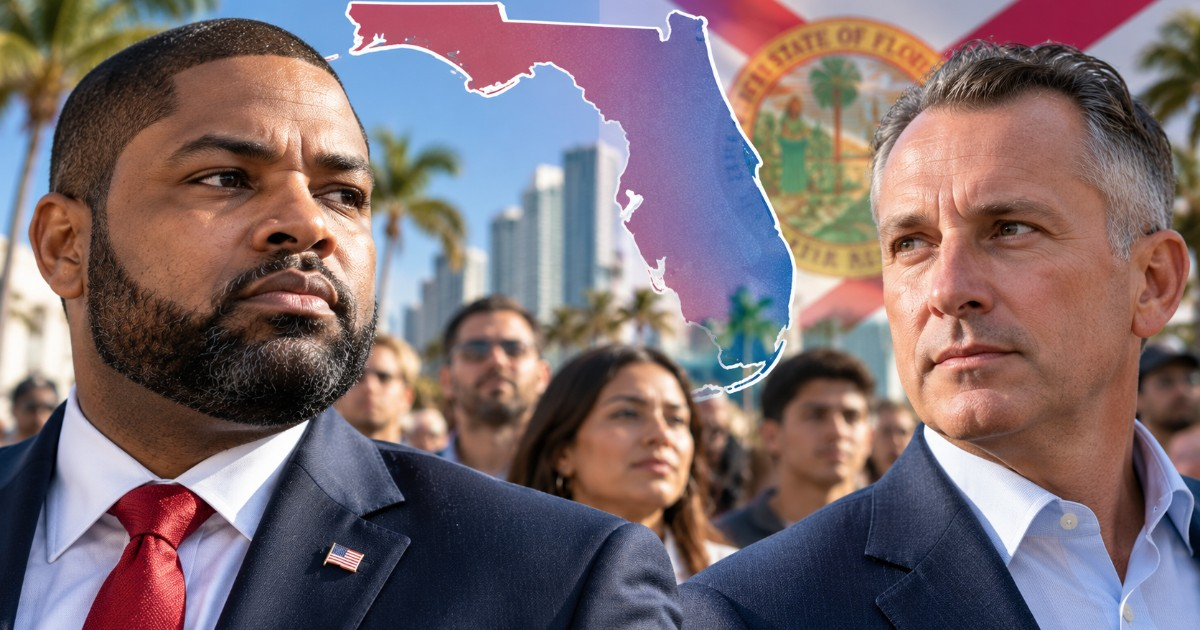
A new electoral poll in Florida presents a picture quite different from what some surveys reflected just a few weeks ago: the Republican Byron Donalds is leading the Democrat David Jolly by seven points in the race for governor and is also regaining ground among Hispanic voters.
The NBC6/Telemundo Station Group poll conducted by Mason-Dixon places Donalds with a 48% voter intention, compared to 41% for Jolly.
Another 10% of the respondents remain undecided, and about 1% support another candidate.
The election will take place on November 3rd and will determine who will replace Ron DeSantis as the head of Florida after his two consecutive terms as governor.
The most striking fact is among Hispanics
Among the Hispanic voters surveyed by Mason-Dixon, Donalds now has 48% compared to 43% for Jolly.
The result is particularly significant because a previous survey revealed a completely different situation.
In mid-September, a poll by St. Pete Polls showed both candidates nearly tied statewide: Donalds had 43.5% and Jolly 43.4%.
In that survey, however, Jolly was ahead among Hispanics with 48% compared to 39% for Donalds.
CiberCuba reported at that time about this situation while analyzing Donalds' campaign offensive to reclaim the Hispanic vote, including an investment of at least one million dollars in Spanish-language advertising.
But the results of both surveys should not be compared as if they were continuous measurements conducted by the same company.
St. Pete Polls and Mason-Dixon used different samples, dates, and methodologies. Furthermore, the results among Hispanics correspond to smaller subgroups than the overall survey, which means they have a higher margin of error.
What can be affirmed is that the new survey presents a much more favorable picture for Donald among Hispanic voters than the one published in mid-September.
Who are Byron Donalds and David Jolly?
Byron Donalds is a Republican congressman representing southwest Florida in the United States House of Representatives and is one of the figures close to President Donald Trump within the Republican Party.
Before arriving in Congress in 2021, he was a member of the Florida House of Representatives and worked in the banking, finance, and insurance sectors.
Donalds selected state senator Bryan Ávila, born in Hialeah and son of Cuban exiles, as his candidate for lieutenant governor.
The campaign has given Ávila a particularly visible role in reaching out to Hispanic voters. In his Spanish-language advertising, the Cuban-American senator has focused the message on the cost of living, security, and opposition to socialism.
David Jolly, for his part, was also a member of Congress, although his political career has taken a very different path.
He was originally elected as a Republican from a district in Florida, later left the party, spent several years as an independent, and is currently running as a Democratic candidate.
Her campaign has focused on issues such as the cost of homeowners' insurance, healthcare, public education, and the regulation of certain technology projects and data centers.
The race for the Senate also favors the Republican candidate
The same survey measured another major state contest in November: the federal Senate election.
The Republican Ashley Moody appears with 50% compared to the 40% of the Democrat Angie Nixon.
The non-partisan candidate Neil Gillespie obtains 2%, while another 8% of voters remain undecided.
Moody currently holds the Senate seat that became vacant when Marco Rubio left the Upper Chamber to become Secretary of State.
Before arriving at the Senate, Moody served as the Attorney General of Florida from 2019 to 2025 and had previously worked as a judge and federal prosecutor.
Angie Nixon is a Democratic state representative for Jacksonville, a labor organizer, and one of the figures of the progressive wing of her party.
Among Hispanic voters, Moody records a 47% compared to Nixon's 40% in the new poll.
Socialism also appears as a factor among voters
The survey also included a separate question about how it would influence the vote if a candidate described themselves as “democratic socialist”.
In the overall response from the state, 52% said that this definition would make them less likely to support the candidate, compared to just 8% who indicated it would increase the likelihood of voting for him.
Among the surveyed Hispanics, the percentage who stated they would be less likely to support a candidate with that definition reached 57%.
The question did not mention Nixon by name or any other candidate, so that result does not allow us to conclude on its own that this issue explains Moody's advantage.
Nixon has been associated with the Democratic Socialists of America (DSA), a leftist organization in the United States that advocates for democratic socialism.
For a portion of the Latino electorate in Florida, particularly Cubans and Venezuelans with family experiences related to socialist or communist governments, this debate carries particular political sensitivity, even though the Hispanic community in the state is diverse and does not vote as a homogeneous bloc.
The cost of living dominates concerns
The economy emerges as the main issue behind electoral decisions.
When Mason-Dixon asked what factor most influenced the 2026 vote, 30% mentioned inflation and the cost of living.
Subsequently, the direction of the state or country appeared at 17%, followed by the enforcement of immigration laws at 16%.
Food prices were also cited by 26% as the main factor that makes it difficult to cover daily expenses. Another 17% said their incomes are not growing at the same pace as prices, while 15% pointed to the cost of gasoline.
Housing, insurance, and property taxes have also become central issues in the gubernatorial campaign.
Voters are divided on Trump
The survey also asked about the performance of President Donald Trump.
The result was exactly divided: 48% approve and 48% disapprove of his management, while another 4% have no defined opinion.
Among the Hispanics in the sample, 45% approve of Trump and 49% disapprove.
That fact is interesting because Donalds, who is closely politically aligned with the president, simultaneously ranks ahead of Jolly among those same Hispanic voters.
However, a survey does not allow for the determination of the specific reasons that lead each voter to support a state candidate while holding a different opinion about the president.
The independents present another picture
Donalds enjoys a high level of support among Republicans, while Jolly holds similar backing among Democrats, but independent voters exhibit a different behavior.
Among the independents surveyed, Jolly is ahead of Donalds, while a significant proportion remains undecided about their vote.
This helps explain why, despite Donalds' lead in this poll, there is still a sufficient percentage of undecided voters for the campaign to remain open in the weeks ahead.
How the survey was conducted
Mason-Dixon conducted the survey between September 28 and October 1.
625 registered voters in Florida selected at random participated and were interviewed live by phone. All confirmed that they would likely vote in the general elections on November 3rd.
The sample included 277 Republicans, 214 Democrats, and 134 independent voters.
The margin of error for the survey as a whole is approximately ±4 percentage points with a confidence level of 95%.
The margin of error is greater when analyzing smaller groups, such as Hispanic voters, young people, or independents, so those figures should be interpreted with greater caution.
A decisive month for Florida and the Cuban vote
The election on November 3 will determine not only who leads Florida for the next four years but also who will occupy one of the state's two seats in the United States Senate.
For the Cuban community in South Florida, both contests are particularly significant.
The Republican formula for the governorship includes a Cuban American, Bryan Ávila, while issues such as immigration, cost of living, property taxes, insurance, and the political relationship with Cuba are part of the electoral debate.
The new survey suggests that Donalds and Moody enter this phase of the campaign with a better position among Hispanics than reflected by some previous polls.
But there is still almost a month of campaigning left, a significant percentage of voters remain undecided, and the methodological differences between polls make it advisable to avoid interpreting any single measurement as a prediction of the outcome on November 3rd.
Related videos:
Filed under: