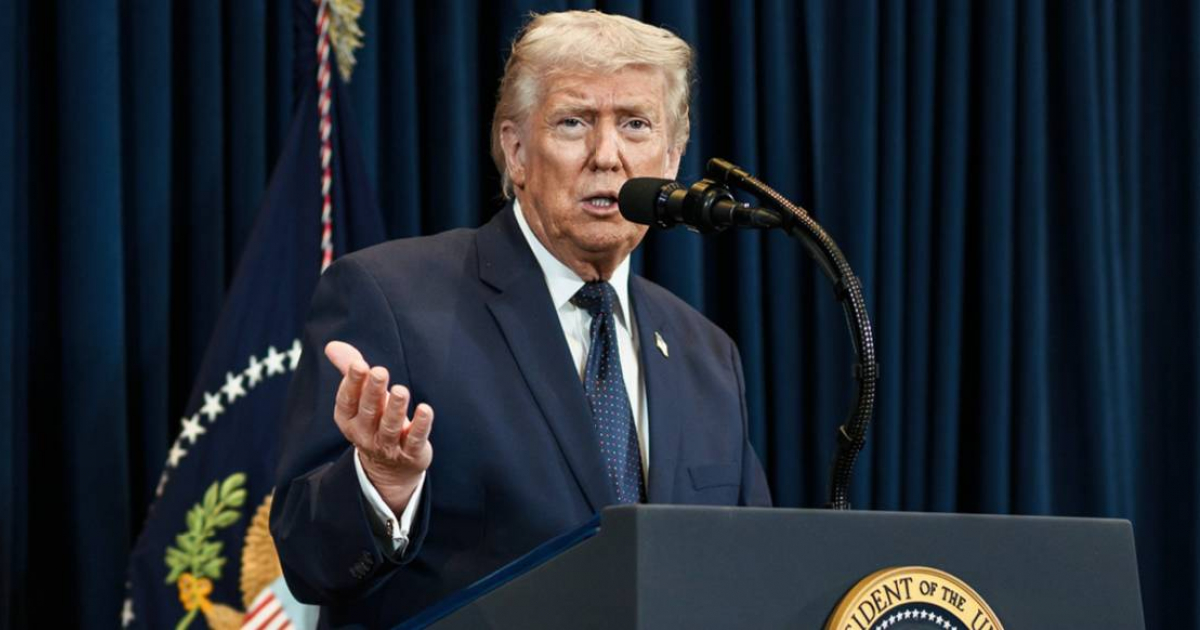
Donald Trump announced at campaign rallies his intention to promote the so-called “No Invasion of Our Country Act”, a proposal that, according to the president, would make it impossible for any successor to reopen the border to illegal immigration.
However, as of today, that initiative does not exist as a registered legislative project in Congress.
Trump first presented the idea on September 9, 2026, during the Republican midterm convention held in Dallas, Texas.
"We will make it legally impossible for any future president to destroy our country by having the right to reopen the border. We will pass the No Invasion of Our Country Act," he declared before thousands of attendees at the American Airlines Center.
The proposal was reiterated on October 2, 2026, at a rally in Mobile, Alabama, with a more precise wording: “We will pass the No Invasion of Our Country Act, which will prohibit any future president from reopening our borders to illegal immigrants.”
La política fronteriza de Trump y sus implicaciones legales siguen generando debate. Para mantenerte al tanto de todos los cambios en , sigue nuestra cobertura actualizada.
Both events are part of the Republican campaign leading up to the legislative elections on November 3, 2026.
Is there already a bill?
The answer is no. Searches on Congress.gov do not yield any legislative text, bill numbers, or formal sponsors associated with that name. The "No Invasion of Our Country Act" is, for now, a political promise announced at rallies, not a formally introduced initiative in Congress.
Yes, there is a related but distinct project: the H.R. 9773, titled the "Permanent Trump Secure Border Act," introduced by Representative Chip Roy (Republican from Texas) on July 20, 2026, and approved by the House Judiciary Committee by a vote of 16 to 14. This project has not progressed to the full House nor has it been enacted into law.
Trump linked the proposal to other legislative priorities he plans to push after the November elections, such as the SAVE America Act, which would require voter identification and proof of citizenship.
What limits would such a law have?
From a constitutional perspective, Congress does have primary authority over immigration and can enact regulations that limit the Executive's discretion. However, no ordinary law can prevent a future Congress from repealing or amending it: that is the fundamental rule of the American legislative system.
Moreover, the sitting president would always retain a degree of residual discretion: priorities for deportation, allocation of resources, granting of parole or work permits would remain executive powers that a law cannot completely eliminate.
The courts, for their part, could invalidate provisions that violate the Constitution, as happened in April 2026, when a federal appeals court blocked the attempt to suspend access to asylum at the southern border.
For the law to be more difficult to reverse, two-thirds majorities in both chambers would be required, which is practically unfeasible given the current balance of power in Congress.
The context: the most restrictive border policy in decades
The proposal aims to establish permanent legislation for the restrictions that currently rely on executive orders, which are susceptible to being overturned by a successor.
The Trump administration has gone 15 consecutive months without releasing detained migrants at the border, apprehensions in the southwest dropped by 94% compared to the monthly average during the Biden administration, and ICE made 49,571 arrests just in July 2026.
In June 2026, Trump signed the Secure America Act, a package of approximately 70 billion dollars to strengthen the operations of the Department of Homeland Security, approved by the Senate with a vote of 52 to 47.
In Mobile, Trump warned that if the Democrats won the legislative elections, they would attempt to "reopen" the borders and grant amnesty to 25 million undocumented immigrants, a figure that has not been independently verified.
Related videos:
Filed under: