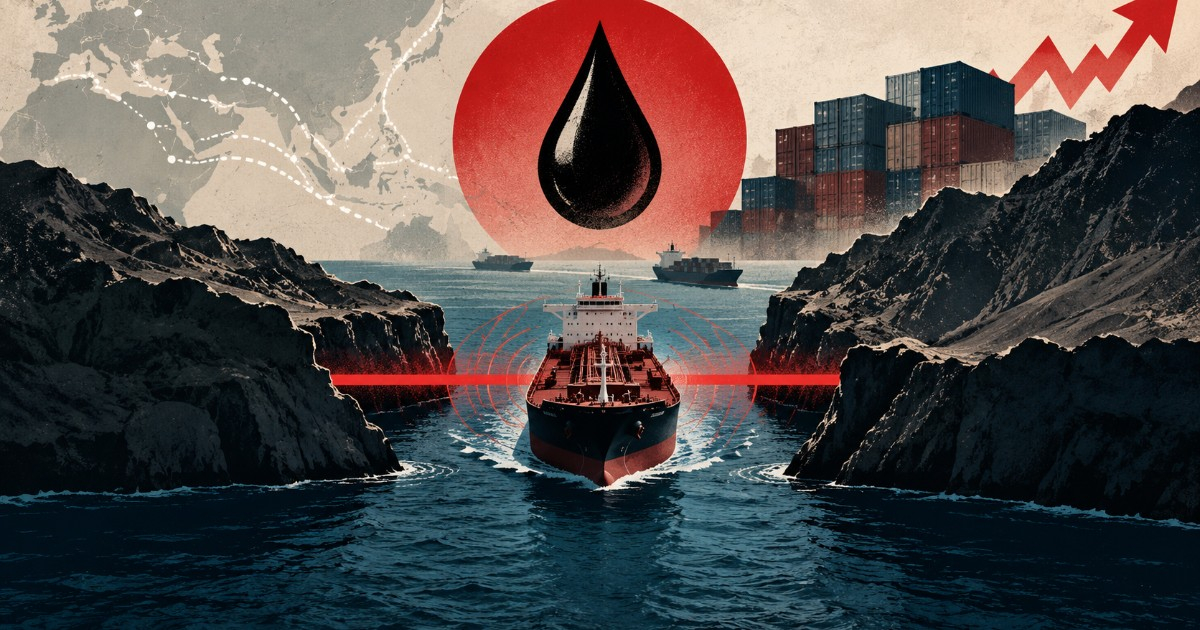
The intense military escalation in Yemen has once again brought to the forefront of global attention a narrow strait just a few dozen kilometers wide, yet crucial for the global economy: Bab el-Mandeb, the gateway to the Red Sea from the Gulf of Aden.
The Yemeni government forces supported by Saudi Arabia are fighting against the Houthis, allies of Iran, in areas near the Strait, while the rebel group has responded with new missile and drone attacks against Saudi targets.
The concern extends beyond the conflict within Yemen. This route is used by ships that connect Asia and Europe via the Red Sea and the Suez Canal, including large volumes of oil, fuels, containers, and goods.
Associated Press reported on Tuesday that the most intense fighting in years is centered around Bab el-Mandeb, as the price of Brent crude remains close to 100 dollars per barrel.
Where is Bab el-Mandeb and why is it so important?
Bab el-Mandeb is located between Yemen on the Arabian Peninsula and Djibouti and Eritrea in the Horn of Africa.
It connects the Gulf of Aden with the Red Sea and, further north, with the Suez Canal.
This turns the strait into one of the major maritime highways of the planet for ships traveling between Asia, the Middle East, and Europe.
AP estimates that around 12% of the world's trade and about a quarter of global container traffic pass through this route.
The United Nations Conference on Trade and Development (UNCTAD) has also estimated that the Red Sea system and the Suez Canal have historically handled around 12% to 15% of global trade.
More than eight million barrels of oil per day
The energy weight of the route has increased significantly during 2026.
The U.S. Energy Information Administration (EIA) estimates that during the second quarter of this year, approximately 8.1 million barrels per day of crude oil, condensates, and petroleum products passed through Bab el-Mandeb.
Of that amount, approximately 6.1 million barrels per day were attributed to crude oil and condensates, while another two million were allocated to refined products.
The volume is especially significant because in the first quarter of 2025, oil traffic along this route had fallen to about 3.9 million barrels per day due to attacks and ship diversions.
During 2026, the route regained significance, especially amidst the tensions and disruptions in traffic in the Strait of Hormuz.
Is the strait currently closed?
No.
So far, there has been no complete closure of Bab el-Mandeb to international maritime traffic.
The concern arises from the proximity of the fighting, the Houthis' ability to attack vessels, and the possibility that shipping companies may choose to avoid the area for security reasons.
The United States Maritime Administration currently has an active alert for the Red Sea, Bab el-Mandeb, and the Gulf of Aden.
The notice states that the Houthis have resumed attacks on commercial vessels and warns that ships associated with the United States, United Kingdom, Israel, or Saudi Arabia are at an especially high risk.
The U.S. authorities recommend that ships exercise extreme caution and stay as far away as possible from the Yemeni coast.
The Houthis have already shown that they can affect this route
The risk is not theoretical.
Since the end of 2023, the Houthis have utilized missiles, drones, and explosive boats against ships crossing the Red Sea.
U.S. maritime authorities reported more than 100 separate attacks on commercial vessels between November 2023 and October 2025, affecting ships associated with over 60 countries.
This summer, the attacks intensified once again.
In August, the International Maritime Organization condemned an attack on the cargo ship Tihamah near the coast of Al Mokha, Yemen, which resulted in the death of several crew members.
The organization warned that such actions threaten global supply chains and force shipping operators to reassess the risks of using the route.
What happens if shipping companies stop using Bab el-Mandeb?
The ships have an alternative: to circumnavigate Africa via the Cape of Good Hope.
But that option involves much longer routes.
The result is an increase in fuel consumption, navigation hours, crew salaries, insurance, and the cost of chartering the vessels.
UNCTAD documented during the previous Red Sea crisis that detours around Africa increased the global demand for shipping capacity and put upward pressure on transport rates.
That increase in costs potentially affects thousands of products transported by sea: from appliances and industrial parts to food, clothing, and consumer goods.
What could happen to the price of oil?
The impact on oil will fundamentally depend on how long the escalation lasts and whether maritime traffic can continue.
While the ships continue to cross Bab el-Mandeb, the main impact may manifest as a risk premium: increased costs for insurance, transportation, and protection.
A prolonged closure or a significant reduction in flows would have much greater consequences.
Companies would have to divert shipments, modify routes, and use different transportation systems, which could temporarily reduce the available supply in certain markets and put upward pressure on prices.
However, that does not mean that an escalation in Yemen will automatically lead to a new increase in oil prices.
The price also depends on global production, reserves, demand, OPEC+ decisions, the situation in the Strait of Hormuz, and other geopolitical factors.
The situation is especially delicate due to the Strait of Hormuz
Bab el-Mandeb is becoming even more significant as the tensions of 2026 have also impacted the other major energy chokepoint in the region: the Strait of Hormuz.
The EIA estimates that the volume of oil passing through Hormuz fell to around 4.9 million barrels per day during the second quarter of the year, well below the more than 20 million barrels typically recorded in previous periods.
Some of the energy flows shifted towards alternative routes, increasing the significance of the Red Sea.
That’s why a simultaneous crisis in Ormuz and Bab el-Mandeb would have a significantly greater impact than an isolated disruption.
The UN also warns about food
The risk is not limited to fuel.
The United Nations World Food Programme warned on October 2 that instability around Bab el-Mandeb could also raise food prices.
The organization reminded that food, fuel, and goods circulate through this corridor between Asia, the Middle East, Africa, and Europe.
A prolonged interruption can increase the transportation costs of both finished products and the fertilizers, energy, and raw materials needed for their production.
A war that is intensifying again
The Houthis have controlled the Yemeni capital, Sana'a, since 2014.
Saudi Arabia led a military coalition in 2015 in support of the internationally recognized Yemeni government.
After years of war, the conflict entered a phase of relative calm following a ceasefire reached in 2022.
That situation began to deteriorate again during 2026.
In September, the Houthis advanced along the Red Sea coast and established strategic positions near Bab el-Mandeb, including the port of Mokha and several islands.
The Yemeni forces backed by Saudi Arabia subsequently launched an offensive to reclaim those areas.
Yemeni officials claim to have regained several positions around the Strait, although fighting continues and the Houthis retain the capability to launch missiles and drones against Saudi Arabia and maritime targets.
Trump had already warned about the risk of a blockade
The current escalation has a recent precedent.
The statement came after the group announced a maritime embargo against ships linked to Saudi Arabia.
Two months later, the threat arises in an even more delicate scenario: ground battles are now taking place around the strait itself, and U.S. maritime authorities believe that the threat to commercial navigation remains active.
How could all of this affect the consumer?
For a consumer in the United States, Europe, or Latin America, the first effect of a prolonged crisis would likely not be finding products missing from stores, but rather paying more to transport them.
More fuel for the ships, higher insurance premiums, and longer routes increase transportation costs.
If oil prices rise as well, the effect could extend to gasoline, diesel, aviation, industrial production, and numerous goods that rely on energy.
For economies that are highly dependent on imports, such as Cuba, a general increase in global transportation and fuel costs could add additional pressure on imported foods and goods.
That does not mean that the current escalation will necessarily lead to an immediate rise in prices.
The decisive variable will be whether Bab el-Mandeb remains operational and for how long shipping companies consider it safe to navigate through it.
For now, the route remains open, but the return of war to its shores has once again put one of the world's major commercial bottlenecks under maximum pressure.
Related videos:
Filed under: