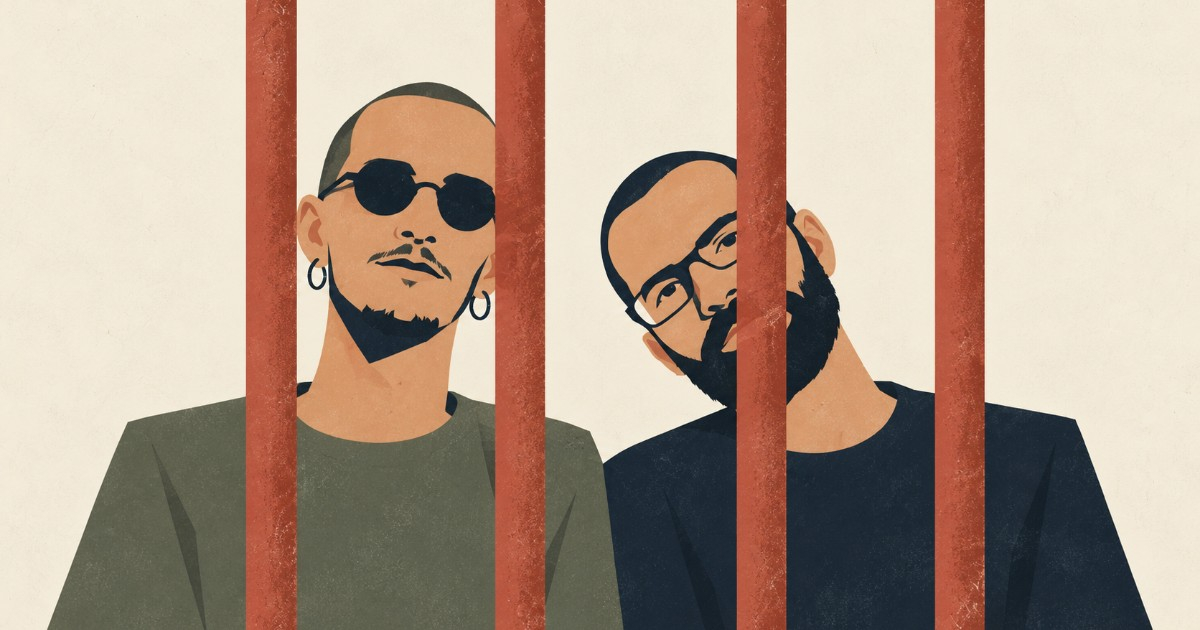
In Cuba, publishing videos against the government, questioning the Communist Party, and denouncing the actions of the Police can result in a criminal charge. This is precisely what the human rights organization Cubalex reports after analyzing the case against the young creators of El4tico, for whom the Cuban regime's Prosecutor's Office is seeking sentences of eight and ten years in prison.
Ernesto Ricardo Medina and Kamil Zayas Pérez have been imprisoned since February 6, 2026. Their work involved producing independent audiovisual content that addressed the economic, social, and political issues in Cuba, questioned government decisions, and promoted public debate.
Now, a legal analysis published by Cubalex on October 7 argues that the Provincial Prosecutor's Office of Holguín is using precisely those critical expressions to build the charges against both young individuals. The organization warns that the process has serious issues related to freedom of expression, the principle of legality, and discrimination based on political opinion.
The provisional conclusions of the Prosecutor's Office are dated September 15 and request eight years of imprisonment for Medina and ten for Zayas. As CiberCuba reported on October 2, the Provincial Court of Holguín has ordered the opening of a trial. The requested sentences do not yet constitute convictions.
The regime turns political criticism into evidence of crime
One of the most concerning aspects of the case file is the use of videos published on Instagram, Facebook, and YouTube to support the crime of propaganda against the constitutional order.
According to Cubalex, the Prosecutor's Office considers relevant for the accusation the publications in which members of El4tico questioned the Cuban reality and the political structures that govern the country.
The organization objects that expressing opinions contrary to the political system does not, in itself, constitute criminal propaganda. Criticizing those in power, reporting social issues, and spreading political opinions are manifestations of freedom of expression, even when they are uncomfortable for the authorities.
The analysis also questions whether the Prosecutor's Office uses the public nature of digital platforms as a circumstance to exacerbate the criminal response. Under this reasoning, the reach of publications could be used to justify a harsher punishment against those who manage to disseminate their criticisms.
The file also contains references to questions raised about the Communist Party of Cuba and the youth's contacts with opposition figures in exile. Among the individuals mentioned in the previous coverage by CiberCuba are Yunior García Aguilera, Carolina Barrero, and Amelia Calzadilla.
Interacting with dissenters, disagreeing with the official discourse, or questioning the Communist Party does not, in itself, constitute the commission of a crime. According to Cubalex, presenting these circumstances as incriminating factors reflects an abuse of criminal law against dissent.
Criticizing the police is also part of the accusation
The second questioned penal figure by Cubalex is that of defamation of institutions and organizations, as well as of heroes and martyrs.
The accusation includes critical expressions from the youth regarding state institutions and the actions of the National Revolutionary Police (PNR), one of the main bodies used by the Cuban authorities to maintain internal control.
Cubalex's analysis warns that turning those criticisms into criminal matters restricts citizens' right to hold authorities accountable and demand responsibility for their actions.
Questioning a public institution does not automatically equate to defaming it. For the organization, the Prosecutor's Office must demonstrate the concrete elements of any alleged crime and not merely punish political expressions that contradict the official narrative.
This distinction is particularly relevant in Cuba, where the Communist Party maintains the constitutional monopoly on political power and independent media operate under strict restrictions. The case of El4tico once again highlights the consequences faced by those who choose to engage in citizen journalism or political criticism without conforming to the state's narrative.
An accusation of incitement that Cubalex considers inaccurate
The third crime attributed to the members of El4tico is incitement to commit a crime.
According to the account from the Prosecutor's Office reviewed by Cubalex, the young people allegedly urged members of the Revolutionary Armed Forces (FAR) and the Ministry of the Interior (MININT) to take power in order to change the constitutional order.
However, the organization identifies a significant legal deficiency: when formulating the accusation, the Prosecutor's Office invokes Article 268 of the Penal Code without sufficiently specifying what the specific crime the defendants are alleged to have instigated is.
For Cubalex, it is not enough to attribute political expressions to the accused. It is necessary to identify the alleged criminal behavior being promoted and to demonstrate that the elements required by criminal law are present.
The questioning is particularly serious when the accusation could result in up to a decade of imprisonment.
In statements collected by Martí Noticias on October 8, Cubalex emphasized that the process serves as an example of the criminalization of freedom of expression and persecution against independent creators.
Eight months imprisoned for a case that human rights organizations consider repressive
Medina and Zayas were arrested on February 6 in Holguín during operations by State Security and the police. During the searches of their homes, technological equipment used to produce and disseminate content was seized, including a computer, a camera, and phones.
Since late March, they have been detained in the Provincial Prison of Holguín, after having gone through police custody.
The reported irregularities began from the moment of the arrests. Cubalex questioned the legality of the home searches and pointed out that the agents did not properly present the corresponding warrant, in addition to warning about the lack of procedural guarantees.
In August, CiberCuba reported on a new complaint from Cubalex as both young individuals had been incarcerated for six months without a public prosecutor's request or a scheduled trial date.
The subsequent presentation of the provisional conclusions does not eliminate the questions regarding the conditions under which they were detained, the extension of preventive custody, nor the basis of the accusations.
The relatives of the young people have also rejected the criminalization of their work. Mileydis Medina Machín, Ernesto's mother, has publicly defended the critical and peaceful nature of the content produced by El4tico and questioned whether their contacts with people in exile could be considered evidence of criminal activity.
The true background: the persecution of independent thought in Cuba
The case of El4tico goes beyond the prosecutors' requests for eight and ten years in prison. It illustrates how the judicial system of the Cuban regime can be used to target those who publicly challenge the power.
The young people did not lead a political party nor did they control a state media outlet. Through an independent audiovisual project, they shared their views on the country's situation and criticized the decisions of their leaders.
For Cubalex, the criminal response to that exercise of expression reveals a much deeper problem: the use of figures from the Penal Code to discourage criticism and punish the dissemination of ideas that contradict the official narrative.
The reported persecution against El4tico is also part of a pattern of criminalization of dissent documented by Cubalex during 2026, which includes legal actions against citizens for posts on social media and other expressions of political dissent.
The right to criticize a government, point out its mistakes, and demand political changes should not lead to a jail cell. That is the fundamental issue raised by the case against Medina and Zayas.
As the judicial process unfolds, both remain in custody. Their families and human rights defense organizations continue to demand their release and the respect of procedural guarantees.
Prison requests still need to be reviewed judicially. However, the analysis by Cubalex already brings to the forefront of the debate a reality repeatedly denounced by Cuban activists: under a system that does not tolerate organized political opposition or independent scrutiny, even a critical video can become the basis for a request for years in prison.
Related videos:
Filed under: