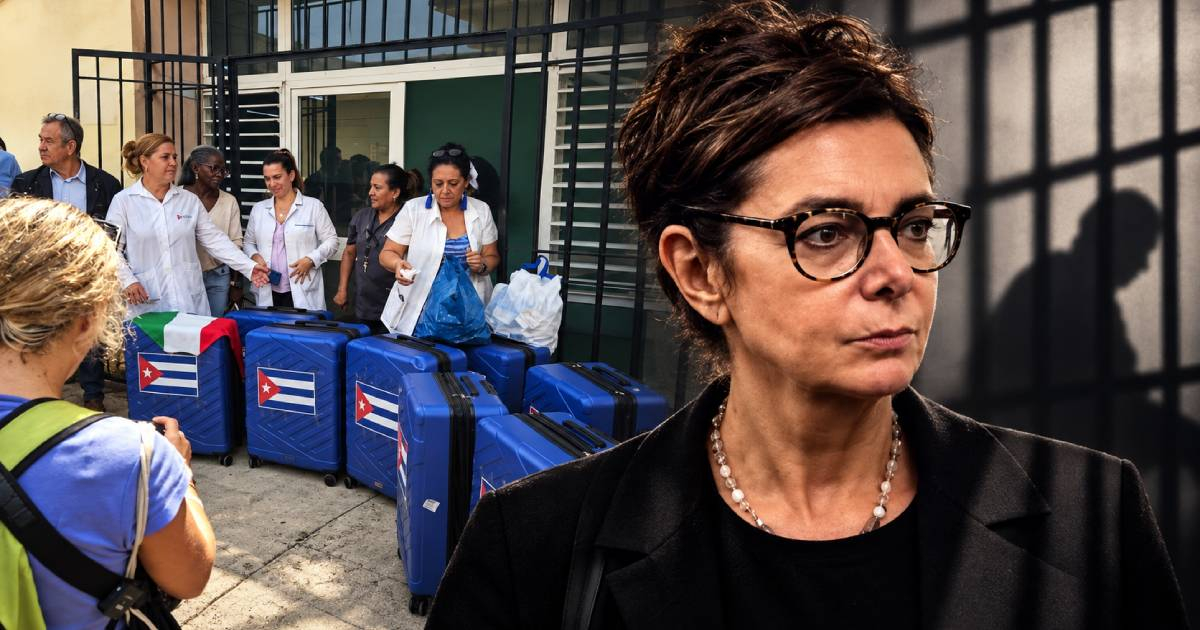
The Italian deputy Laura Boldrini, president of the Human Rights Committee of the Chamber of Deputies, described a Cuba plunged into darkness, scarcity, and the deterioration of its basic services, but attributed the crisis primarily to the sanctions imposed by the United States, without mentioning political repression or the situation of prisoners of conscience on the island.
In an interview published this Thursday by the Italian magazine L'Espresso, the parliamentarian from the Democratic Party (PD) shared her impressions after traveling to Havana as part of a solidarity delegation that also included representatives from the 5 Star Movement.
"The Havana I remembered from my trip in 2006 no longer exists," said Boldrini, who described a capital with hardly any vehicles, dark streets, piled-up garbage, and people rummaging through the waste.
The deputy also recounted scenes of hospitals without medicine and schools without a water supply, where students have to use containers to flush the toilets.
However, when explaining the causes of this deterioration, he focused his criticisms on Washington and stated that the reforms of the Cuban government are unlikely to yield results as long as the U.S. sanctions remain in place.
Boldrini described the restrictions as "collective punishment" against the population and stated that they constitute a crime as outlined in the 1949 Geneva Convention.
He also called on the European Union to pressure President Donald Trump to lift the sanctions and promote a dialogue with the Cuban authorities.
A human rights president who does not mention political prisoners
Despite presiding over the Human Rights Committee of the Italian Chamber, Boldrini did not address in the interview the situation of political prisoners, the arrests of opponents, or the allegations of repression against activists and independent journalists.
The omission occurs while human rights organizations continue to document violations of fundamental freedoms in Cuba.
By the end of August 2026, Prisoners Defenders reported 1,339 political prisoners on the island, while the Cuban Observatory for Human Rights (OCDH) documented over 3,000 repressive actions between January and September.
Among the recent cases is that of the young activist Anna Bensi, who was sentenced on October 1 along with her mother to two years of restriction of freedom for recording and disseminating the visit of a State Security agent to her home.
The interview also does not examine the internal economic decisions of the Cuban government or the lack of investments that have contributed to the deterioration of the energy infrastructure.
This debate includes the management of resources by the military conglomerate GAESA and the aging of thermal power plants, both relevant factors for understanding the crisis beyond the impact of U.S. sanctions.
A solidarity campaign received by Díaz-Canel
Boldrini's visit took place between September 23 and 30 as part of the "Energy for Life" campaign, promoted by Italian organizations such as Arci, ANPI, CGIL, and the Italy-Cuba Friendship Association.
The delegation brought 500 kilograms of medications and school supplies, while the initiative raised 380,000 euros, mainly intended for the purchase of solar panels and other supplies for Cuban institutions.
During their stay, the lawmakers were received by Miguel Díaz-Canel, who publicly thanked the Italian assistance and highlighted the ties between the two countries.
Boldrini's position also contrasts with the stance recently expressed by the European Parliament.
On September 17, the European Parliament approved, with 374 votes in favor, 198 against, and 19 abstentions, a resolution demanding the release of opposition figures Félix Navarro and Saylí Navarro and calling for measures to address human rights violations in Cuba.
On the other hand, the Foreign Affairs Commission of the Italian Chamber unanimously approved a resolution from the Democratic Party to strengthen humanitarian aid to the Cuban population on Wednesday. The initiative proposes to enhance cooperation in the areas of medicine, fuel for healthcare services, and maternal and child care.
Related videos:
Filed under: