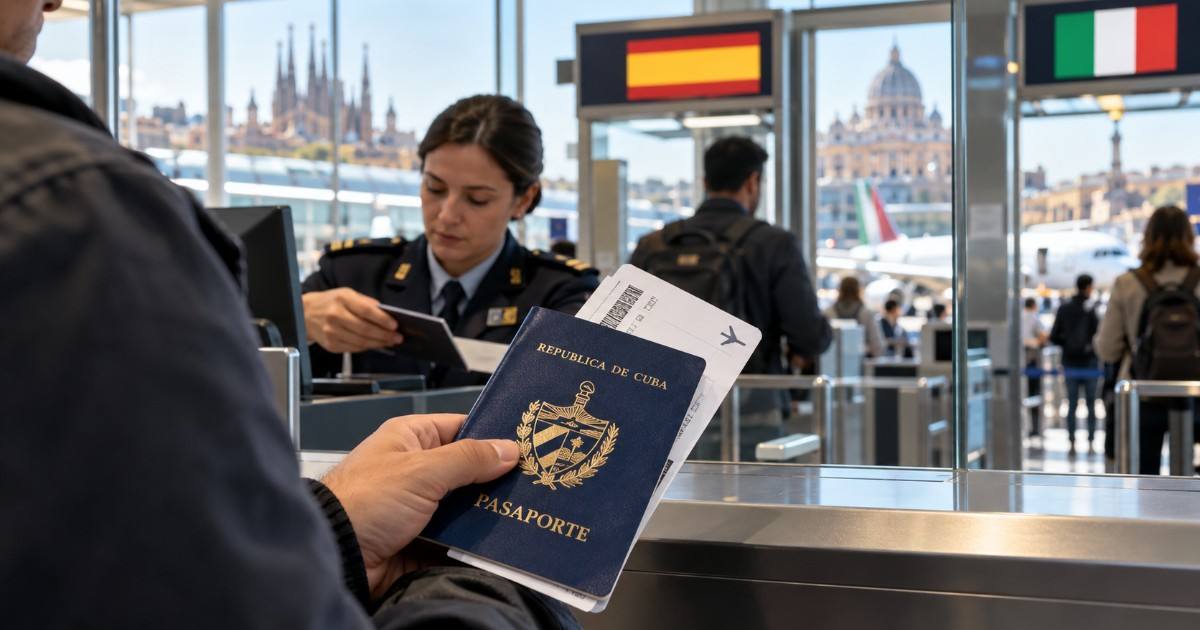
Spain has extended the temporary border controls for passengers arriving from Italy by air or sea until October 22, 2026, a measure that also impacts Cubans traveling between the two countries and requires special attention to immigration documentation.
The new extension is included in the Order INT/1033/2026 published in the Official State Gazette, which states that the controls will continue from 00:00 on October 8 until 24:00 on October 22.
The decision prevents the Spanish controls from ending on October 7, as had been previously planned.
CiberCuba explained this week what documentation must be carried by Cubans traveling between Spain and Italy and had warned that the Spanish measure would expire on October 7 unless the government approved a new extension.
That is precisely what has happened.
What connections are subject to controls?
The extension does not indiscriminately affect all travelers entering Spain from any European country.
The order maintains the same terms set when Spain reinstated controls on August 8. These apply to people arriving in Spain from Italy via passenger flights or maritime connections.
Specifically, flights whose last departure airport before arriving in Spain is located in Italian territory are included, as well as ships, ferries, and other passenger maritime services whose last departure port is in Italy.
The measure does not refer to a land border between Spain and Italy, which does not exist, nor does it transform all movements within Schengen into crossings of an external border.
It doesn't mean that Spain has closed the border
The extension does not mean that Spain has closed its borders with Italy, nor that both countries have stopped being part of the Schengen Area.
The general principle within Schengen remains the free movement without internal border controls, but European regulations allow states to temporarily reestablish those controls when they deem there is a serious threat to public order or internal security.
In practice, this means that a person traveling from Italy to Spain may be required to present their documentation even though it is a journey between two countries in the Schengen area.
Why does Spain maintain the controls?
The Spanish Government claims that the reasons of urgency and serious threat to public order and internal security that initially led to the adoption of the measure still persist.
The original order from August linked the decision to the migration pressure arising from the central Mediterranean route and the associated risks of irregular movements within the Schengen area, as well as the use of these routes by criminal organizations and potential security threats.
The new order does not change those arguments and maintains that the circumstances that justified the controls are still present.
What should a Cuban with a Schengen visa take with them?
For a citizen traveling solely with a Cuban passport, the extension does not create a new visa nor does it require obtaining a special permit to travel from Italy to Spain.
You must travel with your valid Cuban passport and the corresponding valid Schengen visa, when necessary, as well as being able to prove that you are legally residing within the Schengen area.
Authorities may also request, when appropriate, documentation related to the purpose of stay, accommodation, financial means, or travel plans.
A valid uniform Schengen visa generally allows travel within the countries of the area for the authorized days while respecting the applicable stay limits.
Cubans residing in Spain or Italy
Cuban citizens who are legal residents in Spain, Italy, or another Schengen State must carry a valid travel document and their current residence card or authorization.
The Spanish Ministry of the Interior states that foreign residents in a Schengen State can travel to other countries within the area for a general maximum of 90 days within any 180-day period, provided they meet the corresponding conditions.
The existence of temporary controls does not eliminate that right, but it makes having the necessary documents available during the journey particularly important.
Cubans with Spanish citizenship
Those with dual Cuban and Spanish citizenship can prove their status as citizens of the European Union with their valid Spanish ID or valid Spanish passport.
In a situation of temporary controls within Schengen, it is advisable to use Spanish documentation to directly prove the right to free movement as a European citizen.
And the Cuban Americans?
Cubans who are also U.S. citizens and travel with a United States passport remain subject to the regulations applicable to U.S. travelers for short stays in Schengen.
The existence of these temporary controls does not, by itself, create an obligation to obtain an additional Spanish or Italian visa; however, the traveler must carry a valid passport and be able to demonstrate that they meet the legal conditions for stay.
These controls should not be confused with ETIAS. CiberCuba recently explained which Cubans will be subject to ETIAS and who will still need a visa to travel to Europe.
Italy also maintains controls over arrivals from Spain
The Spanish measure is not the only one in effect between the two countries.
Italy linked the decision to the migratory situation concerning Ceuta, potential secondary movements within the European space, and considerations of internal security.
This means that a traveler may encounter controls both when traveling from Italy to Spain and, during the relevant period, when moving in the opposite direction.
Could you finish before October 22nd?
Yes. The Spanish order stipulates that the measure will be subject to ongoing evaluation and may be lifted before October 22 if the threats that justified its adoption disappear or if they can be addressed through less restrictive measures.
It is also made clear that the controls cannot be automatically extended after October 22.
If the Government wanted to extend them beyond that date, it would have to approve a new justified decision and conduct another assessment of their necessity and proportionality.
Therefore, Cubans planning to travel between Spain and Italy in the coming weeks should check shortly before their departure that their passport, visa, or residency permit is valid and review any potential new updates from the authorities.
Related videos:
Filed under: