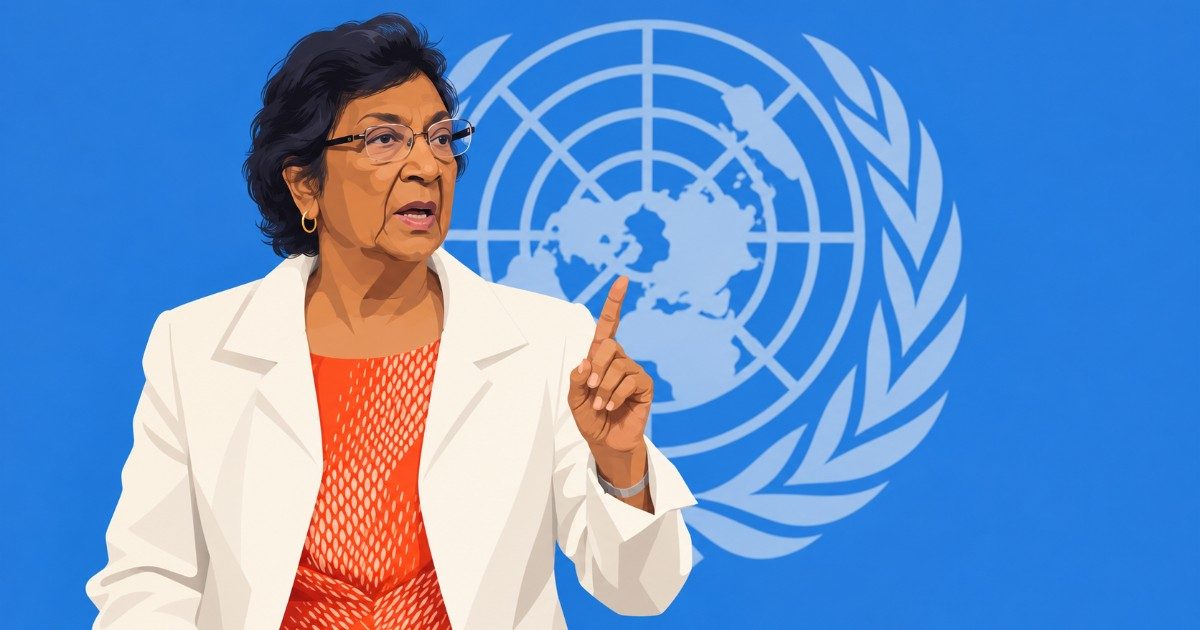
The South African jurist Navanethem "Navi" Pillay was honored this Friday, October 9th, with the Nobel Peace Prize 2026 for her efforts to promote peace and international law. The Norwegian Nobel Committee recognized a dedication to defending human rights and seeking accountability for war crimes, crimes against humanity, and genocide.
The official announcement, made in Oslo, highlighted the courage and integrity of Pillay, 85 years old, and her contribution to strengthening international judicial institutions. The Committee noted that her work demonstrates the importance of resolving conflicts through law rather than violence.
According to the official review of the laureate, Pillay has contributed to developing mechanisms to hold states and leaders accountable, as well as to provide justice for victims of serious human rights violations.
From the fight against apartheid to international tribunals
Born in Durban, South Africa, in 1941, to a Tamil Indian family, Pillay grew up under the racial segregation system of apartheid. In 1967, she opened her own law firm and defended activists opposing the regime, including Nelson Mandela, before starting a career in the judiciary.
In 1995, she was appointed as a judge of the Supreme Court of South Africa. She also served on the International Criminal Tribunal for Rwanda, where she presided from 1999 to 2003. Her work in that institution helped establish precedents regarding the prosecution of sexual violence and rape as potential acts constituting genocide and crimes against humanity.
She later served as a judge at the International Criminal Court and, from 2008 to 2014, held the position of United Nations High Commissioner for Human Rights, a role in which she denounced abuses and advocated for compliance with international standards for the protection of individuals.
His role in the investigations regarding Gaza
One of the more recent chapters of his career was the presidency, from 2021 to 2025, of the United Nations Independent International Commission of Inquiry on the Occupied Palestinian Territories, including East Jerusalem, and Israel.
In a report presented in September 2025, that commission concluded that Israeli authorities and forces had committed acts of genocide against the Palestinian population of the Gaza Strip. Israel categorically rejected those findings and questioned the impartiality of the commission.
It was a conclusion from an independent investigative mechanism established by the UN Human Rights Council, not a judicial ruling. The Nobel recognition of Pillay is based on the entirety of her career and not solely on that report.
The jurist also serves as an ad hoc judge at the International Court of Justice in the case brought by Gambia against Myanmar, concerning allegations of genocide against the Rohingya population. This role is distinct from her previous positions in international criminal tribunals.
An award in defense of international law
The Nobel Committee explained that its selection aims to emphasize the necessity of protecting international justice at a time of wars, conflicts, and political pressures on judges and institutions. For the organization, the ability to hold accountable those who commit atrocities and to recognize the rights of victims is an essential condition for building peace.
This year's prize is endowed with 12 million Swedish kronor, according to the Nobel Foundation. The award ceremony is scheduled for December 10 in Oslo. In the 2026 edition, there were 287 nominations: 208 individuals and 79 organizations.
Pillay succeeds the Venezuelan opposition leader María Corina Machado, winner of the Nobel Peace Prize 2025 for her defense of democratic rights in Venezuela. That recognition prompted a strong reaction from the Cuban leader Miguel Díaz-Canel, who accused the Nobel Committee of political bias.
Related videos:
Filed under: