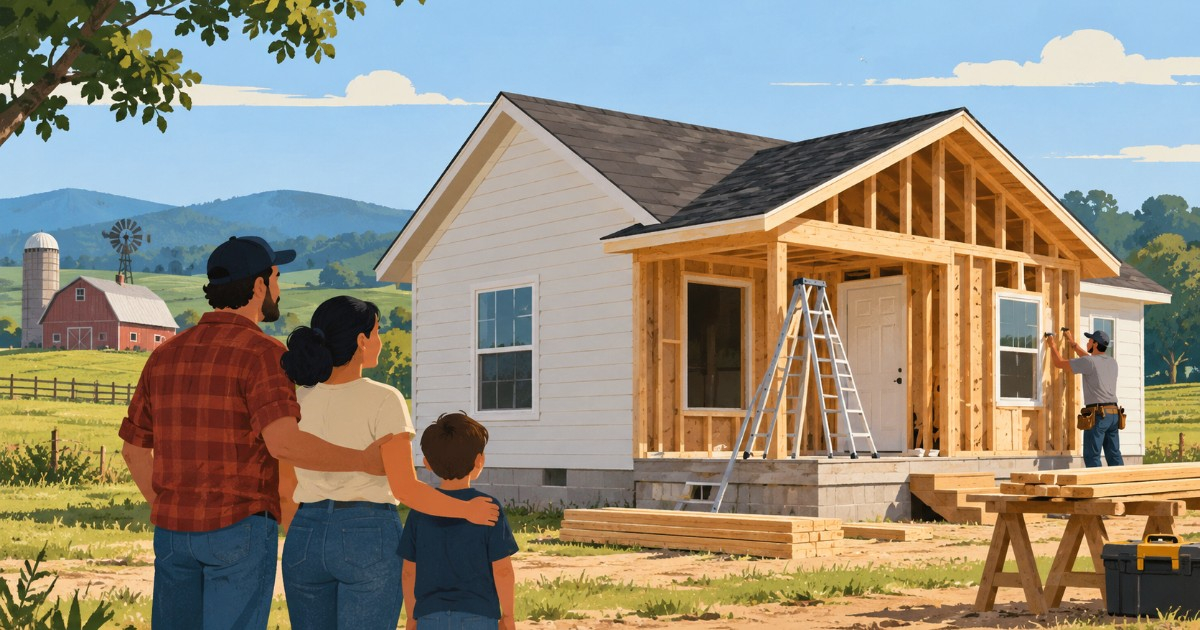
The United States Department of Agriculture (USDA) announced this Friday, October 9, that it has committed 28 million dollars for fiscal year 2026 to support construction and rehabilitation projects for housing in rural areas aimed at families with low and very low incomes.
According to the official statement, the resources pertain to the federal program for technical assistance for homes built through mutual help. The grants fund the work of organizations that advise and supervise groups of families during the construction process, not cash disbursements to individuals.
The administrator of the Rural Housing Service, George Kelly, stated that the program supported the development of 579 new homes and the rehabilitation of another 181. These results were reported by the agency concerning funds committed during the fiscal year, not a newly opened call for receiving checks or individual assistance.
How the rural housing program works
The initiative, called Mutual Self-Help Housing Technical Assistance Grants and known as Section 523, provides grants to public or private non-profit organizations and tribes recognized by the federal government.
These entities organize groups of families who participate in the construction of their homes and collaborate on the work of others. The organizations provide technical assistance, coordinate tasks, supervise the projects, and help participants with financing procedures.
The official program rules state that Section 523 grants cannot be used to purchase land or construction materials, pay off participant debts, or hire workers to perform the work on their behalf.
The USDA also indicated that the technical assistance from beneficiary organizations supported the construction of 155 homes financed through direct loans from the Section 502 program. The statement does not specify whether those houses are included among the 579 new homes in the overall balance.
Who can benefit and how to participate
Families do not directly apply for the 28 million dollars. To participate in a mutual aid construction project, they must find an organization that develops the program in an eligible rural area and meet the corresponding requirements, including those related to income.
A funding option that can support these projects is the Section 502 Direct Loan. This mortgage program, different from grants for organizations, is aimed at low and very low-income households that meet certain requirements.
Among the conditions for obtaining this loan are the income limits for the area, the ability to assume and repay the debt, the intention to use the home as the primary residence, and compliance with citizenship or eligible immigration status requirements. The property must also be located in a rural area approved by the USDA.
What options are available in Florida?
The USDA has a specific page for the program in Florida, with information about how it works and the offices that serve each region of the state.
The presence of the program in Florida does not mean that any resident of the state can access housing or that all municipalities are eligible. Interested parties can enter an address in the official USDA eligibility map, although the final decision rests with the agency when evaluating an application.
For residents of South Florida, the USDA identifies the Royal Palm Beach office as a point of contact for counties such as Miami-Dade, Broward, and Palm Beach. Their published phone number is 561-792-2727. The assignment of an office to a county does not imply that a residence located anywhere within that territory qualifies as rural.
The federal announcement should not be confused with Hometown Heroes, the assistance program for homebuyers in Florida reported by CiberCuba in July, which operates under different rules and funding.
The USDA reallocated seven million dollars
As part of the distribution of the 28 million dollars, the department moved seven million from low-performing mutual aid project supervision contracts to direct grants for the participating organizations. This reallocation is part of the announced funds and does not represent an additional seven million.
Those who want to learn about the available projects and participation procedures can check the USDA office corresponding to their area to see if any organization is currently offering a mutual self-help housing construction project in an eligible rural location.
Related videos:
Filed under: