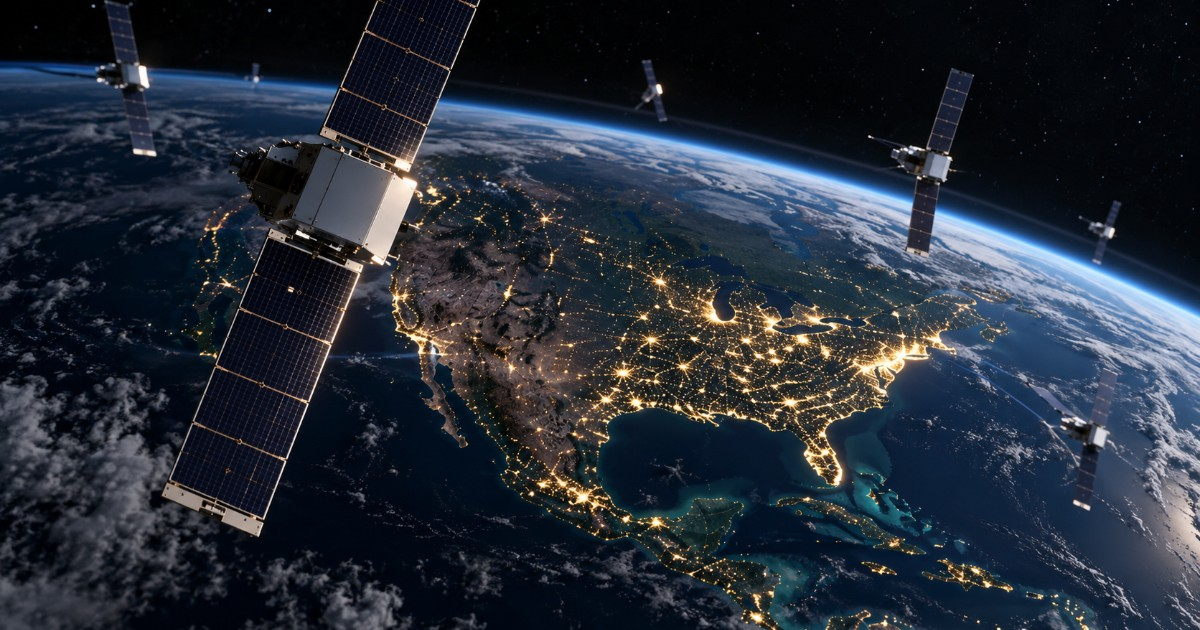
SpaceX, Elon Musk's company, wants to turn Starlink Mobile into an alternative to the major telephone operators in the United States, such as AT&T, Verizon, and T-Mobile. The company announced an agreement to acquire mobile phone frequencies that would allow it to combine its satellite network with terrestrial infrastructure and improve signal reception inside buildings.
The investment firm Grain Management announced on Thursday, October 8 that it will sell 100% of its nationwide spectrum license portfolio in the 800 megahertz (MHz) band to SpaceX. The deal still requires approval from the Federal Communications Commission (FCC) and fulfillment of other conditions, so the purchase is not yet finalized.
In its statement of October 8, SpaceX specified that the agreement includes up to 14 MHz of paired spectrum in the 800 MHz band, a resource it considers essential for establishing a mobile network capable of connecting devices both from space and from the ground.
The licenses stem from a previous operation: Grain Management acquired that T-Mobile portfolio in August 2026, in exchange for cash and its own spectrum in the 600 MHz band, the company explained.
What would change for mobile phone users?
The Starlink Mobile proposal aims to combine satellites and terrestrial networks to expand connectivity options. The frequency bands serve different functions: the 2 GHz band would help provide greater data transmission capacity, while the 800 MHz band would offer a coverage layer with better penetration through walls and other obstacles.
This last point is particularly important in buildings and areas where mobile signals often weaken. SpaceX claims that most existing phones are already compatible with that band, although this technical compatibility does not mean they can automatically subscribe to or use the future service.
The company seeks to strengthen its presence in rural areas, along highways, and in regions with irregular coverage, but it also aims to operate in urban environments. To compete broadly with established companies, it would need to deploy ground infrastructure, obtain the necessary permits, and finalize its commercial offer.
Starlink is already involved in direct connections between satellites and conventional phones through agreements with operators like T-Mobile. The new development is its intention to create a hybrid network with its own frequencies, without implying that it has ceased collaborating with its current partners.
The FCC gives partial approval to a constellation of 15,000 satellites
The announcement of the purchase coincides with another regulatory advance. On October 6, the FCC partially and conditionally approved SpaceX's application to deploy and operate a new constellation of up to 15,000 satellites intended for direct communication with devices. Some of the company's requests remain pending resolution.
This is a different decision from the agreement to purchase the 800 MHz frequencies, which still requires the appropriate authorization. The approval of the constellation also does not mean that the 15,000 satellites are already in orbit or that a fully deployed commercial network exists.
SpaceX claims that its upcoming second-generation Starlink Mobile satellites could provide over 100 times the bandwidth of the current generation. This is a forecast of technological capability announced by the company, not a verified connection speed for consumers.
When will it be possible to subscribe to Starlink Mobile?
For now, SpaceX has not announced pricing, phone plans, or a specific date for the general launch of its new hybrid network in the United States. There is also no verified comparison of prices or service quality that would allow one to claim it will be cheaper or better than AT&T, Verizon, or T-Mobile.
Its arrival in the market will depend on the completion of frequency acquisitions, the construction of infrastructure, the progress of next-generation satellites, and the applicable regulatory conditions.
What does this announcement mean for Cuba?
The spectrum agreement announced by SpaceX pertains to the United States and does not involve the launch or authorization of Starlink Mobile in Cuba, where ETECSA controls state telecommunications.
In March 2026, Elon Musk stated that Starlink technology could operate in Cuba, although it was not officially marketed on the island. That statement did not mean that any Cuban phone could connect directly to the satellites.
The purchase of U.S. frequencies does not change that situation either: in order to use satellite mobile services in a territory, the necessary technical, commercial, and regulatory conditions must be in place.
Related videos:
Filed under: