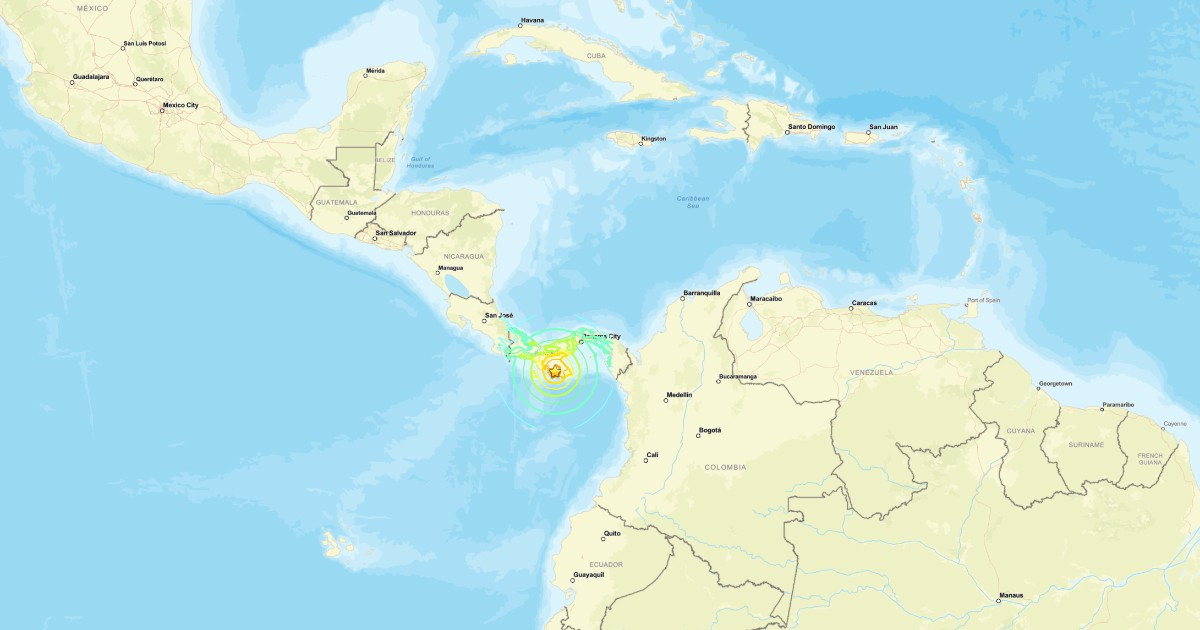
A 7.6 magnitude earthquake shook Panama this Friday, October 9, 2026, at 12:56 p.m. local time, according to the revised data from the United States Geological Survey (USGS). The strong tremor was recorded near Pitaloza Arriba, in the province of Herrera, and raised concerns about a possible tsunami threat in areas along the Pacific coast.
The epicenter was located by the USGS approximately ten kilometers west-southwest of Pitaloza Arriba, with an estimated depth of 10 kilometers. The magnitude was initially reported as 8.0 but was later revised to 7.6. Both the location and other seismic parameters may be adjusted as more records are analyzed.
The tremor was felt even in Panama City, where buildings shook and some people took to the streets after evacuating buildings. The Associated Press reported on these evacuations as residents awaited information on the consequences of the earthquake.
NOAA issued an initial advisory for a possible tsunami
The Pacific Tsunami Warning Center (PTWC), part of the National Oceanic and Atmospheric Administration of the United States (NOAA), issued an initial message shortly after the earthquake regarding the potential for dangerous waves in certain areas along the Pacific coast.
The initial bulletin, released at 18:01 UTC (1:01 p.m. in Panama), included in its assessment the coastal areas of Panama, Costa Rica, Colombia, Ecuador, Peru, Nicaragua, El Salvador, Guatemala, and Mexico. It featured estimated arrival times for a potential initial wave at points along the Panamanian coast, including Punta Mala, Puerto Piña, Punta Burica, and Balboa Heights.
These hours are projections of a possible scenario, not measurements that confirm the arrival of a tsunami. An initial warning does not mean that all the mentioned countries have declared alerts or national evacuations. The threat should be reassessed as specialized agencies receive data on sea level.
The PTWC message is directed at national authorities, who are responsible for determining the applicable measures in their territory. To learn about the most recent assessment, the latest bulletins from NOAA and the guidance from the National Civil Protection System of Panama (Sinaproc) should be consulted. The initial warning may be modified or canceled; it should not be automatically interpreted as a continuing alert.
First reports after the earthquake
In its initial report, the Associated Press did not yet have a complete tally of potential victims or material damage. The images and accounts beginning to circulate on social media need to be verified before being attributed to this earthquake.
The risk mentioned in the first bulletin refers to areas of the Pacific Ocean. It should not be confused with the warnings that, in other instances, have affected the Caribbean. In February 2025, for instance, CiberCuba reported the cancellation of a tsunami warning in the Caribbean following an earthquake north of Honduras. This was a separate event.
What to do if you find yourself in a coastal area
The NOAA recommends that people located near the sea who have felt a strong or prolonged tremor should move away from the coast and seek higher ground or head inland as soon as it is safe to do so, without necessarily waiting for an official warning.
It is also advised to stay away from beaches, ports, and river mouths, to follow the instructions of local authorities, and not to return to evacuation areas until they give permission. A tsunami can arrive in multiple waves, and the first one is not necessarily the largest.
Related videos:
Filed under: