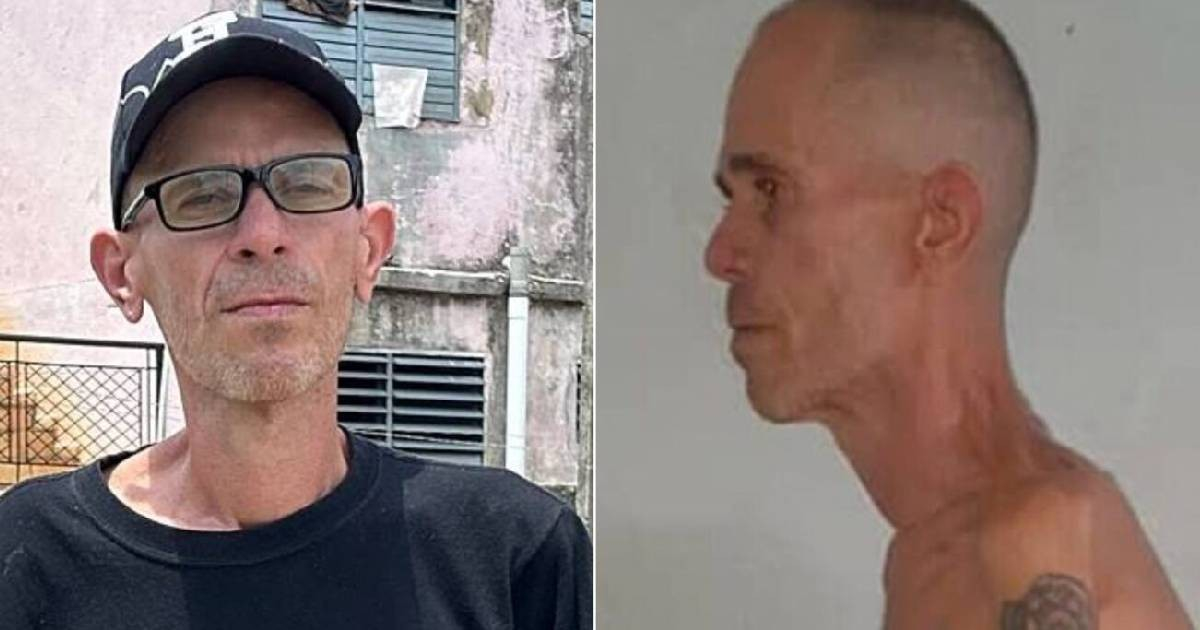
The Cuban regime has once again detained Alexander Díaz Rodríguez, a political prisoner from the 11J suffering from cancer, amidst a campaign for the U.S. government to grant him a humanitarian visa that would allow him to receive oncology treatment outside the island, according to Telemundo 51 this Thursday.
The detention, the exact circumstances of which have not been independently confirmed by the time of this report, represents at least the third arbitrary arrest that Díaz Rodríguez has faced since his release in April, and follows the documented pattern of systematic harassment that the regime applies to the political prisoners from 11J.
Díaz Rodríguez, 45 years old and a resident of Artemisa, fully served a five-year sentence in Kilo 5 and a Half prison in Pinar del Río, after being arrested during the protests on July 11, 2021, in Cárdenas, Matanzas, and sentenced for "sedition" and "disobedience."
Released on April 12 in a devastating physical condition: he had dropped from weighing 81 kilograms upon entering to just 37 upon leaving, a loss of 44 kilograms in five years.
During his confinement, he was diagnosed with malignant thyroid cancer, contracted hepatitis B, developed anemia and severe malnutrition, and reported systematic torture: beatings that fractured his ribs and teeth, being placed in between 11 and 12 punishment cells, a hunger strike lasting over thirty days, and prolonged isolation.
The authorities repeatedly denied him the extrapenal license, considering him "counter-revolutionary."
"I left under extreme conditions. I have to pay rent, I can't find work, I’m being pursued by State Security, I’ve fallen ill, I was diagnosed with cancer," Díaz Rodríguez himself reported in a video released in May.
Repression did not cease with his release. In July, State Security agents detained him along with another activist as they were heading to a reception at the U.S. Embassy in celebration of the anniversary of American independence.
He remained cut off from communication for almost three days and reported beatings, forced nudity, and mock executions.
"I was kidnapped. I was stripped naked. I was beaten. They pointed a gun at me, simulating Russian roulette," he recounted in a video shared by Prisoners Defenders.
The case had attracted unusually direct diplomatic attention from Washington. Mike Hammer, the chief of mission at the U.S. Embassy in Cuba, personally visited him in Artemisa on June 1, with State Security agents stationed at nearby corners. "What this man has suffered is inexplicable."
"The United States will continue to insist on the release of all those who remain unjustly imprisoned," Hammer stated.
Since mid-April, the Embassy had been evaluating a possible humanitarian visa for Díaz Rodríguez to receive treatment in the U.S.
A petition on Change.org gathered over 500 signatures in support of this request, arguing that staying in Cuba poses a life-threatening risk due to the progression of cancer and the chronic shortage of oncological medications on the island.
The humanitarian visa mechanism exists and has been applied to other prisoners from the 11J: activist Sissi Abascal arrived in Miami in May through this process, managed by the Legal Rescue Foundation and the Department of State, although approval for Díaz Rodríguez has not been confirmed.
Cubalex documented 86 repressive incidents linked to the U.S. Embassy between January and September 2026, with an increase in the hours leading up to diplomatic events.
Prisoners Defenders recorded 1,356 political prisoners in Cuba as of October 7, 2026, with 338 individuals imprisoned specifically for their involvement in the 11J by the end of June.
The mother of Alexander, Morayma Rodríguez Batista, has been repeatedly pressured by State Security to stop reporting the case.
Her response was emphatic: "With me, it's out of passion; I don't plan to stop speaking out and protesting for Alexander."
Related videos:
Filed under: