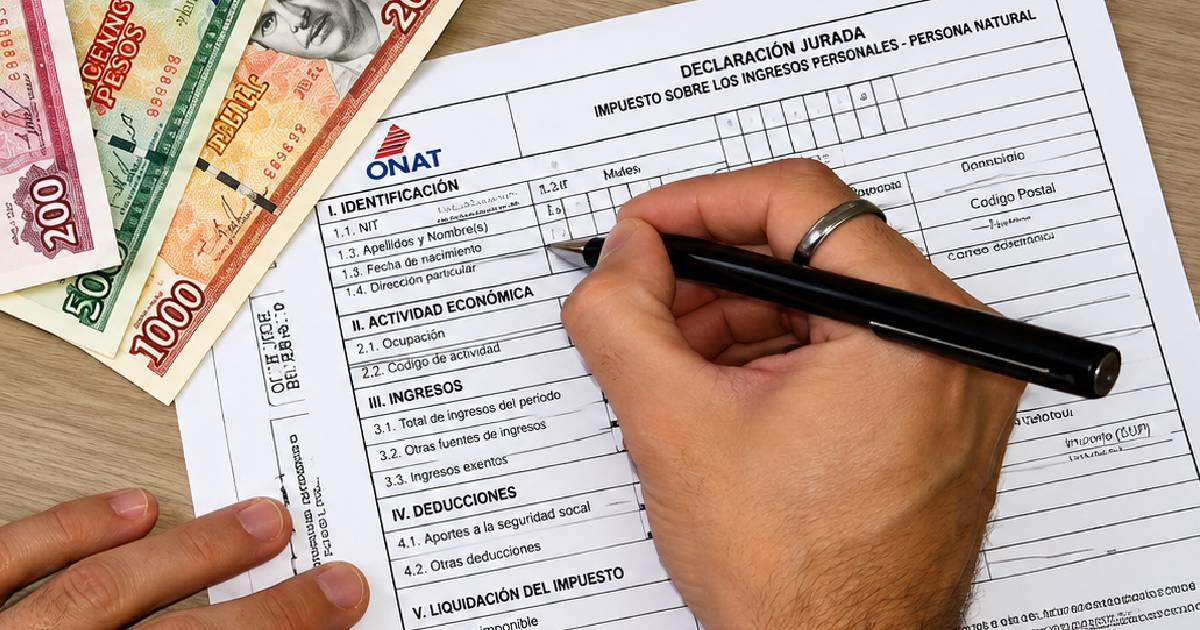
The Cuban regime announced this Friday that it has a legal arsenal to combat tax evasion, which includes freezing bank accounts, confiscating assets, and even initiating criminal proceedings with penalties of up to five years in prison.
According to the state media Cubadebate, Cuban authorities —including the Attorney General's Office— publicly outlined the mechanisms available to ensure that "no case of tax evasion goes unpunished."
The official article, presented as a legal explanation, effectively serves as a public warning directed at taxpayers, particularly self-employed workers and the small and medium-sized private enterprises that have proliferated since 2021.
The most aggressive instrument is the so-called "collection order without acceptance," created by Resolution 126/2026 of the Ministry of Finance and Prices. This figure allows the National Office of Tax Administration (ONAT) to request direct debit of firm tax debts from banks without the need for the account holder's consent.
In the case of legal entities, the debit operates on the current account; for individuals engaged in economic activities, it applies to the Tax Bank Account. However, in cases of underreporting or confirmed evasion, the measure can even extend to the personal accounts of the debtor, following a prior warning.
If the available balance does not cover the total amount owed, the bank is authorized to make partial and successive debits until the full amount is settled. If 10 business days pass without payment or a deferral agreement, the ONAT may issue a seizure order on movable property, real estate, credit rights, salaries, and bank accounts.
Administrative sanctions have also become stricter: the modifications published in the Official Gazette at the end of 2025 raised fines up to 40% of the total owed, in addition to the interest for late payment.
In criminal law, Article 319.1 of the current Penal Code punishes tax evasion with one to three years of imprisonment, a fine of 300 to 1,000 units, or both. If the crime causes serious harm to the State Budget, the penalty increases to two to five years. The use of deceit, accounting forgery, or other intentional maneuvers can also result in a prison sentence of two to five years.
The question that Cubadebate itself raises—whether paying the debt prevents criminal proceedings—has a conditional answer: Article 323.2 of the Penal Code states that "if the person pays the debt before the oral trial concludes, the court may file the proceedings or reduce the minimum and maximum limits of the penalty, provided that no fraudulent means or procedures have been used to evade, obstruct, or delay the collection by the ONAT."
The figures provided by the regime reveal the magnitude of the problem it seeks to address. By the end of November 2025, the ONAT had detected debts amounting to over 10,914 million pesos, with 171 reports of alleged evasion and 179 cases processed that year for possible tax offenses.
In a previous report, the Attorney General's Office stated that 30 cases were directly referred to criminal proceedings.
The ONAT can also request that individuals be prohibited from leaving the country for failing to fulfill their tax obligations, and it has the authority to order the temporary or permanent closure of establishments and revoke licenses for underreporting or evasion.
All this legal framework unfolds in a context of severe economic crisis, with a state that urgently needs revenue to sustain a bankrupt budget, and has chosen to tighten the tax pressure on the private sector instead of reforming the structures that have sunk the Cuban economy for decades of dictatorship.
Related videos:
Filed under: