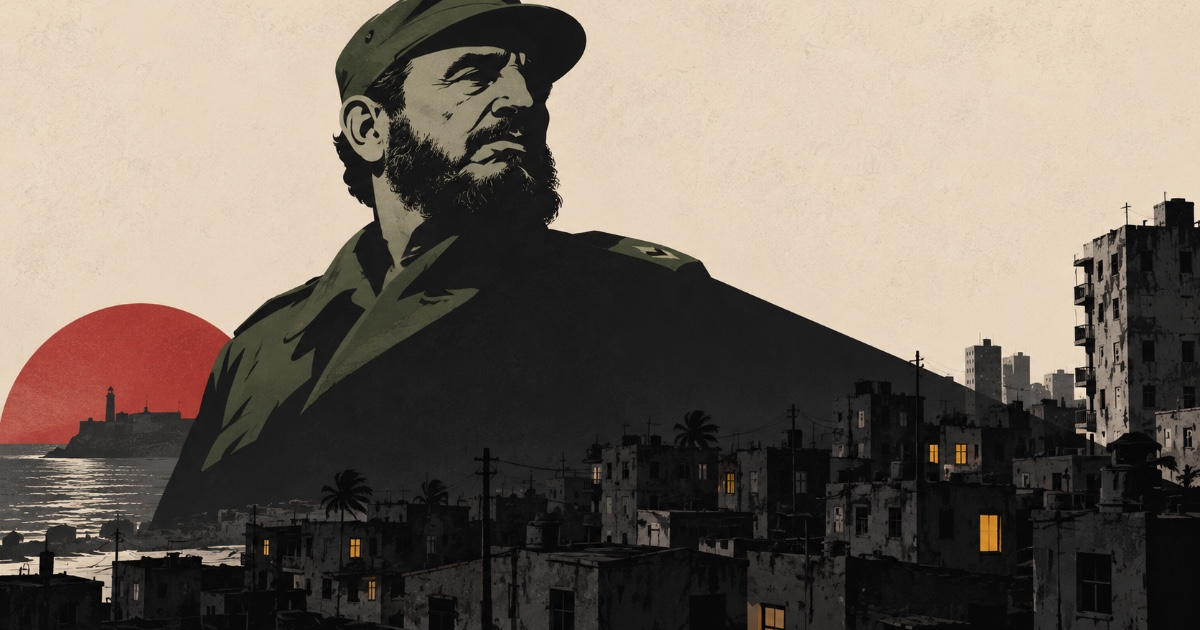
The Cuban News Agency (ACN) invited people on October 10 to admire Fidel Castro's "inexhaustible legacy." They did this with a photograph of the leader and an excerpt from a 1968 speech calling for the defense of the Revolution and the strengthening of revolutionary thought. The hashtag #100YearsWithFidel accompanied the tribute. Meanwhile, for the same Saturday, the Cuban electrical system forecasted an impact of 1,680 megawatts during peak demand hours. The slogans, it seems, maintain a much more stable availability than electricity.
The message disseminated by ACN on X reproduces part of Castros's address at La Demajagua, delivered on October 10, 1968, to commemorate the centenary of the start of Cuba's independence wars. The agency recalls his exhortation to "defend the Revolution against imperialism," but leaves the quote with ellipses before one of his most significant promises: "to carry forward the battle against underdevelopment."
That last sentence appears in the 1968 speech, preserved in a historical edition by the National Congress Library of Chile. The ACN's selection encompasses the defense of power and ideological formation; the battle against poverty has been left out of the picture. And precisely that was one of the promises that deserved to be put under scrutiny.
The harvest that was supposed to be won
In that same intervention, Castro stated that the goal of producing ten million tons of sugar was "practically a battle won." Two years later, the 1970 harvest concluded with around 8.5 million tons: an extraordinary volume, but insufficient to reach the objective. In a speech from July 1970, Fidel himself acknowledged that the sugar production effort had caused imbalances and declines in production in other sectors.
The contrast with the present is even more pronounced. The Cuban harvest for 2024-2025 did not exceed 150,000 tons, according to calculations by EFE based on official information. This is not a definitive global figure released by the Government, but rather an estimate based on the available partial results. The country that dreamed of ten million tons didn’t even reach a small fraction of that goal.
The year of that speech was also the year of the so-called Revolutionary Offensive, driven by Castro in March 1968. According to data from the official press of the time gathered by the economist Óscar Espinosa Chepe, the State intervened in 55,636 small businesses, including corner stores, cafés, barbershops, and workshops. The centralization of these activities was a political decision made by the founder of the system, not a problem inherited by accident.
Underdevelopment continues to take its toll
The United Nations World Food Program today describes a Cuban economy that has lost 15% of its gross domestic product over the past six years, marked by inflation, fuel shortages, and difficulties in accessing food. The organization also notes that the state basic basket relies almost entirely on imports and that the government itself acknowledges shortages and delays in its distribution.
In July 2026, the Ministry of Labor and Social Security established a minimum wage of 3,210 Cuban pesos per month through Resolution 14/2026. Two months later, the National Office of Statistics and Information (ONEI) reported that the year-on-year inflation for August reached 25.19%, with a monthly increase of 4.92%. These figures correspond to the official index, which does not necessarily reflect the full price escalation in the informal market. The minimum wage can be modified by decree; however, the cost of making ends meet does not adhere to the same regulations.
Electricity provides another measure of the gap between rhetoric and everyday life. The report from the National Electric System dated October 10, 2026 reported an availability of 1,250 MW in the early hours, compared to a registered demand of 2,470 MW, and forecasted a deficit of 1,650 MW during the night peak, with a forecasted impact of 1,680 MW. On October 9, the service had been affected for 24 hours. The so-called energy battle, unlike anniversary slogans, has a measurable cost in households without electricity.
A country that is losing its population and punishing dissent
The demographic balance does not lend itself easily to a triumphant celebration. According to the figures presented by the ONEI and reported by CiberCuba, the effective population of the island decreased to 9,434,593 inhabitants by the end of 2025: 313,414 less than the previous year. There were 68,064 births compared to 136,214 deaths; migration was another decisive factor in the population loss. It is the official records themselves that document an increasingly empty and aging Cuba.
And while the state media calls for the defense of the Revolution, many Cubans still cannot question it freely. Human Rights Watch reported in July 2026 that the organizations Justicia 11J and Prisoners Defenders estimated there are around 800 political prisoners in Cuba, nearly half related to the protests of July 11, 2021. The organization has denounced sentences for exercising fundamental freedoms, mistreatment, and ongoing restrictions on dissent.
Attributing every malfunction of a power plant or every decision made by the current ministers to Fidel Castro would be to oversimplify history. However, it would also be absurd to disconnect him from the political and economic system he built, from the mass elimination of small businesses, from the monopoly of the Communist Party, and from decades of centralized planning. Raúl Castro and Miguel Díaz-Canel have upheld that model and are responsible for their own decisions and the continuity of its outcomes.
The proclaims the Communist Party as the superior leading political force of society and the State and declares the socialist system irrevocable. This is a very specific part of the legacy that remains intact. Nearly six decades after the promise to overcome underdevelopment, the country continues to count lost megawatts, inhabitants leaving, and products that do not arrive. At least one thing seems truly inexhaustible: the official willingness to celebrate achievements without accounting for their results.
Related videos:
Filed under: