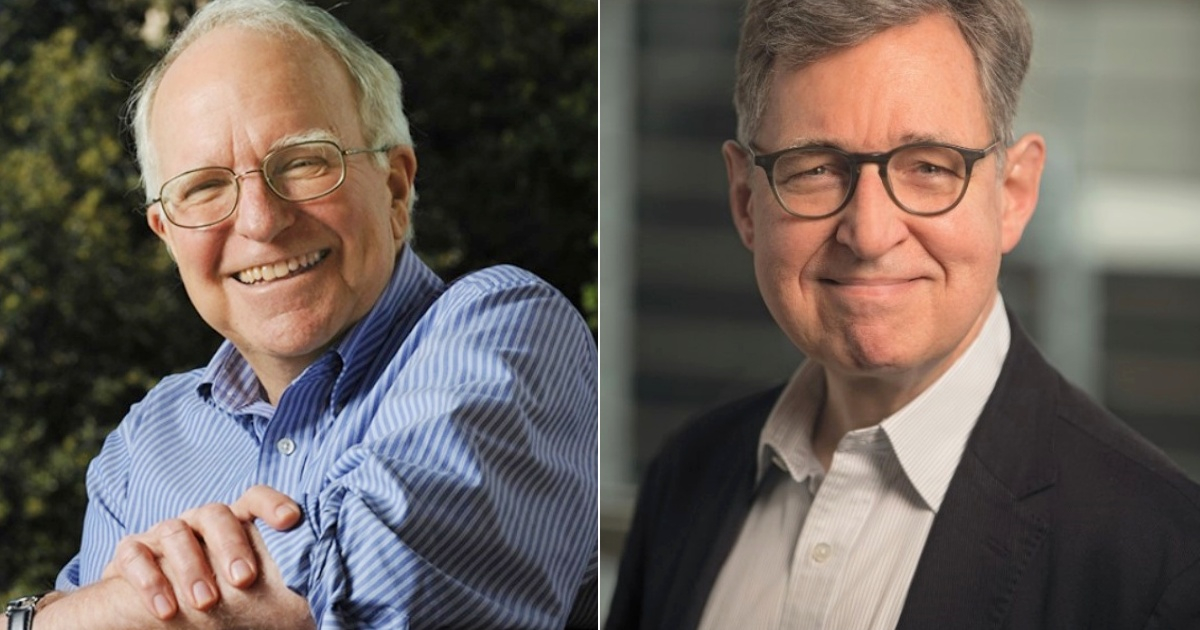
The Royal Swedish Academy of Sciences awarded the Sveriges Riksbank Prize in Economic Sciences in Memory of Alfred Nobel 2026 on Monday to American economists Robert E. Hall and Michael Woodford, recognized for laying the microeconomic foundations for macroeconomic stabilization.
Both researchers will receive a total of 12 million Swedish kronor —approximately 1.2 million dollars—, distributed equally.
Who are the award winners?
Robert E. Hall, born in 1943 in Palo Alto, California, earned his PhD from the Massachusetts Institute of Technology (MIT) in 1967 and is a professor at Stanford University, where he is also a research associate at the Hoover Institution.
He presided over the American Economic Association in 2010 and led the National Bureau of Economic Research's program on economic fluctuations for decades.
Michael Woodford, born in 1955 in Chicopee, Massachusetts, also received his Ph.D. from MIT in 1983 and has held the John Bates Clark Chair in Political Economy at Columbia University in New York since 2004.
His book Interest and Prices: Foundations of a Theory of Monetary Policy (2003) has amassed over 14,000 academic citations and has become a central reference for central banks worldwide.
Upon learning of the award, Woodford reacted with restraint.
"It’s a surprise, but I feel really good about it," he declared during the announcement press conference, according to BBC.
Why their work matters
The significance of their research is better understood by recalling the context in which it emerged.
The oil crises of the 1970s led to stagflation—high inflation combined with low growth and unemployment—a phenomenon that classic Keynesian models could neither explain nor rectify.
The Academy was direct in describing that failure: the approaches of the time "did not reduce unemployment; rather, they led to uncontrolled inflation."
Hall and Woodford rebuilt macroeconomic analysis from its microeconomic foundations: instead of relating aggregate variables through statistical equations, their models start from how households decide how much to consume and save, and how firms set prices in markets with imperfect competition.
A central element of this approach is the role of expectations.
"When governments and central banks communicate their economic policy plans, they can influence this vision of the future and steer the economy in the right direction," noted the Academy while describing the merits of the awardees.
This tool proved to be crucial during the financial crisis of 2008 and the COVID-19 pandemic, when interest rates dropped to zero and communication became the primary instrument of monetary policy.
The jury's verdict
John Hassler, president of the Economic Sciences Prize Committee, emphasized the practical utility of the developed models: "The work of the laureates has provided us with a solid theoretical foundation for the models now used by central banks and governments around the world."
“Thanks to them, we are better prepared to face economic crises, such as energy crises or sudden changes in household consumption,” added Hassler.
The award, established in 1968 by the Swedish central bank, has 57 editions and 99 laureates.
Americans represent approximately 70% of all award recipients since the first edition in 1969.
You can check the full schedule of the 2026 Nobel Prizes to follow the rest of the announcements.
The formal presentation of the award will take place on December 10, 2026 in Stockholm, a date that coincides with the anniversary of Alfred Nobel's death in 1896.
Related videos:
Filed under: