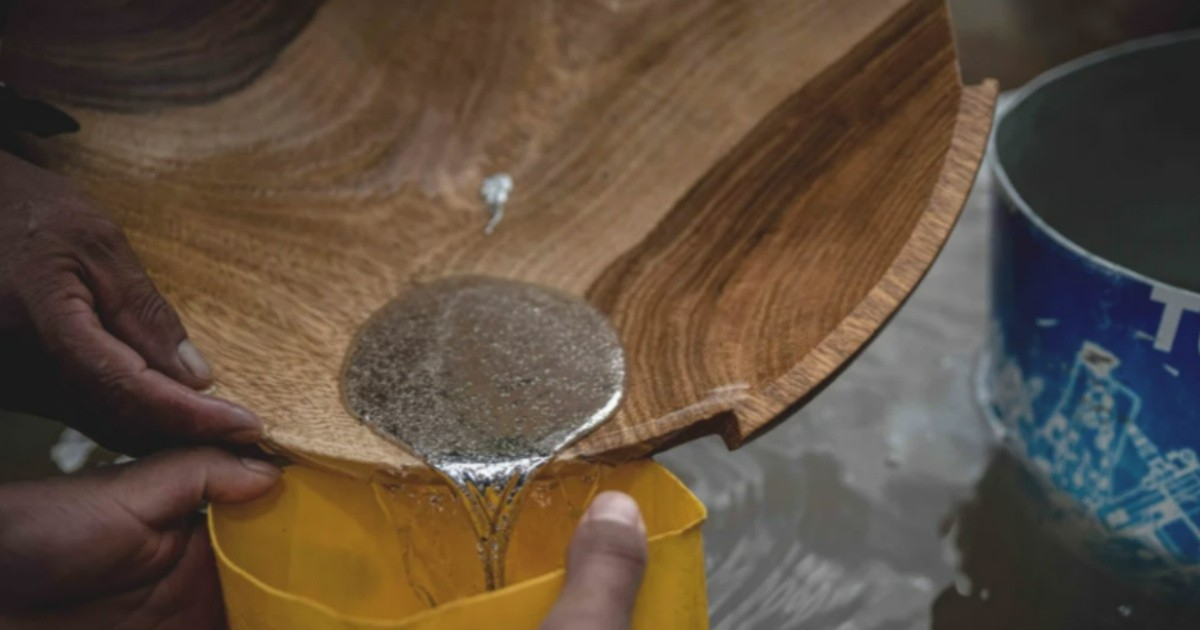
The proliferation of illegal gold mining in the municipality of Jobabo, in the province of Las Tunas, has led to a silent health emergency: the indiscriminate use of mercury in artisanal extraction is causing neurological, renal, and psychiatric diseases in an increasingly younger population, as warned by the Toxicology specialist Dr. Alejandro Mestre Barroso in a report by the state media Periódico 26 published this Saturday, Action Day Against Mercury Pollution.
What started as a subsistence activity in communities like La Guásima and Jobabito has escalated into a public health problem of concerning magnitude, driven by the economic crisis facing Cuba.
The artisanal extraction process, known as "asobe," involves washing the soil, adding elemental mercury to amalgamate the gold, and then burning the resulting mixture. When heat is applied, the elemental mercury is transformed into inorganic mercury, which is highly toxic. The mercury that falls into lagoons and rivers during the washing process is broken down by microorganisms and converted into methylmercury, a substance that is even more lethal and accumulates in the food chain.
"The primary target organ is the central nervous system," warns Mestre Barroso, who notes that the consequences range from neurodegenerative complications to cardiovascular and renal issues.
The first documented case arrived at the Jobabo Hospital as a "rare Parkinson's" in a worker from illegal mines. "It seemed like toxic Parkinson's to us," recalls the specialist. From that point on, the clinical picture of the area began to reveal its full severity: today, Jobabo records one of the highest rates of nephropathy in the province, along with elevated levels of psychiatric patients with schizophrenia, paranoid disorders, and depression.
The most alarming aspect is the profile of those affected. "We are receiving young people, aged 25 to 30, with acute renal failure due to mercury complications," says the toxicologist. "Since 2024, we have treated over 25 patients. If we examine the national statistics, that figure triples."
The first alert regarding illegal mining in the province was issued in 2024. Two more were issued in 2025, and an additional one at the beginning of this year. Far from being contained, the activity has expanded to El Cornito and other areas, with people arriving from neighboring municipalities. "We cannot pinpoint the specific area with the highest incidence of exploitation, but the highest levels of impact from the phenomenon are in Jobabo and La Guásima," the specialist notes.
The economic engine is evident: a gram of refined gold sells for over 60,000 Cuban pesos in the local market, a figure that far exceeds any traditional rural income on the island. Authorities have conducted several operations in the area: eight individuals were arrested in Jobabo in March 2025 for the illegal extraction and trafficking of gold dust, and fifteen more were detained in July of that same year, although the activity has not ceased.
In August 2026, a violent incident among illegal miners resulted in one death in the area, highlighting that the risks of this activity extend beyond health concerns.
Cuba has been a signatory of the Minamata Convention on Mercury since 2018, a treaty that requires countries with artisanal gold mining to reduce and eliminate the use of mercury in amalgamation. The Environmental Studies Center of Cienfuegos is collecting samples from the affected areas to determine pollution levels. The MINSAP regulated occupational medical examinations in September 2026 and included mercury among the chemical risks subject to mandatory workplace monitoring.
The specialist warns that if damage is detected early, there is a solution: "A person who starts with any symptoms and seeks medical attention promptly can find a solution. There are antidotes that, depending on the clinical picture, can reduce the effects." However, once the damage becomes chronic, it is very difficult to reverse. "This is not just a problem for Jobabo or Las Tunas," concludes Mestre Barroso. "It is a public health issue that requires an immediate and coordinated response. Mercury spares no one, and its victims are getting younger."
Related videos:
Filed under: