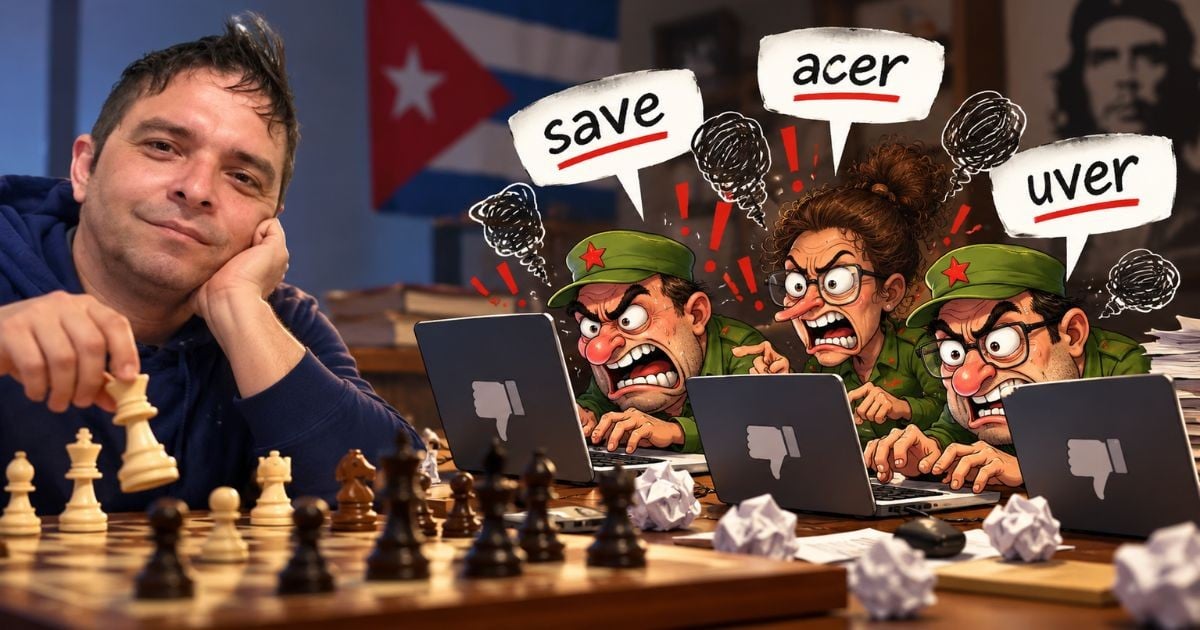
The Great Cuban chess master Lázaro Bruzón sparked a wave of laughter on social media after a regime cyber-fighter attacked him in writing and, in the process, misspelled "ajedrez" as "agedre."
The post by Bruzón on Facebook this Saturday was brief, ironic, and deadly: "The level of cyber fighters and spelling is getting worse every day... It offends me too much that they write chess like that."
The comment that ignited the fire was signed by a user identified as Humberto Saborit, who attempted to attack the chess player with the following message—reproduced here with its original errors: "You are no longer on the agedre ranking, and since you have never worked, now you have to do it to pay the bills; the easiest thing is the networks." Without accents, without commas, and with "agedre" as the focal point of his offensive, the self-proclaimed defender of the revolution handed Bruzón the perfect ammunition.
Bruzón himself quickly added another comment to the post, raising the stakes: "Sorry, but this one takes the cake. They deserve to go straight to first grade. These are the defenders of the 'revolu'," joked the Grand Master. The attacker had made glaring mistakes such as: "save" instead of "sabe," "aser" instead of "hacer," and "talves" instead of "tal vez," with almost more blunders in each word than the number of letters that make them up.
Internet users enthusiastically jumped on the joke. One elegantly summarized the situation: "The players of agedre are quite vile (that's roughly what I understood)." Another was more straightforward: "I didn't know 'agedre' was used to pay the 'viles.' Bad spelling." A third offered an alternative explanation with precise sarcasm: "Don’t laugh, you know nothing. He wrote it in English as agedre, and it’s pronounced eiyidri. Capichi or not capichi." And someone wrapped it up with a clinical diagnosis: "Wow. Reading this lowers your IQ by the second. The battling Seboruco."
The episode is not an isolated incident: it is the latest chapter of a sustained escalation by Bruzón against cyber combatants throughout 2026. In June, he had already challenged them with the phrase "Cubans who are free speak from real profiles" and a symbolic "Checkmate, just surrender." On October 2, he reaffirmed his commitment to public denunciation and described as "miserable" anyone who justifies imprisoning young people for singing protest songs. Just days before this latest episode, he posted a video on Instagram with a warning that already sounds like a slogan: "I will not be silenced, I will not stop talking about Cuba."
The so-called cyber fighters —or "cyber clarias," as they are nicknamed by much of the diaspora— are digital defenders of the Cuban government affiliated with the Communist Party, State Security, and organizations such as the Committees for the Defense of the Revolution. They often operate from anonymous accounts to attack opponents and amplify the official narrative. In 2024, the CDR themselves promoted a sticker with the slogan "My mobile is my rifle," unapologetically institutionalizing this practice.
The spelling error of the digital combatant takes on an even more bitter dimension when considering the state of education in Cuba. The 2026-2027 school year started with severe gaps in its teaching coverage, as acknowledged by the Minister of Education herself, with an accumulated deficit of over 20,000 vacant positions.
The previous school year ended early in June due to blackouts and a shortage of fuel. In September, a school sign with "biembenido" instead of "bienvenido" went viral, illustrating in just one word the educational quality crisis facing the island. That a regime supporter writes "agedre" instead of "ajedrez" in that context is not just a matter for jokes: it is a symptom.
Bruzón, six-time national champion of Cuba and a resident of Missouri since July 2018, has been facing attacks from anonymous profiles for eight years, none of which have managed to silence him. As he pointed out in September when talking about his native province: "My dear province of Las Tunas is at the forefront of informants and snitches."
At least in terms of spelling, the island's "avant-garde" also seems to be well established.
Related videos:
Filed under: