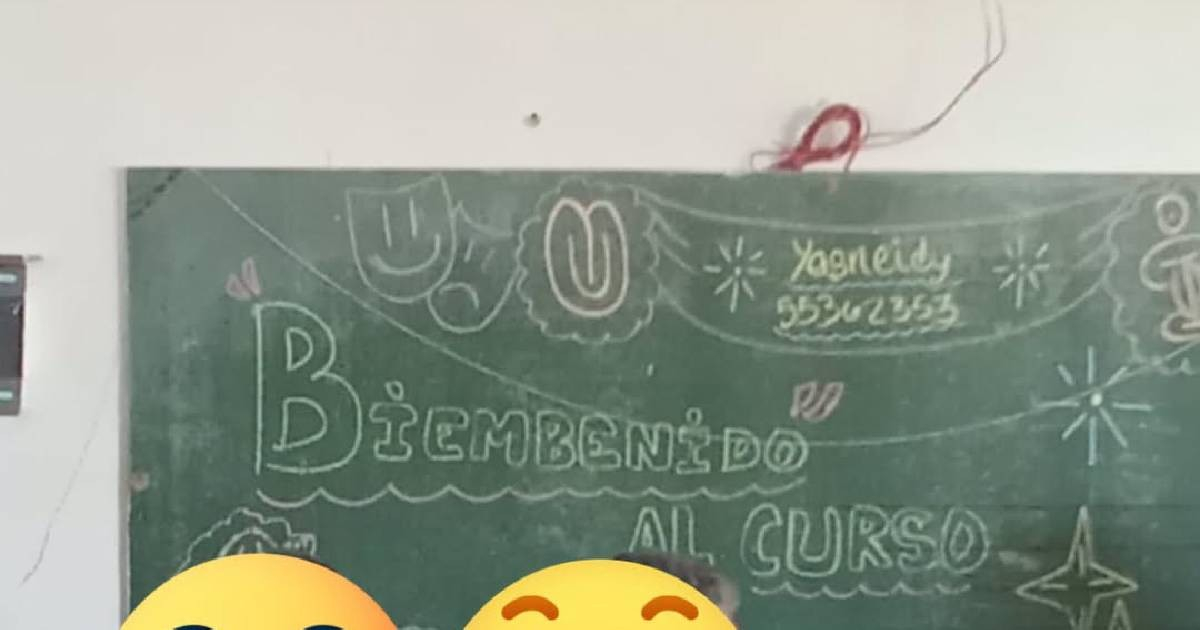
A photograph taken this Tuesday at the primary school Salvador Allende in Alamar, Havana del Este municipality, encapsulates the state of education in Cuba with a single image: the blackboard in the preschool classroom is decorated with stars and flowers drawn in chalk, and the welcoming message written by the teacher who will teach those children to read and write says “WELCOME TO THE COURSE”.
The post, made on Facebook by Yuley Boza on the first day of the school year 2026-2027, quickly spread among Cuban users and the diaspora, who reacted with a mix of disbelief and irony to the spelling mistake — "biembenido" instead of "bienvenido" — made by the very teacher responsible for laying the foundations of written language in her students.
"The future is really messed up, to be honest, if the foundations of primary education are so poorly laid from the very beginning," Boza wrote alongside the image.
The comments on the post ranged from perplexity to dark humor. "I was left stunned and out of ideas," wrote one user. Another opted for forced optimism: "I hope it's a meme." A third comment found the only merit in the chalkboard writing: "At least he/she used the rule that 'm' comes before 'b' and 'p' correctly." The most scathing verdict was also the most concise: "Enthusiasm 10 / Spelling 0."
The episode is not an isolated incident. In 2021, a professor from the Central University "Marta Abreu" of Las Villas publicly alerted about spelling errors in the educational teleclasses broadcast by Cuban television, and that same year, the word "DESICIÓN" was found in the subtitles of the Noticiero Estelar.
The scene in Alamar takes place against the backdrop of an educational crisis that the Minister of Education, Naima Ariatne Trujillo Barreto, described as "very difficult" before the first bell of the year rang.
The school year started with a teacher coverage of only 73%, according to data collected by Infobae. Only 12% of primary students had new uniforms, and power outages affected up to 70% of the country during peak demand hours, according to figures from the Electric Union released by the EFE agency.
The shortage of teachers is the root of the problem. For the 2024-2025 school year, the vacancies in Cuban schools reached 24,000, which is equivalent to 12.5% of the total expected. To fill these gaps, the system turns to university students, retired teachers who have returned, and educators who teach subjects outside of their specialty, an improvisation that has direct and visible consequences for the quality of education.
More than 1.5 million children and adolescents returned to school this Tuesday across Cuba. For many of them, the first written message they saw upon entering the classroom contained a spelling mistake.
Related videos:
Filed under: