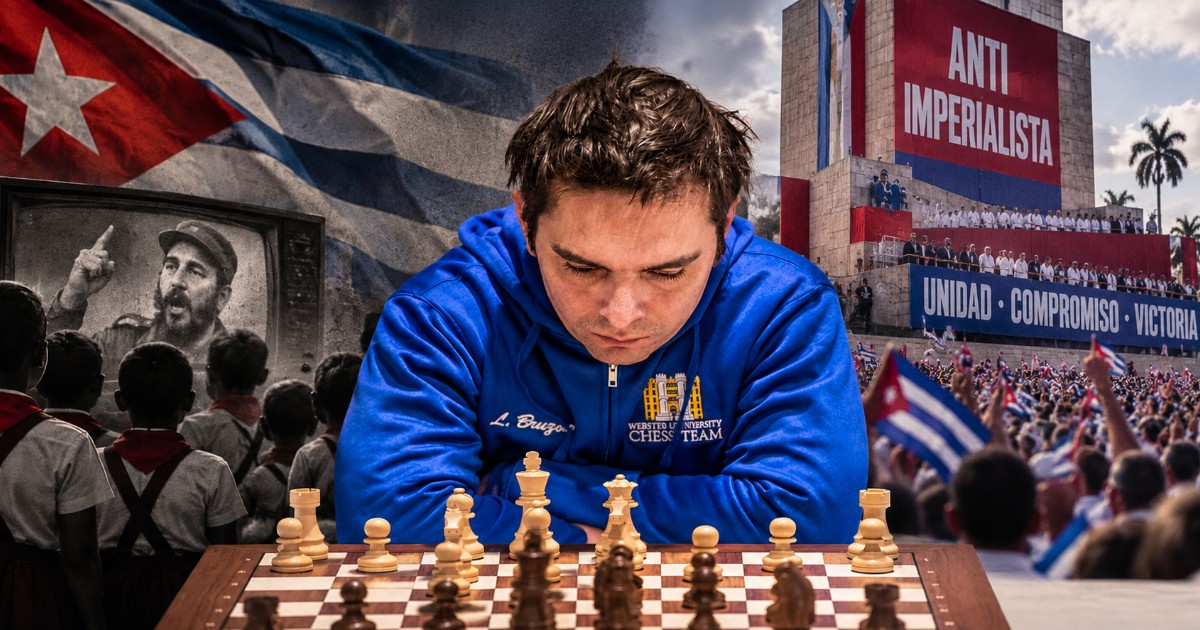
The great Cuban chess master Lázaro Bruzón, one of the critical voices against the regime from the sports arena, questioned those who still justify political repression in Cuba and warned that access to information has dispelled the excuses of those who consciously defend the system.
In an extensive reflection posted on his Facebook profile, Bruzón discussed the indoctrination that has influenced several generations of Cubans, the role of the internet in the awakening of political consciousness, and the responsibility of those who, in his view, continue to support repression.
“That evil will not last forever. There will be changes and there will be justice. Today we all have access to data, history, and evidence. Everyone can choose the side they want, but no one should complain when their time to account comes. There are no more excuses; that story of 'confusion' no longer works,” he wrote.
The chess player, who has maintained a publicly critical stance towards the Cuban Government in recent years, began his analysis by addressing a recurring debate among Cubans: when they should have understood the true nature of the political system established in 1959.
For Bruzón, it is unfair to examine the past without considering the conditions under which entire generations grew up, subjected since childhood to an education that presented the Revolution and its leaders exclusively from a favorable perspective.
He recalled that, for decades, only a minority of Cubans had the necessary tools and family environment to question the official discourse. In his own home, he explained, politics was never discussed, nor was the system debated.
«That was the design: to shape you from a young age so you don’t see any other truth», he stated, referring to the influence of propaganda in schools, the media, and everyday life.
His reflection also includes a distinction that he considers essential for understanding the deterioration of Cuba: the harm caused by the system, he argues, cannot be measured solely through economic indicators.
"The economy was never the main harm. The harm was moral, civic, human. The harm was the total cancellation of freedom," he stated.
According to Bruzón, the fundamental problem in Cuba is the political system imposed in 1959, which, in his view, eliminated individual freedoms and divided citizens into those considered revolutionaries and those labeled as traitors.
The Grand Master identified internet access as one of the events that has most contributed to transforming the way Cubans understand the history and reality of their country.
It is considered that the ability to consult diverse sources, compare narratives, and be aware of events that were previously beyond the reach of most people has weakened the government's capacity to impose a singular interpretation of the facts.
"The arrival of the internet and the ability to contrast, verify, and learn directly from history have exposed the regime," he stated.
In this regard, he argued that the current conditions are different from those that existed when the population relied almost exclusively on state television, the official press, and the content provided in schools.
The reflection took on a particularly critical tone when Bruzón referred to the public discussions about Anna Bensi, the young Cuban whose case has provoked numerous expressions of solidarity and denunciations of repression.
The chess player recounted that he had heard Luis Dener analyze a program from La Joven Cuba in which, according to his interpretation, three participants were attempting to justify the repression against Bensi and portray her as responsible for what happened.
It also questioned how, while defending those positions, there was outrage over the criticisms directed at Gabriela, linked to the pro-government program Con Filo, for having traveled to Mexico to pursue a master's degree in human rights.
"It is grotesque," said Bruzón, who used particularly harsh words to reject what he sees as a double standard in the handling of both cases.
In his opinion, those who participate in spaces aimed at discrediting individuals who question the Government are part of a communication structure that helps sustain the Cuban political system.
The chess player insisted that, unlike in previous decades, it is much more difficult today to justify certain positions by claiming ignorance of the facts.
"This is the difference of this era: information has freed the Cuban, and at the same time, it has exposed those who still lend a hand to whitewash the dictatorship," he concluded.
The defense of freedom of expression and the denunciation of abuses in Cuba have become recurring themes in Bruzón's public interventions.
In early October, the Grand Master rejected the advice of those who recommend he remain silent about the situation in Cuba and argued that speaking out about what is happening in the country transcends ideological differences.
On that occasion, he explained that he receives messages from people advising him not to get involved in political matters because they believe his statements will not change the reality. However, he reaffirmed his decision to continue expressing himself publicly.
This Tuesday also denounced the abandonment of former Cuban athletes, whom he described as individuals used by the system while they were achieving sports results and later sidelined when they ceased to be useful for official propaganda.
In that reflection, he acknowledged that he himself spent years within the Cuban sports structures without fully understanding, in his own words, the political function that the athletes' successes performed.
His personal journey helps to understand the origin of these positions. Bruzón, the 2000 World Youth Chess Champion and one of the most prominent figures in the history of this discipline in Cuba, left the Island in 2018 after a long career representing the country.
In a interview granted in April 2026, he recounted how his departure from Cuba and the subsequent conflicts with sports authorities led him to reevaluate his former beliefs and to study more deeply the functioning of the political system.
During that conversation, he explained that his process of personal transformation did not happen instantaneously, but rather emerged from experiences that made him question ideas he had accepted for much of his life.
That journey is precisely one of the central elements of his new publication: Bruzón acknowledges the challenges faced by those who grew up under official indoctrination, but he believes that the current availability of information demands a different level of responsibility from those who continue to defend repression.
Related videos:
Filed under: