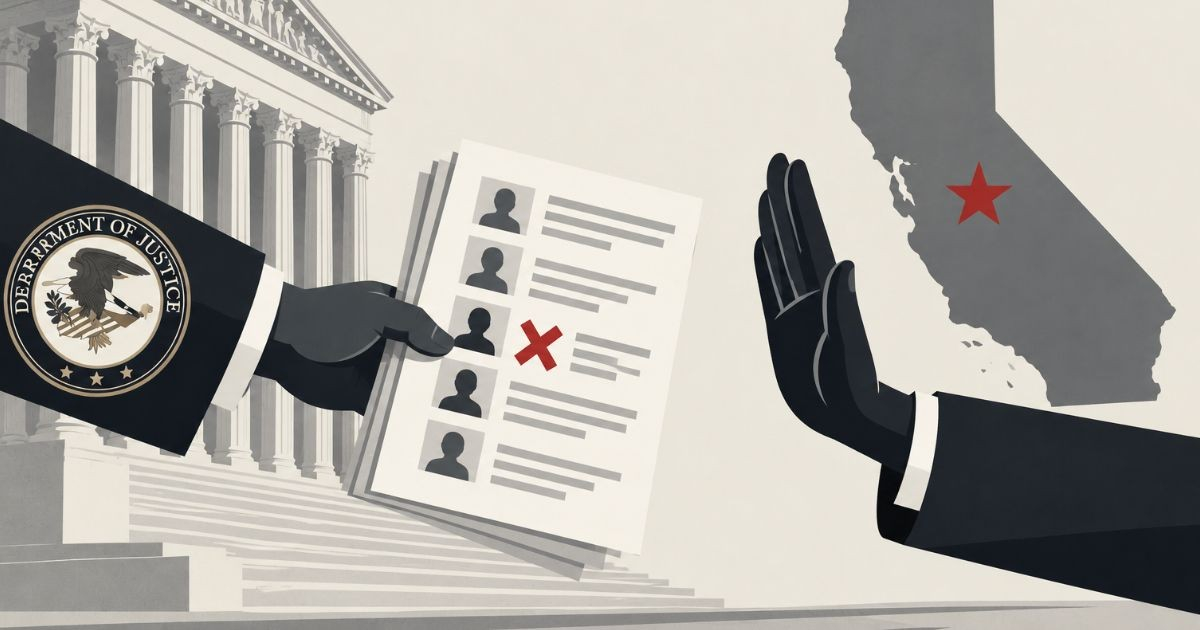
The U.S. Department of Justice demanded that California review, within 48 hours, a list of individuals it believes are likely non-citizens and take action regarding their ballots before the federal elections on November 3.
The Secretary of State, Shirley N. Weber, rejected the pressure and questioned Washington's intent to impose those actions without providing, in her opinion, sufficient evidence or a legal basis to justify them.
The requirement is stated in a letter dated October 13, 2026, signed by R. Trent McCotter, Acting Deputy Attorney General, and addressed to Weber.
The document warns that the federal government may seek urgent judicial intervention if the electoral authorities do not comply with the requirements.
The conflict revolves around the verification of citizenship and the handling of mail-in ballots, at a time when California is already making preparations for the elections on November 3rd.
The controversy also raises an important distinction: that the federal government considering a person possibly non-citizen does not, by itself, prove that they are illegally registered or that they have committed electoral fraud.
The letter requests a review of a list of individuals whose U.S. citizenship, according to the Department of Justice, requires verification.
If the authorities are unable to confirm that condition, Washington requests that their ballots be segregated, but not canceled, while their eligibility is being determined.
The request includes two specific instructions for voting by mail: to hold the mailing of ballots that have not yet been sent to the designated individuals and, concerning those that have already been returned, not to verify their signatures or count them until the citizenship issue is resolved.
The Department of Justice also offers to provide a digital copy of the information through a secure address. This offer is part of the federal communication and is relevant because local authorities have raised objections about how they received the data.
The letter constitutes an administrative demand accompanied by a threat of litigation, not a court order nor a ruling that has declared the questioned votes illegal.
The state response arrived on Wednesday, October 14th. In an official statement, Weber stated that her office received the demand, but did not receive the list of individuals that needed to be investigated.
The official questioned why the Department of Justice allowed only 48 hours to obtain the information, review it, and make decisions that could impact ballots less than three weeks before the elections.
Weber also stated that federal authorities have not provided the evidence or the legal justification that, in his view, would be necessary to support the request.
He defended the electoral procedures in California and stated that state legislation sets requirements to ensure that only U.S. citizens can register to vote.
The Secretary of State believes that federal actions related to electoral registers can create public distrust.
This is the assessment expressed by your office, while the Department of Justice maintains that its intervention aims to verify the eligibility of the identified individuals.
The situation in Los Angeles County adds another element to the disagreement: its election registrar, Dean C. Logan, confirmed that he received correspondence from the Department of Justice on the afternoon of October 13, accompanied by a USB drive that allegedly contained the questioned records.
However, in his official statement from October 14, Logan explained that his office did not open the device because doing so would conflict with its privacy and cybersecurity protocols.
The official also specified that the communication did not indicate how many people were included nor did it describe the content of the stored records.
His office, he added, was reviewing the matter in coordination with the Secretary of State and the California Attorney General's Office to determine the next steps.
Logan argued that any action affecting a voter's eligibility must be based on verifiable information and the procedures established by legislation.
The receipt of the device, therefore, does not mean that the county has confirmed the immigration status or citizenship of the individuals allegedly included.
The dispute has roots in the federal strategy of reviewing electoral records. On October 7, it was reported that ICE had analyzed tens of millions of records in search of potential non-citizen voters, utilizing information from various sources and data processing tools.
There is also a legal controversy surrounding the federal SAVE system, which is used to verify information related to citizenship.
In September, the Trump administration requested the Supreme Court to reactivate an expanded version of that tool, after its use was restricted by court decisions.
For Cubans residing in the United States, the distinction between legal residency and U.S. citizenship remains essential.
Having a permanent residency card, known as a green card, does not, by itself, grant the right to vote in federal elections. This right generally belongs to U.S. citizens who meet the other electoral requirements.
A recent controversy in Florida also highlighted the differences between eligibility rules and the powers to pursue violations.
On October 7, a federal judge in Miami dismissed a charge based on a federal provision against the voting of non-citizens, in a decision limited to the case examined that did not allow permanent residents to participate in federal elections.
Related videos:
Filed under: