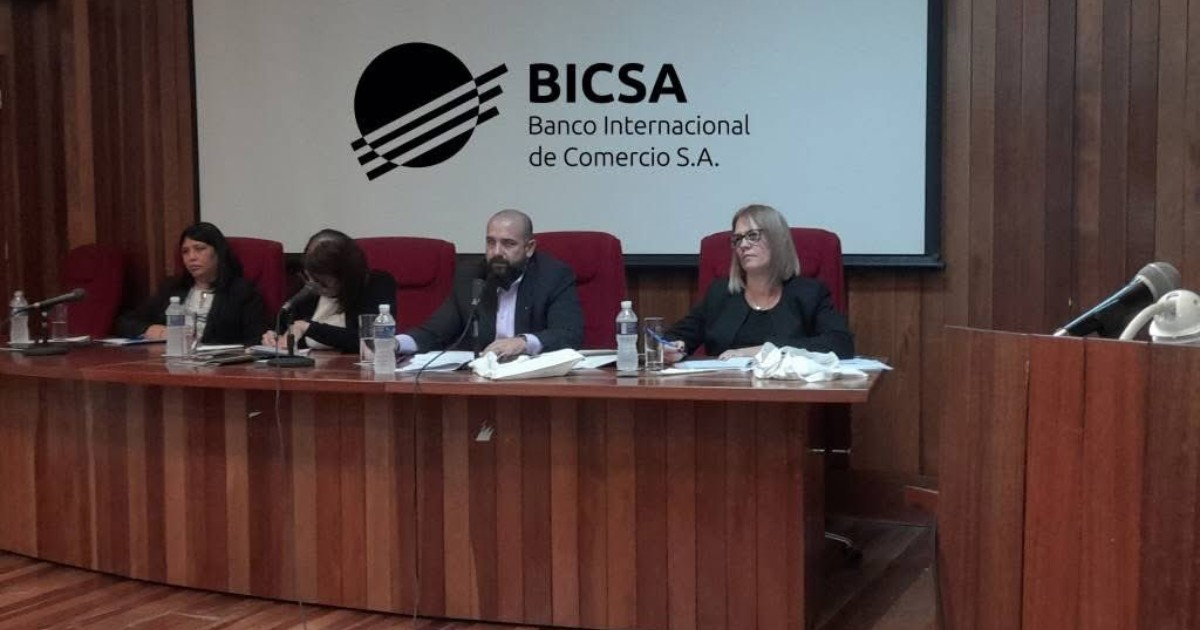
The U.S. Department of State sanctioned the International Bank of Commerce S.A. (BICSA) this Thursday, a state-owned Cuban financial institution, for providing financial services to the Iranian Karafarin Bank since at least 2022, an institution that Washington had already designated as sanctioned in 2020.
The measure was announced by Secretary of State Marco Rubio and was enacted under section 2(a)(i)(A) of Executive Order 14404, signed by President Trump on May 1, 2026, which authorizes broad sanctions against those operating in the financial sector of the Cuban economy.
"For too long, communist Cuba has been able to operate as a base for hostile actors and terrorist groups —including the Islamic Republic of Iran, the world's leading state sponsor of terrorism— to target the United States," Rubio stated while announcing the designation.
The Secretary of State was emphatic in warning that the Trump administration would not tolerate a pariah state hosting military, intelligence, and terrorist operations less than a hundred miles from U.S. territory, and promised to continue dismantling the financial and security linkages between the Cuban regime and Iran and other dangerous actors.
The action by the State Department was coordinated simultaneously with an operation from the Department of the Treasury against Iranian financial networks called “Operation Economic Outcast”, launched in August 2026 by Secretary Scott Bessent under the name “Economic D-Day.”
In that same round, the Treasury also designated the Iraqi bank International Development Bank for Investment and Finance, as well as two Iranian banks operating in free trade zones: Jazireh International Bank Company and Chabahar International Bank Overseas Company.
"The siege around the Iranian economy is tightening, and even its supposed allies cannot save it," said Bessent, who added that the Treasury will not relent until the regime's coffers are empty and all financial channels supporting its war machinery are cut off.
As a result of the designation, all assets and interests of BICSA located in U.S. territory or under the control of persons subject to U.S. jurisdiction are blocked and must be reported to the Office of Foreign Assets Control (OFAC).
In addition, any foreign entity that conducts transactions with BICSA is subject to secondary sanctions.
The sanction on BICSA is part of a pattern of increasing financial pressure that the Trump administration has applied against the Cuban regime throughout 2026.
The International Financial Bank (BFI), the financial arm of the military conglomerate GAESA responsible for managing most of the foreign currency on the island, was sanctioned on June 23 along with other entities of the Cuban military framework.
Weeks later, the Banco Exterior de Cuba was included in a new round of sanctions imposed in September, along with four entities linked to the mineral resources and energy sectors.
With the designation of BICSA, three of the main state banks in Cuba have already accumulated U.S. sanctions in less than four months, representing the most sustained financial blow that Washington has dealt to the regime's banking system since Trump resumed the presidency.
Cuba and Iran have maintained cooperative relations for decades, aligned in their opposition to the foreign policy of the United States.
Tehran granted credits to Havana of nearly 700 million dollars during the first decade of this century, and both governments have entered into successive economic and financial agreements, the most recent of which was discussed in 2017 within the framework of the XVI Cuba-Iran Intergovernmental Commission.
The historical ties between Cuba and Iran have been extensively documented as an alliance between two regimes that share a rejection of American influence.
Related videos:
Filed under: