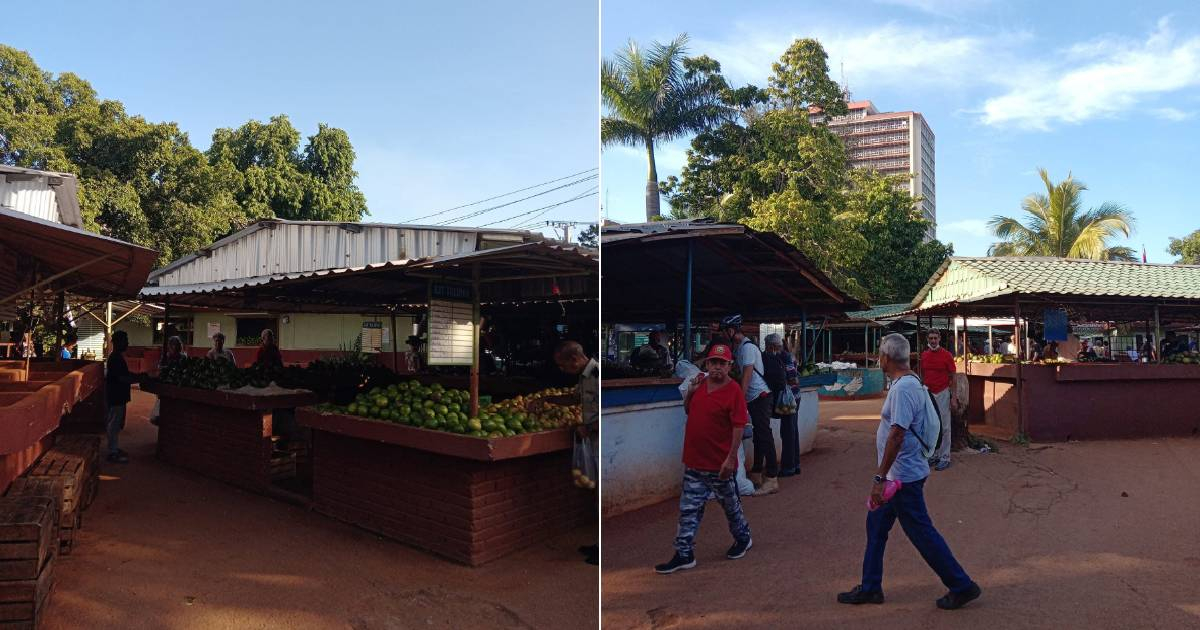
The journalist and university professor Iraida Calzadilla reported that vendors at the agricultural market of the Youth Labor Army (EJT) in Tulipán, located in the Plaza de la Revolución municipality of the capital, refuse payments via Transfermóvil, demand cash, and display a QR code with a counterfeit web address of that platform to deceive buyers.
Doctorate in Communication Sciences and tenured professor in the Journalism Department at the University of Havana, Calzadilla published her complaint on Thursday on Facebook. She recounted that the irregularities reemerged less than two months after the government announced the creation of a body of inspectors to enforce digital payments.
"The payment is now starting to be only in cash or half of the derogation, just as the payment through Enzona is resurfacing, which we all know comes with connectivity challenges and its almost impossible viability," wrote the professor.
The complainant explained that some stalls reportedly display two payment options: one through EnZona and another via a QR code that resembles Transfermóvil. When buyers are unable to complete the transaction with the latter, the attendants attribute the issue to the customer's connection or phone.
Calzadilla explained that he detected the forgery while reviewing the web address associated with the code and confirmed his suspicions with two other individuals, one of whom is military.
When informing the market inspectors, they acknowledged that she was right. However, when she took a photograph to document what had happened, the two stall attendants threatened her, according to her testimony. "One of them told me he was religious," she recounted.
In the following days, the teacher returned to the establishment and found that the situation remained the same. She reported that the inspectors had not taken action regarding the rest of the market even though they were aware of the irregularities.
"I wonder where the body of inspectors is that at the beginning of the 'campaign' issued several fines there and temporarily closed some platforms," questioned Calzadilla.
The report highlights the gap between the announced measures to expand digital payments and what, according to testimony, is happening in a Havana market where cash transactions persist and a suspected scheme of fraud involving QR codes is taking place.
The comments on the post gathered similar testimonies from other buyers. Several noted that they had experienced similar situations in the capital's markets, where sellers claim technical issues as a reason not to accept transfers.
Others highlighted the particular vulnerability of older adults, who rely on cashing their pensions at banks with long queues and restricted hours.
Calzadilla herself illustrated that paradox by recounting that the day before its publication, she waited on the bench of the Ministry of Transportation until 4:30 in the afternoon to collect her pension and was unable to enter before closing time.
"How tough, but how tough the life of old Cubans is. Not even with money in Transfermóvil can we buy," he concluded.
The complaint reflects a documented pattern throughout the island with operations that yield immediate results, but their effect fades as soon as the inspectors leave.
In August, Guantánamo closed four businesses and imposed 29 fines in a single day for refusing to accept electronic payments.
In Sancti Spíritus, an April operation resulted in over 450 fines totaling more than 650,000 pesos.
The current regulations, specifically Resolution 93/2023 from the Ministry of Domestic Trade and Resolution 111/2023 from the Central Bank, require all establishments to enable payment gateways such as Transfermóvil or EnZona.
The , effective since September 4, strengthened that regulatory framework. Nevertheless, at agricultural fairs in Havana municipalities such as La Lisa and El Cotorro, hardly any stall used digital payments in May.
Related videos:
Filed under: