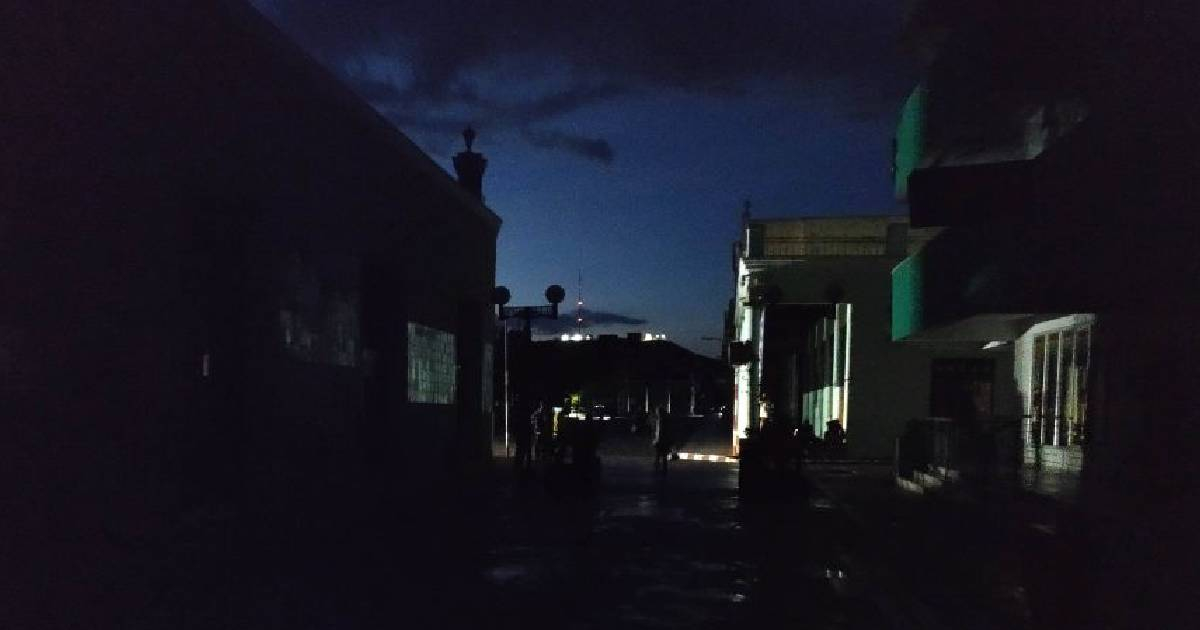
The Holguín Electric Company announced this Saturday on its Facebook page the suspension of the rotation of city circuits every 12 hours, citing the already well-known "complex situation of the National Electric System."
The measure only exempts circuits 1, 2, 19, 20, and 21, which supply the Express of Hospital Lenin, the largest hospital center in the province. For the rest of the residents of Holguín, the company promised to resume rotation "starting from the recovery of the Base Generation of the System," without providing a specific date or time, and concluded the announcement with its usual courteous phrase: "We apologize for the inconvenience caused."
The reaction on social media was immediate and, above all, devastating. “When did the remaining circuits have a fixed rotation of every 12 hours? They put them on whenever they could or wanted,” wrote one user. Another was more succinct: “It was too good to be true; it didn’t last long at all.” A third added with sarcasm: “That rotating every 12 hours must be a joke.”
The sharpest irony came from those who hadn't even experienced that supposed rotation. "Will there be any rotation for the forgotten in the municipalities? Or do we still have it every 30 hours? I mean Sagua de Tánamo," asked an internet user. From Mayarí, another pointed out that in that locality, outages already lasted 27 hours, and with the suspension of the rotation "now it must be every week." The question that best summed up the collective sentiment was undoubtedly the shortest of all: "What rotation?"
At dawn on Saturday, October 17th, the availability of the National Electroenergy System (SEN) was only 758 MW, compared to a demand of 2,250 MW and a reported disruption of 1,493 MW, according to the report from Unión Eléctrica as of 6:00 a.m. For peak demand hours, a deficit of 2,042 MW and a disruption of up to 2,072 MW were forecasted.
In Holguín, the demand served was only 50 MW, while, according to records from the provincial Electric Company at 8:44 a.m., the Banes 2 circuit, Tanganica branch, had accumulated 43 hours and 15 minutes without electrical service. Other circuits, such as Guerrita and Ocujal, recorded interruptions of 39 hours and 35 minutes and 39 hours and 18 minutes, respectively.
The collapse has specific and accumulated causes. The day before, unit 1 of the Ernesto Guevara de la Serna thermoelectric plant in Santa Cruz del Norte (Mayabeque), suffered a fire that further reduced national availability. Additionally, the Lidio Ramón Pérez thermoelectric plant in Felton, Mayarí, went offline also on that Friday. The Antonio Guiteras thermoelectric plant, the largest in the country, has failed at least 17 times so far in 2026.
This suspension is not an isolated incident but the latest chapter of a crisis that has been ongoing throughout the year. Cuba has accumulated eight total disconnections from the SEN so far in 2026, the most recent one occurring on September 18.
The frustration has reached a breaking point on the streets. This past Saturday, residents of Santa Rita, in Jiguaní (Granma), took to the streets shouting "We want power!" in front of a police patrol that was unable to disperse them.
A netizen foresaw the outcome with bitter clarity: "When the SEN completely collapses, which won't be long, the NTV will say that we are a fortunate country because we have the moon at night and the sun during the day."
Related videos:
Filed under: