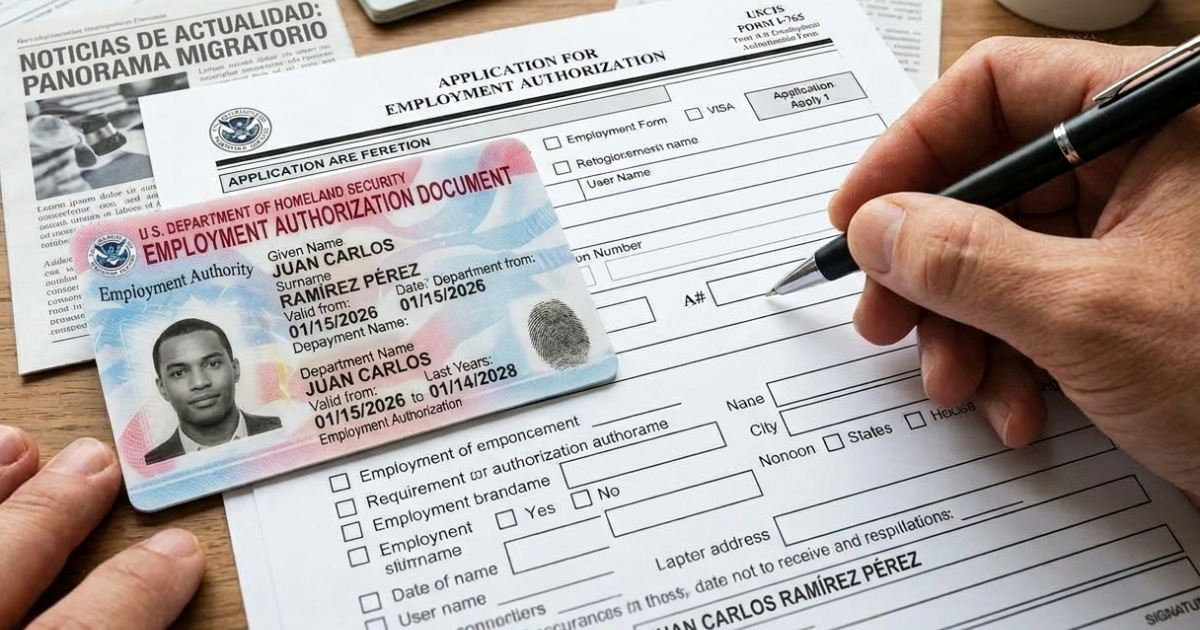
If you have a work permit (EAD, Employment Authorization Document) and are considering renewing it, there is an important change you need to be aware of: submitting the renewal on time no longer guarantees that you can continue working with the expired card while USCIS makes a decision.
If your permit expires before the new one arrives, you may have to stop working unless you have an applicable extension or another valid basis for work authorization.
The Department of Homeland Security (DHS) published on October 14 in the Federal Register the final rule that eliminates the automatic extension of up to 540 days for certain renewals submitted after October 30, 2025.
The regulation came into effect on October 14 and confirms, unchanged, the provisional rule of 2025.
For many Cubans with pending asylum or in the process of adjusting their status, this means they need to plan for renewal well in advance to reduce the risk of being temporarily without work authorization.
What was the automatic extension and what changes?
Before the change in October 2025, certain individuals who applied for the renewal of their EAD before it expired could benefit from an automatic extension of up to 540 days, provided they met the relevant requirements.
In those cases, the expired card and the I-797C receipt notice from USCIS could be used together as proof of work authorization during the extension period.
The provisional rule published on October 30, 2025 removed that benefit for renewal applications submitted from that date, except for applicable exceptions. The final rule from October 2026 upholds that decision.
DHS reported that it received 653 public comments during the process and justified the change by the need to complete the necessary verifications before granting a new work authorization period.
In practice, the receipt of a renewal submitted under the new rules does not, by itself, grant an extension of the employment authorization. If the card expires before USCIS approves the application, the individual will need another valid basis to continue working legally.
Who does it affect and who does it not affect?
The automatic extension applied only to certain categories of work permits. Among the most relevant for the Cuban community were:
- C08: asylum seekers with pending cases (form I-589). Some Cubans with I-220A work with a permit from this category.
- C09: individuals with a pending status adjustment application (form I-485), including those processing residency under the Cuban Adjustment Act.
- A05 and A03: asylum seekers and refugees, respectively.
- A10: individuals with withholding of removal.
If you have an EAD from one of those categories and submitted the renewal on October 30, 2025, or later, you can no longer take advantage of the general automatic extension that has been eliminated by the new regulations.
The category of your permit is printed on the card in the "Category" field.
However, there are situations that require specific verification:
- Renewals submitted before October 30, 2025. They can maintain the automatic extension of up to 540 days if they meet all applicable eligibility requirements, including timely submission and conditions related to the category of the permit and the receipt.
- EAD related to TPS. Certain extensions provided by law or through specific notices published in the Federal Register may still be valid. It is necessary to check the applicable provisions for the country and the corresponding period.
- Parole Permissions (C11). This category was not included in the general automatic extension removed by the new rule. Those who rely on an EAD C11 must ensure that they maintain valid employment authorization.
- Individuals with other work authorization. The expiration of the EAD does not necessarily mean that a person loses their right to work. Some immigration statuses allow individuals to work independently, and there are other acceptable documents to verify work authorization.
Therefore, before assuming that you need to suspend your work activities, it is important to check if there is any exception or independent authorization applicable to your situation.
When to submit the renewal?
USCIS generally recommends applying for the EAD renewal well in advance, and for many categories, it allows you to do so up to 180 days before expiration.
However, the application window may vary depending on the immigration category.
Not everyone can apply for renewal exactly six months in advance.
To reduce the risk of employment disruptions, it is advisable to follow these steps:
- Check the expiration date and the category displayed on your card.
- Check the official USCIS instructions to determine when you can submit the renewal for your category.
- Prepare the necessary documents and fees in advance to submit the application as soon as it is permitted.
- Consulta los USCIS processing times para el formulario I-765 y tu categoría.
The final rule warns that the later a renewal is submitted, the greater the risk that the current permit may expire before a decision is received.
The official information is available on the USCIS I-765 form page, where you can also check the instructions and submission options. CiberCuba also offers a to assist in completing the application.
How much does it cost to renew?
In addition to the fee for Form I-765, certain renewal applications are subject to additional charges established by law H.R. 1.
These additional fees are paid separately and, according to the federal regulations, are not subject to exemption or reduction.
With the update effective from October 16, 2026, the amounts of those additional fees are:
- Renewal of the EAD for asylum seeker: 275 dollars.
- Renewal of the EAD by parole: $280.
- Renewal of the EAD for TPS: 280 dollars.
These amounts correspond to the additional fees and do not necessarily reflect the total cost of the application. Before making a payment, check with USCIS what charges apply to your category and submission type.
A request with an incorrect payment may be rejected, which would delay the process. You can also check the new USCIS fee schedule and its effects for Cubans.
What happens if your permit expires before you receive the new one?
If your EAD expires while the renewal is still pending and you do not have an applicable extension or another valid basis for work authorization, you will not be able to continue working legally until you obtain that authorization.
The final rule from DHS includes the example of a person with a pending adjustment of status application who must stop working when their EAD expires if they have not yet received the renewal and lack other authorization.
The expiration can have several practical consequences:
- Employment Verification. The employer must fulfill the reverification obligations of the I-9 form when applicable. The employee may present any acceptable document or combination of documents that prove their work authorization, according to the applicable rules. It is not necessary to submit a new EAD if they have another valid proof.
- Driver's license in Florida. Para determinadas personas que no son ciudadanos estadounidenses, el Departamento de Seguridad Vial y Vehículos Motorizados de Florida (FLHSMV) determina la vigencia de la licencia según la documentación migratoria aceptada. Si el EAD es el documento utilizado para acreditar la presencia legal, su vencimiento puede complicar la renovación de la licencia. Sin embargo, Florida accepts different immigration documents, por lo que el vencimiento del permiso de trabajo no determina automáticamente la validez de todas las licencias.
- Immigration situation. The expiration of the EAD does not automatically cancel a pending asylum or adjustment of status application. Work authorization and immigration status are related issues, but they are distinct.
DHS estimates that between 20,000 and 33,000 permits could expire without being renewed on time during an 18-month period starting in May 2027.
The deadline is approaching, and the renewal hasn't come: what can you do?
If you have already submitted the renewal and have not yet received a decision, you can check if your case meets the conditions to request expedited processing (expedite request).
USCIS considers this possibility in certain circumstances, including a severe economic loss for an individual or company.
According to their official guide on expedite requests, the risk of losing employment may be relevant to demonstrate a severe economic loss, depending on the circumstances and the evidence provided.
However, the need to obtain a work permit does not guarantee that USCIS will expedite the case. The agency also considers whether the urgency is due to a late submission attributable to the applicant.
To request an expedite, you can contact the USCIS Contact Center, use their virtual assistant Emma, or check the available options in your online account.
You should have the receipt number and evidence to support the urgency on hand, such as a letter from your employer or documentation regarding the economic consequences of the delay.
It is also advisable to speak with your employer before the deadline to understand the available job options if the authorization does not arrive on time.
DHS warns that expediting a case may speed up its review, but it does not eliminate security checks nor guarantee approval.
Another change on the way: the proposal regarding parole permits
On June 5, 2026, DHS published a proposed rule regarding discretionary work permits, including the C11 category for certain individuals with parole.
The proposal includes additional requirements, such as demonstrating economic need, new conditions related to E-Verify for employers, and restrictions associated with certain criminal records.
As of October 18, 2026, the measure remained a proposal. The public comment period ended on August 4, and a final rule had not yet been published.
Therefore, these proposed changes should not be confused with the elimination of the automatic extension, which is already in effect.
For those with an expired parole, CiberCuba also explains what consequences it may have and what immigration options Cubans should consider.
What to do to avoid losing your work authorization?
The most important thing is to check the expiration date of your EAD, identify your category, and submit the renewal within the allowed timeframe, with the correct documentation and payments.
If your application is still pending and the deadline is approaching, check if you have any applicable extensions or other authorizations to work. If not, inquire about your eligibility for expedited processing and discuss with your employer before the document expires.
If your case involves a deportation order, criminal record, a change in immigration status, or other special circumstances, it is advisable to consult with a licensed immigration attorney or an accredited representative by the Department of Justice.
Legal notice: this article provides general information and does not constitute legal advice. Immigration rules and policies in the United States may change. To assess your specific situation, consult an authorized professional.
Related videos:
Filed under: