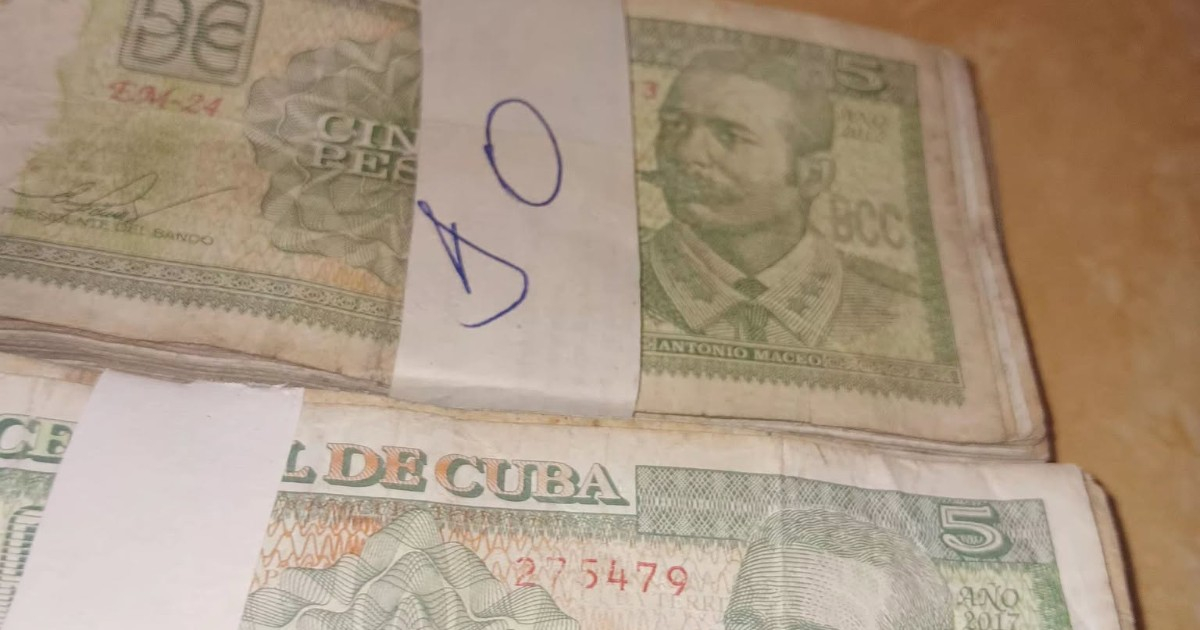
A Cuban received one thousand pesos in five-peso bills —two hundred bills of the lowest denomination in circulation— and was unable to spend them because businesses, small and medium-sized enterprises, and individuals refuse to accept them.
The image of two bundles of 5 Cuban pesos, series 2017, featuring the face of Antonio Maceo, posted in the group "El toque en Cuba" on Facebook sparked a wave of reactions that reflects widespread frustration across the island.
"My neighbor collected her monthly payment at the bank and was given 1,000 pesos in 5 peso bills. When she went to buy two pounds of sugar for 480, they told her that they do not accept those bills at that rental establishment," commented a user on social media identified as Mary López Hernández.
The complainant also wondered when the government would address so many injustices, such as that of her neighbor.
Comments on social media reflect accumulated outrage. "It seems that this is all the bank has for retirees... The high denomination bills are being kept away... Sad for my country, sad for my elderly," wrote one user.
Another person pointed out the contradiction of the banking system: "It's incredible: those in the MSMEs deposit in the bank in any denomination, and then they don't want to receive the same amount they deposited. Banks give back what they are given; they themselves come in with backpacks full of 5 and 10 bills. It's valid money in circulation; no TCP, PDL, or MSME can say they won't accept it."
The chain of rejection extends upward: "Now the small and medium-sized enterprises don't even want to take the 50 bills. Now we are really doing well. Help me think," summarized another comment.
Some point directly to the regime as the one responsible: "Tell your neighbor to start protesting against the bank, which does whatever it wants with your money. But of course, it's easier to talk about the individual and not confront the government," wrote a user.
And another was even more direct: "They don't care about us at all. If there supposedly is $20,000, what ordinary Cuban earns that?"
The case is not isolated. Since late 2024 and with increasing intensity throughout 2026, private businesses, small and medium-sized enterprises, and self-employed individuals across Cuba have refused to accept 1, 5, 10, 20, and even 50 peso bills, despite the fact that all of them remain fully legal tender.
The most affected are retirees and pensioners, who receive their benefits directly in cash and in the denominations that the bank has available.
A documented case illustrates the extent of the problem: Arturo Chang, a 74-year-old retiree from Santa Clara, attempted to buy bread with 100 five-peso bills provided by the bank as part of his monthly pension of 3,653 pesos, and the store refused the payment.
The Bank of Credit and Commerce (BANDEC) in Ciego de Ávila described this practice as a "blatant violation of citizens' rights" and warned in August that no establishment can refuse low-denomination bills or dictate the payment method to customers.
However, the warnings have not resulted in concrete sanctions. In early October, a small to medium-sized enterprise limited payment to 500 pesos when a customer attempted to purchase rice using 50 peso bills, which indicates that the rejection is escalating even towards higher denominations.
The root of the problem is structural. Cuba is experiencing a severe cash shortage: more than 50% of the ATMs in Havana stopped working in 2026, and the province of Granma acknowledged that it does not have cash to pay the pensions of over 111,000 retirees.
State banks distribute what they have, which are low-denomination bills, while higher-value notes do not reach the most vulnerable sectors.
In September 2026, the Central Bank of Cuba issued 10,000 and 20,000 peso bills, the highest denominations in the country's history. However, these new emissions do not reach pensioners, who continue to receive their payments in bundles of small bills that they are unable to use.
More than 1.7 million retired Cubans rely on bank payments of pensions, many less than 10 dollars a month at the unofficial exchange rate, and they bear the brunt of a monetary crisis that the regime has not been able to resolve.
Related videos:
Filed under: