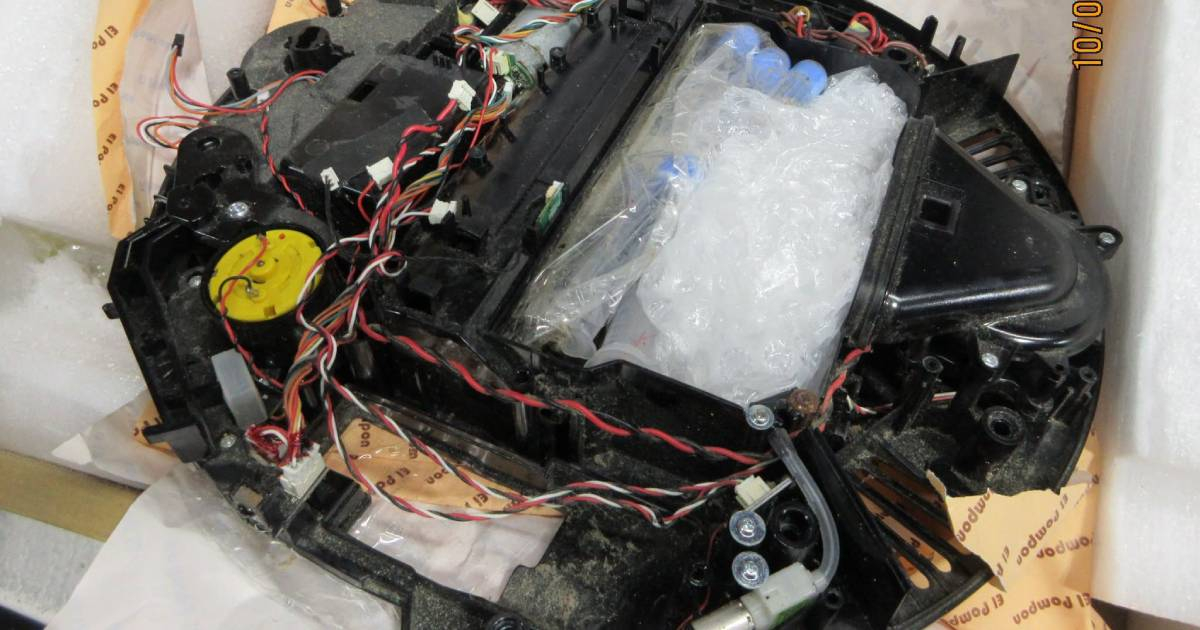
A vacuum robot that arrived in the United States from Spain concealed a surprise that had nothing to do with household cleaning: inside, it was transporting live ants, hidden among the components of the device.
The unusual discovery was made by agricultural specialists from the U.S. Customs and Border Protection (CBP) in Louisville, Kentucky, as reported by the federal agency on its official Facebook page.
The photographs released by the authorities show the robot fully opened, with wires, electronic parts, and compartments exposed. Among its components, small transparent tubes containing the ants were found, some of which can be clearly seen in the images.
The shipment did not have the permission or certificate required by the United States Department of Agriculture (USDA), through its Animal and Plant Health Inspection Service (APHIS).
In response to the irregularities, the authorities proceeded to destroy the prohibited items in accordance with federal regulations.
The CBP did not specify how many ants the device was transporting, what species they belonged to, or who the recipient of the package was. It also did not provide information about any potential arrests or sanctions related to the shipment.
Although the finding may seem like a mere curiosity, U.S. authorities warn that the unauthorized introduction of insects poses a potential threat to the country's agriculture and ecosystems.
Why is it forbidden to introduce ants without authorization?
The United States Department of Agriculture states that all species of ants are subject to regulation for their importation and transfer between states.
Those who wish to introduce them legally must obtain a special permit known as PPQ 526, a requirement that also applies to those who trade these insects between different states in the country.
The concern is well-founded. Some species of ants from other territories can become invasive, compete with native species, damage crops, affect plants, and reduce biodiversity.
Their establishment in new ecosystems can also lead to economic losses and force authorities to allocate significant resources to control or eradicate them.
Additionally, there is a market of enthusiasts who raise ants in artificial colonies, although this activity is subject to restrictions to prevent the spread of potentially harmful species.
This is not the first time that hidden insects have been discovered in a shipment
At the end of August 2026, agricultural specialists from CBP intercepted a package presented as a gift in Miami that concealed 37 tubes containing live ants under a false bottom.
According to reported by AOL in September, the insects were sent to the Department of Agriculture for evaluation, while the rest of the shipment was destroyed.
In that case, the species of the ants was not publicly identified, nor was there any information about arrests.
In another recent post, CBP itself showed how an agent and a detection dog were inspecting a suitcase in which a prohibited wooden product was found.
Under the message "Barking up the wrong tree," the agency explained that its agricultural specialists and trained dogs work to detect items that could introduce pests and invasive species capable of harming crops, livestock, and the environment.
The authorities did not specify in that publication the origin of the passenger, the airport where the finding occurred, or the exact characteristics of the seized wooden product.
Interventions against the entry of unauthorized biological materials have also involved travelers coming from Cuba.
In May 2026, a passenger arriving from Cuba was fined 300 dollars after border agents discovered plant cuttings hidden inside a jacket and a teapot in his luggage during an inspection in Fort Myers, Florida.
Related videos:
Filed under: