
Related videos:
The Field Operations Office of the U.S. Customs and Border Protection (CBP) reported this Sunday that a passenger arriving from Cuba was fined $300 after attempting to bring in plant cuttings hidden in their luggage upon arrival at Fort Myers Airport, Florida.
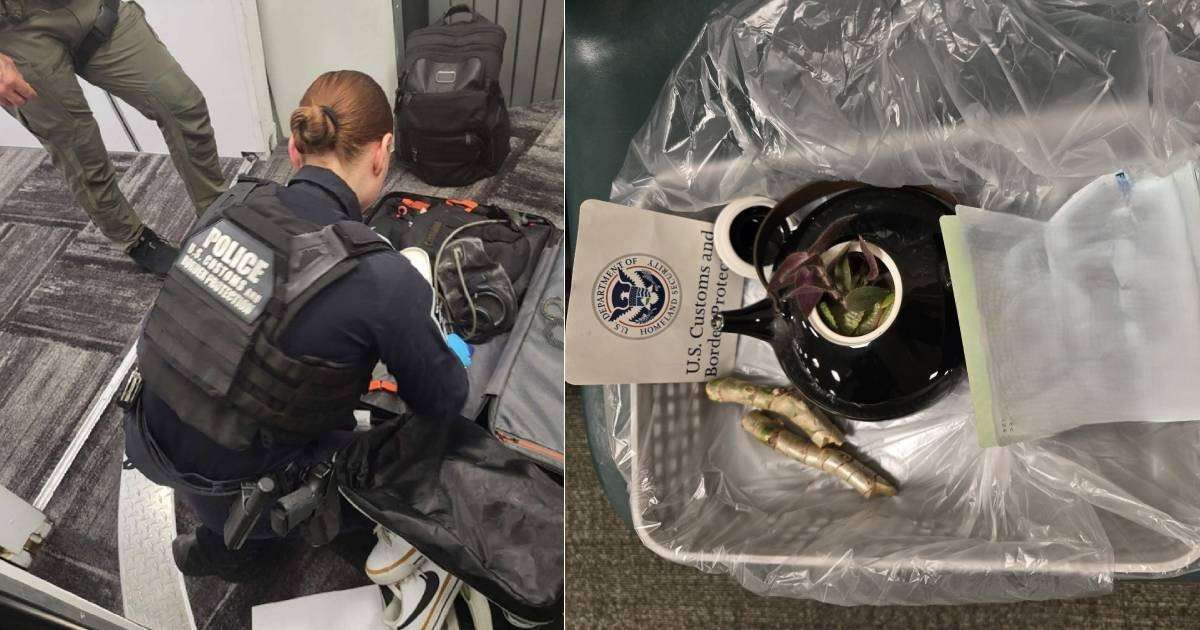
The agency announced the seizure on its official Facebook account with a message written with humor and puns related to tea: "A passenger from Cuba loaded with plant cuttings tried to go unnoticed, but he was no match for the agriculture specialists of the Miami and Tampa Field Office of CBP in Fort Myers. The 'Aggies' discovered the hidden plants in a jacket and a teapot inside his suitcase. A nice attempt, but it ended with a $300 fine."
The photograph published by CBP shows an inspection tray with a black teapot that contained a small plant with green and purple leaves, a yellow-green rhizome or root, a transparent bag with vegetation, and an official card from the Department of Homeland Security.
The agriculture specialists of the CBP, informally known as "Aggies," are officials trained to detect plants, animals, soil, and other biological materials that could introduce pests or diseases into U.S. territory.
According to the regulations of the U.S. Department of Agriculture (USDA) and the CBP, all travelers are required to declare any agricultural products when entering the country. If the items are declared and the inspector determines that they cannot enter, the traveler generally will not face a penalty; the fine applies when items are concealed or not declared.
The plant material coming from Cuba is subject to special scrutiny due to the phytosanitary conditions of the island and the risk of introducing pests such as fruit flies, fungi, and other pathogens. Plant cuttings are particularly problematic because they can carry insects, eggs, or diseases that are not visible to the naked eye.
The $300 fine imposed in this case corresponds to the minimum range for first offenses of undeclared or concealed agricultural items. Penalties can escalate up to $10,000 in cases of repeat offenses or when it involves commercial quantities.
This is not the first time travelers from Cuba have been intercepted at U.S. airports with undeclared items. In August 2025, a Cuban was caught at Miami airport with 64 concealed bullets hidden inside a Nesquik container, and that same month customs seized a bottle containing biological substance from a passenger arriving from the island in Houston.
In 2024, the CBP issued approximately 15,000 civil penalties related to agricultural products, averaging $1,200 per case, reflecting the magnitude of agricultural smuggling at the country’s airports.
Filed under: