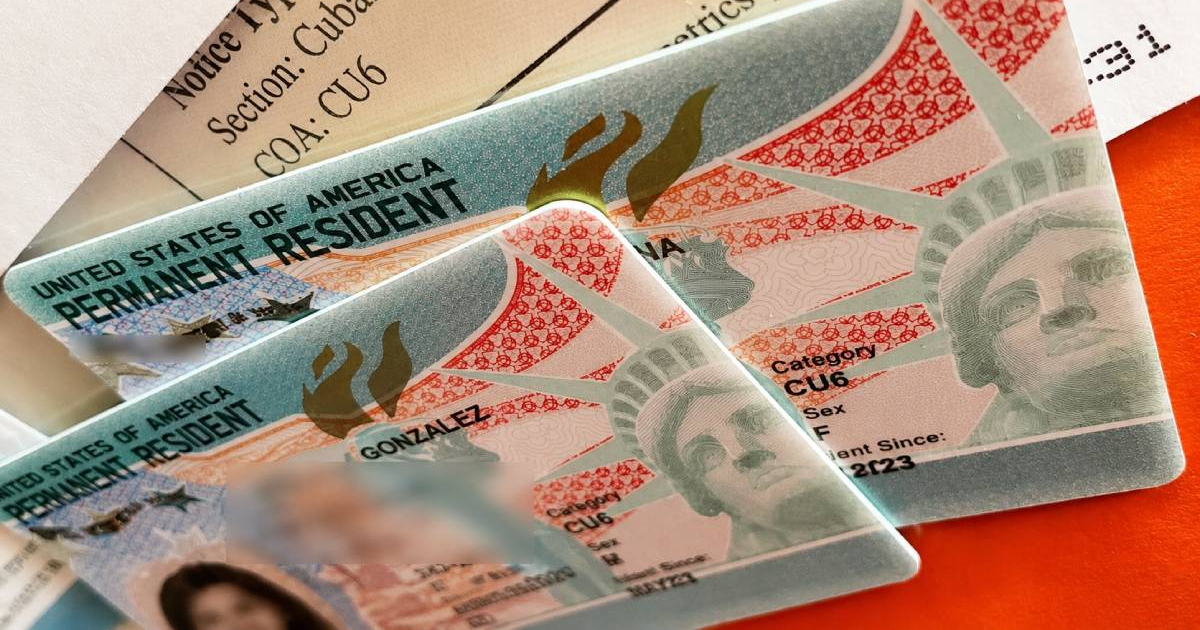
The approval of permanent residencies for Cubans under the Cuban Adjustment Act experienced a historic drop during the period from April to June 2026: the U.S. Citizenship and Immigration Services (USCIS) only granted 139 applications, while rejecting another 447, a difference that highlights the significant decline in outcomes for those seeking to regularize their immigration status through this route.
The figures correspond to the quarterly statistical report from USCIS for the third quarter of fiscal year 2026, covering the months of April, May, and June, and specifically detailing the results of status adjustment applications using Form I-485 under the Cuban category.
According to the data, the agency resolved a total of 586 cases during those three months: it approved 139 and denied 447.
This means that only 23.7% of the decisions were favorable, while 76.3% ended negatively.
In practical terms, USCIS rejected more than three applications for every one it approved, a ratio that contrasts with the results recorded in previous years.
The magnitude of the decline becomes even more evident when comparing the approvals for the same quarter over the last three years.
Between April and June 2024, USCIS had granted 49,965 permanent residencies under the Cuban category and rejected 662 applications.
In the same period of 2025, approvals decreased to 10,432, while rejections rose to 757.
Now, in 2026, the figures show only 139 approvals and 447 denials.
The comparison with 2024 represents a reduction of approximately 99.7% in the number of approved residences, an extraordinary decline in just two years.
Compared to the same quarter of 2025, the decline reaches approximately 98.7%.
However, there is an important element for correctly interpreting these statistics: the absolute number of denied applications in the quarter of 2026 was lower than in the equivalent periods of 2024 and 2025.
The most notable change occurred in the approvals and the total number of decisions made by USCIS.
In 2024, 50,627 cases were resolved during the analyzed quarter, compared to only 586 in 2026.
Therefore, it is not simply the case that USCIS is denying a greater absolute number of residency applications, but rather that it is resolving significantly fewer cases and, among those it decides, denials are now predominant.
The behavior also contrasts with the first three months of 2026.
Between January and March, USCIS resolved only 95 Cuban applications: it approved 50 and denied 45, resulting in an approval rate of 52.6%.
In April, May, and June, the number of decisions increased to 586, but the proportion of favorable resolutions dropped to 23.7%.
The reduction was 28.9 percentage points between the two quarters.
This percentage, however, requires a fundamental clarification: it does not mean that any Cuban currently applying for residency has only a 23.7% chance of obtaining it.
The rate exclusively reflects the outcomes of the cases that USCIS decided during those three months. It does not allow for the calculation of the approval probability for all pending applications nor predict the result of each individual case.
The composition of the resolved files, their background, and the circumstances of each applicant can influence the decisions.
Another concerning indicator is the accumulation of requests that remain without a definitive response.
By the end of June 2026, USCIS recorded 342,360 pending cases under the Cuban adjustment category.
Two years earlier, in June 2024, there were approximately 146,000 cases pending. In other words, the pending volume has more than doubled.
The accumulation occurs despite a significant decrease in new applications.
Between April and June 2026, USCIS received 6,279 applications for adjustment under the Cuban category, compared to over 72,000 during the same quarter in 2025.
The reduction in new applications is around 91%.
Even with fewer cases entering the system, the number of resolutions remains too low compared to the accumulated volume, which helps explain the significant backlog.
The quarterly report also places the median processing time reported for this category at approximately 16.3 months during the analyzed period.
This means that, among the cases included in that calculation, half were resolved in that time or less, while the other half took longer. It does not provide a guarantee regarding how long a currently submitted application will take.
The figure should be distinguished from other historical statistics published by USCIS, which use different reference periods.
At the beginning of October, it was reported that the historical median processing time under the Cuban Adjustment Act had reached 11.8 months for the fiscal year 2026 up until July, more than three times the 3.3 months recorded in 2023.
Both indicators reflect different statistical periods and should not be interpreted as contradictory figures or as guaranteed waiting times.
The decline in approvals occurs amid changes in the immigration policies of the Donald Trump administration and legal disputes regarding USCIS procedures.
On May 21, 2026, the agency issued a memorandum regarding the discretionary nature of status adjustment and the exceptional circumstances that may influence certain immigration decisions.
The guidance emphasized that the adjustment of status is a discretionary benefit and noted that, as a general rule, those temporarily in the United States should seek consular processing in their countries of origin, except in extraordinary circumstances.
The policy raised concerns about its possible impact on Cuban immigrants seeking permanent residency, although the quarterly data alone does not prove that the memorandum is the direct cause of the decline in approvals.
On the other hand, USCIS had implemented administrative restrictions that affected the processing of applications from citizens and nationals of 39 countries, including Cuba.
On August 24, 2026, a federal court in the Northern District of California blocked two memoranda related to that pause and ordered the resumption of the regular processing of the affected cases.
Furthermore, the restrictions related to the processing pause and the May memorandum regarding the discretionary nature of status adjustment are distinct measures. They should not be confused or dismissed together.
The situation can be especially delicate for Cubans with complex immigration procedures, including those who received I-220A documents, entered through parole programs, or have pending asylum applications.
The Cuban Adjustment Act is still in effect and allows certain citizens or individuals born in Cuba who meet its requirements to apply for permanent residency, including having been inspected and admitted or granted parole, and demonstrating at least one year of physical presence in the United States.
However, not all immigration documents equate to an admission or parole for the purposes of that legislation.
In particular, the situation of those who were released under an I-220A order requires individual analysis, as that document does not automatically constitute the parole required to apply for the Adjustment Act.
A pending asylum application does not by itself guarantee that a person meets all the requirements to obtain residence through this route.
The significant decline in approvals had already started to be reflected in earlier statistics.
In April, it was reported that USCIS had approved only 15 residences for Cubans in a month, a drop of 99.8% compared to levels recorded in previous periods.
For those who have already submitted Form I-485, delays and administrative changes make it especially important to keep your contact information updated and to review official notifications from USCIS.
The status of a request can be checked through the official USCIS case tracking system by using the associated receipt number.
Related videos:
Filed under: