
Related videos:
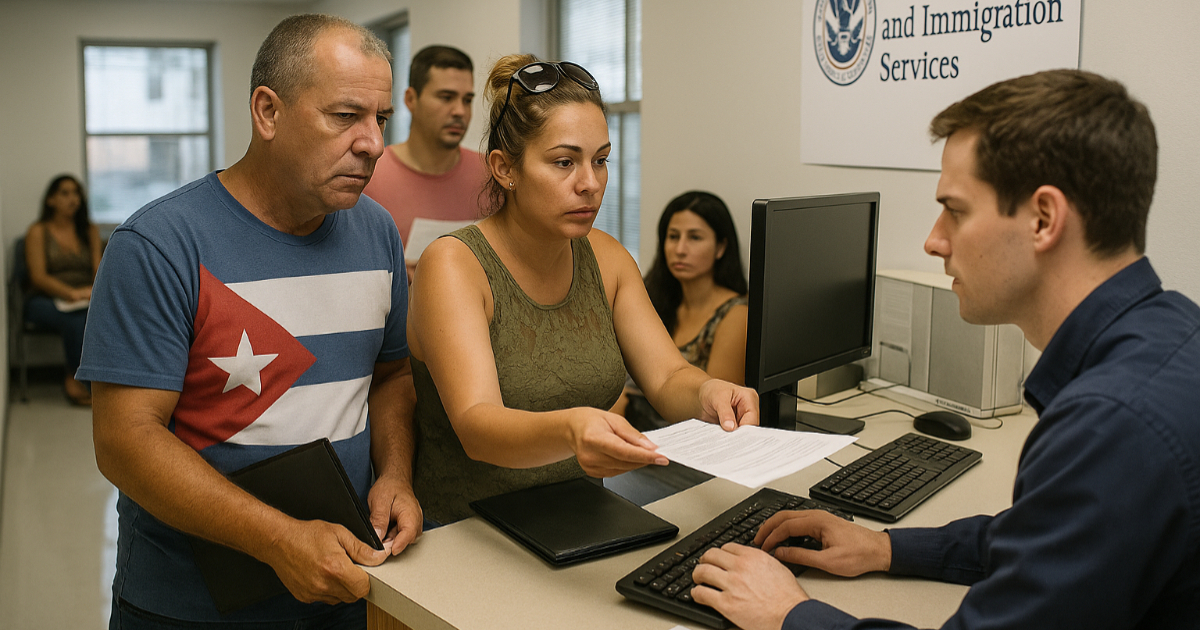
Permanent residency approvals for Cubans in the United States plummeted by 99.8% between October 2024 and January 2026, according to an analysis by the Cato Institute based on data from the Citizenship and Immigration Services (USCIS) and ICE.
The figures illustrate an unprecedented decline: in February 2025, the last full month of the Biden administration, USCIS approved 10,984 permanent residencies for Cubans. In January 2026, with over 7,000 applications received, only 15 were approved and four denied, with thousands of cases on indefinite hold.
The mechanism behind the collapse is, according to the Cato Institute, intentional. In February 2025, USCIS suspended all immigration applications from those who entered under the parole program for Cuba, Haiti, Nicaragua, and Venezuela, canceling their immigration status to facilitate ICE arrests.
"Cubans were the most affected because, under the Cuban Adjustment Act, all of them met the requirements to obtain permanent residency and the green card," the Cato Institute report notes.
Although the law can only be repealed by Congress, the administration blocked its practical application by freezing the procedures.
In December, the government paused all immigration applications submitted by citizens of 19 restricted countries for travel to the United States, including Cubans. The measure halted the processing of residency cards and citizenship applications.
Immigration attorney Rosaly Chaviano confirmed to Telemundo 51 that there are thousands of cases left in indefinite waiting.
"Due to the pause announced by the government, we are not seeing any residency approvals," he explained, adding that Cuban nationality alone has become a reason for suspension: "They said that being Cuban nationals is already enough to be part of this group of countries that has to be put on hold."
The legal trap has direct consequences for ICE. "Unfortunately, the position of ICE officers is that if a person has a pending residency application, that is not sufficient for them," Chaviano warned.
The increase in the detention of Cubans is dramatic: by the end of 2024, ICE was making fewer than 200 monthly arrests of Cubans; by the end of 2025, it exceeded 1,000 arrests per month.
Overall, arrests of migrants from the Island surged by 463% during the same period from October 2024 to January of this year.
A month later, ICE and USCIS signed a joint memorandum authorizing the arrest of individuals with pending applications, revoking an internal policy that had prohibited it.
The ICE office in Miami leads raids across the country with an average of 120 arrests daily. Since January 2025, more than 530 Cubans have been deported on at least four direct flights, and the Department of Homeland Security reports 42,084 Cubans with final deportation orders.
In March, lawyers filed a class action lawsuit against USCIS for delays affecting over 100,000 Cuban residency applications. Given this situation, Chaviano advises always carrying documentation that proves your immigration status is in process: "If you have a pending residency application, the receipt for the residency. If you have a work permit, you should have the card, and any proof that you have pending processes."
David J. Bier, director of migration studies at the Cato Institute, summarized the mechanism: "The Trump administration has drastically reduced legal immigration and suspended requests for ICE to arrest those who could obtain secure status."
Filed under: