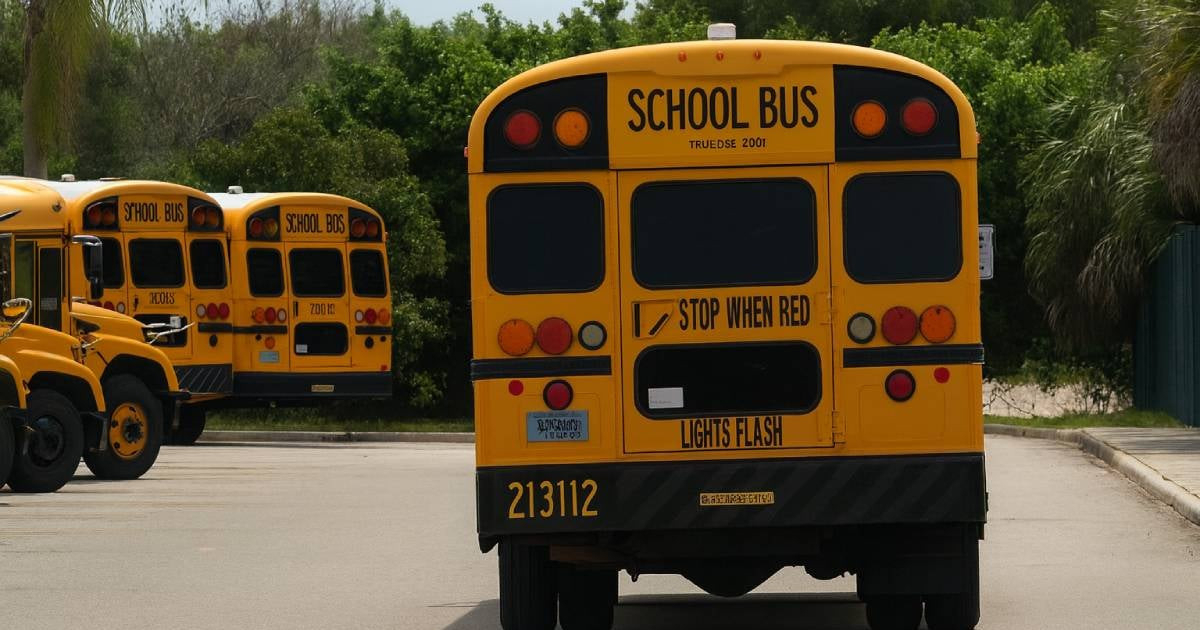
More than 20,000 fines of $225 have been processed in just over a month in Broward County, Florida, thanks to cameras installed on school buses to catch drivers who do not stop when the vehicles activate their stop signals.
The high number of penalties serves as a warning for those traveling through South Florida: passing a stopped school bus can cost hundreds of dollars, even when the violation is detected without the presence of a police officer on the road.
According to reported by NBC6 this Monday, school authorities began sending out fine notifications by mail on September 9, after granting drivers a grace period of approximately one month to familiarize themselves with the system.
The figures have even surprised those in charge of the program. Michael Gregory, head of Security and Protection for the Broward School District, explained that between 2,000 and 4,000 potential violations are detected each week.
"The goal is to reduce violations. I am truly surprised by the figures we are seeing," Gregory stated to NBC6.
The official specified that since the notifications began to be issued in September, the system had already processed more than 20,000 violations.
The initiative works through cameras installed on the county's school buses, which are capable of recording from different angles the vehicles that pass by them when they are stopped to pick up or drop off students.
However, the cameras do not impose fines on their own. The images of possible violations are sent to the authorities, and a police officer must review them before deciding whether to issue a notification.
Officer Michael Rosario from the Broward County School District Police stated that he reviews hundreds of recordings each day, and many show drivers attempting to pass the bus before it has completed its stop.
"What is happening is that people try to beat the bus, and they shouldn't want to do that.", he explained.
Rosario emphasized that drivers should reduce their speed when approaching a school bus, rather than speeding up to avoid being stopped behind it.
The program is operated with technology from the company BusPatrol, which believes that the high initial number of citations may decrease as drivers become accustomed to the monitoring.
The company expects Broward to experience a reduction in violations similar to what was observed after the implementation of cameras in Miami-Dade.
The obligation to stop is established in section 316.172 of Florida law, which requires drivers to come to a complete stop when a school bus activates its stop signals.
The rule also applies to drivers traveling in the opposite direction, except on certain roads divided by physical barriers.
According to the official instructions of the Broward School District, on two-lane streets, all vehicles must stop, regardless of the direction they are traveling.
The same obligation applies on four or more lane roads that do not have a physical divider, as well as on those that only have a central lane for turning.
A turn lane or painted lines on the pavement do not exempt one from stopping for a school bus.
The exception is found on divided roadways separated by a raised median, a physical barrier, or an unpaved strip of land that is at least five feet wide. In those cases, motorists traveling in the opposite direction of the bus are not required to stop.
However, vehicles traveling in the same direction as the bus must always stop when it activates its stop signals, even if there is a separation between the two directions of traffic.
Drivers must remain stopped until the bus removes the stop signals and it is safe to proceed.
This distinction is particularly important on multi-lane avenues, where some drivers mistakenly believe they can continue driving just because they are on the opposite side of the street.
The penalty for the Broward camera program is $225 per violation.
According to the school district, the initial fines issued through this procedure are civil penalties and do not add points to the driver's license.
However, this does not mean that all violations related to school buses have identical consequences. Violations detected directly by traffic agents and other provisions outlined in the legislation may be subject to different procedures and penalties.
Drivers who receive a notification can review the evidence before deciding how to proceed.
The Broward School District confirms that violations can be checked on the AlertBus portal, which is used to manage notifications for the program.
To access the images and videos, you need to visit www.alertbus.com and enter the notification number and the vehicle's registration number.
The portal also allows for the corresponding payment to be made.
Those who believe they have received an incorrect fine have the right to appeal it. The specific instructions for submitting the claim are provided on the second page of the notification sent by mail.
The district recommends carefully reviewing that document before starting any procedures, as it outlines the steps and conditions applicable to the case.
For additional information, drivers can contact the AlertBus customer service center at 1-877-504-7080, Monday to Friday, between 8:00 a.m. and 5:00 p.m.
The service has representatives who speak Spanish, English, and Haitian Creole.
The authorities also warn that there are currently no payment plans for the initial notifications of $225. In certain subsequent administrative procedures, there may be other conditions and costs.
Therefore, before paying or appealing a fine, it is important to verify the evidence and follow the official instructions, especially if the incident occurred on a road with a central divider.
The rapid accumulation of violations in Broward recalls the controversy that this system sparked in the neighboring Miami-Dade County.
In March 2025, the Miami-Dade Sheriff's Office suspended fines related to lane separators after receiving numerous complaints from drivers who claimed to have been penalized despite complying with the law.
One of the main problems was related to motorists driving in the opposite direction to the bus, separated from it by a median that legally allowed them to continue.
The controversy led to a review of the program and new measures to prevent the issuance of incorrect citations.
Subsequently, Miami-Dade announced the reactivation of the system in May 2026, with additional controls, independent police review, and a procedure to contest the penalties.
The relaunch also occurred after a judge overturned approximately 5,400 violations from the previous program, amid detected irregularities.
Related videos:
Filed under: