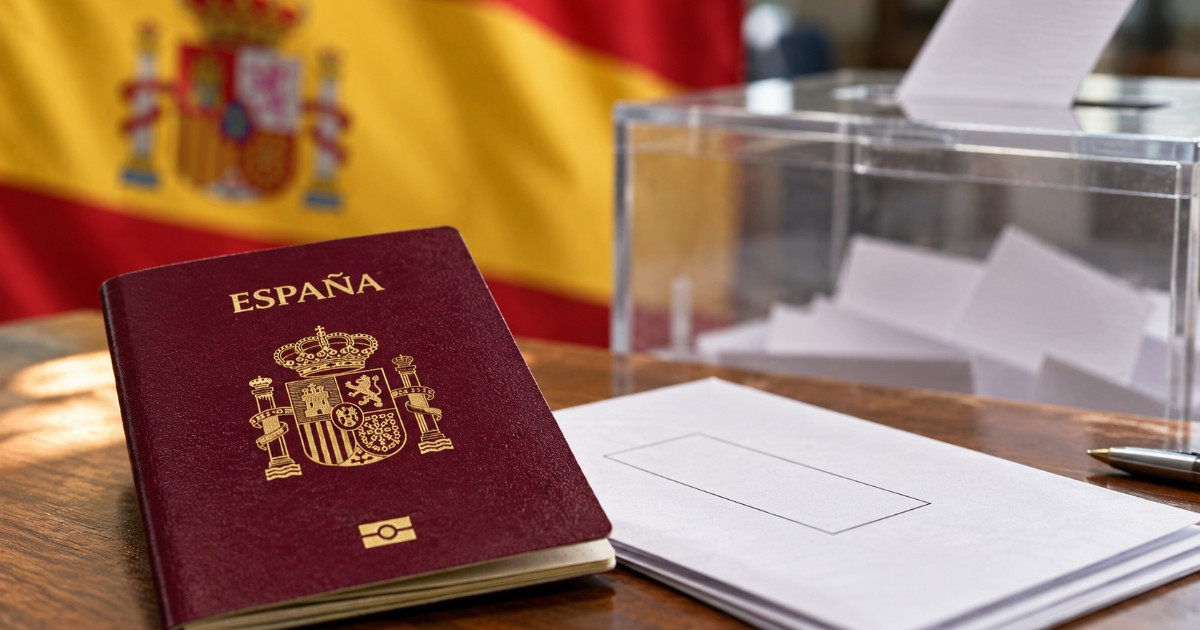
The president of the Popular Party, Alberto Núñez Feijóo, made his strongest statements to date this Tuesday regarding the so-called Grandchildren's Law, asserting that the Constitutional Court will not dare to contradict the Supreme Court or the Central Electoral Board in the conflict over the overseas voting rights of naturalized citizens.
In an interview with Feijóo on the program Herrera en COPE, the popular leader was emphatic: "The Constitutional Court will not dare, knowing full well, to issue an unjust ruling," and added that "it will not dare to commit such a nonsense."
Feijóo made these warnings while the full Constitutional Court —the 12 judges presided over by Cándido Conde-Pumpido— was considering whether to admit the protection appeal filed by the Ombudsman, Ángel Gabilondo, in an attempt to restore the overseas voting rights of 163,020 naturalized citizens before the elections on November 29.
Information from Tuesday indicated that a majority of the Plenary was leaning towards rejecting the admission, in line with a report from the court's legal advisors who deemed the appeal "premature" as the deadline for submissions to the Supreme Court did not expire until October 22.
The leader of the PP also questioned the very name of the regulation: "It is neither a law nor for grandchildren," arguing that the expansion of beneficiaries to include great-grandchildren and great-great-grandchildren was made through an instruction from a general director, not through the Courts.
He described the Law of Grandchildren as "nonsense within the nonsense we've experienced in recent years" and accused the government of Pedro Sánchez of having been "caught cheating" by trying to incorporate, according to the PP's estimate, 2.4 million new voters through the implementation of this law— a figure that the party presents as a political argument and which lacks independent official verification.
As a structural response, Feijóo proposed to promote a Nationality Law that tightens the requirements to obtain the Spanish passport: "Passports are not given away; one must earn the passport."
At the moment, there is no articulated text of that proposal, and the current Law of Grandchildren has not been repealed.
It is essential to clarify that no ongoing court ruling nullifies the nationality already granted or revokes the issued passports: the Supreme Court's suspension exclusively restricts the right to vote from abroad through the registry of absent residents on November 29, as the Spanish Government explained when acknowledging the consular difficulties.
Naturalized Cubans residing in Spain can vote on November 29 without any restrictions.
The impact of this conflict is particularly significant for the Cuban community: there are 252,290 Cubans residing in Spain —the ninth largest foreign community— of which 63% already hold Spanish nationality, and the Consulate of Havana received over 107,000 nationality applications just during 2025.
The proposal for a new law with stricter requirements creates uncertainty among those with ongoing procedures; however, without an approved text or modified existing regulations, active processes continue under the current legal framework.
Related videos:
Filed under: