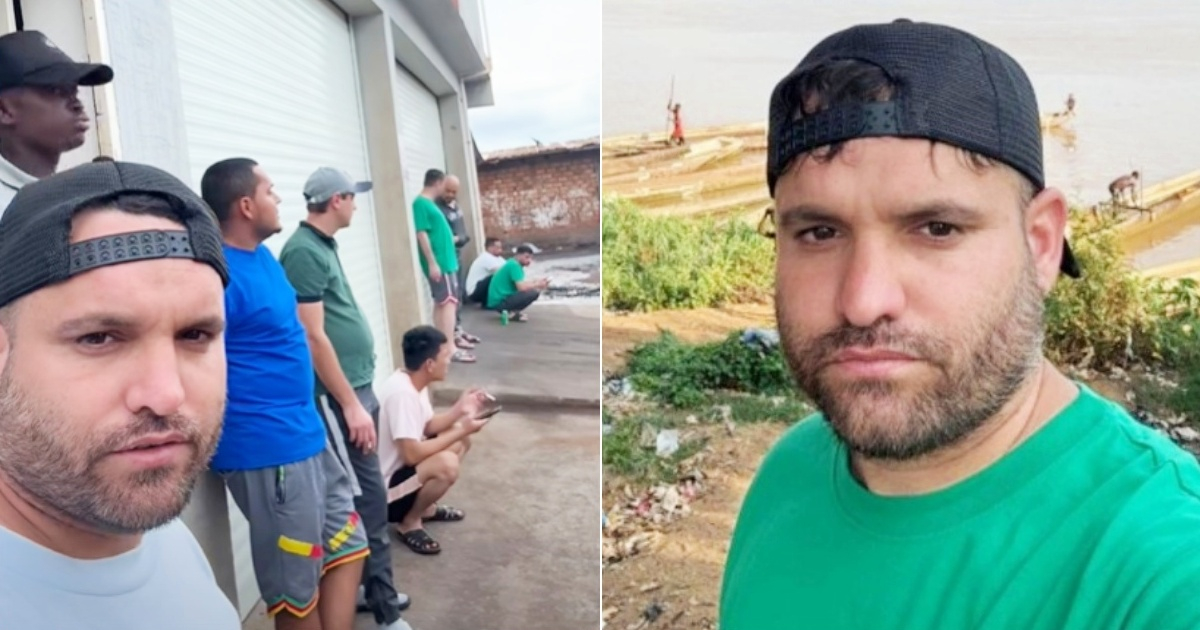
Yasmany Moreno de Armas, a 32-year-old Cuban deported by the United States to the Central African Republic, urged that the Latino vote punish President Donald Trump in the 2026 midterm elections.
Moreno de Armas is asking for that after having supported him in the 2024 presidential elections and ending up stranded in Africa, where he reports diseases, hunger, and extreme conditions.
“I hope the Latino vote punishes him in this election; he deserves it. Many end up deported, like us, here in Africa, I wonder what we have done. If I had known this, I would prefer to go to Cuba; this is a huge trauma for us,” declared Moreno in an interview with Univision.
The Cuban, who resided in Florida before his arrest, said he felt betrayed by the Republican leader, whom he supported along with others in his circle for his promises related to Cuba.
“Cubans feel betrayed by Trump. Many supported him in Florida during the elections, and what did he do? He deported us to Africa. That's the solution. He said he would free Cuba, and he hasn’t done it; he only deports and arrests innocent people. He sent us to hell,” he expressed.
From supporting Trump in Florida to ending up deported to Africa
Moreno arrived in the United States on a raft in 2016 and received humanitarian parole under the then-current policy of "dry feet, wet feet."
He later applied for permanent residency under the Cuban Adjustment Act, but his request was denied because it was submitted after his parole had expired.
On May 11, 2025, he was detained by the Immigration and Customs Enforcement (ICE) and remained in immigration custody for over a year until his deportation on July 30, 2026.
According to his testimony, he was transferred handcuffed at the wrists, waist, and feet, without initially knowing his destination.
On August 1, he arrived in Bangui, the capital of the Central African Republic, a country with which he had no personal or family connections.
Moreno has also explained that he fears returning to Cuba because he was previously imprisoned for "illegal exit from the national territory" during an initial attempt to emigrate.
His case is part of the deportation policy to third countries promoted by the Trump administration, which allows for the transfer of certain immigrants to nations other than their countries of origin.
In statements to Univision, ICE defended Moreno's deportation and noted that he had a record of five traffic violations, including driving with a suspended license.
The agency stated that it received due process and that there was an expulsion order issued on April 27, 2026.
"He sent us to hell": malaria, hunger, and reports of kidnappings
Since his arrival in Bangui, Moreno has denounced the conditions in which dozens of migrants deported from the United States remain.
According to the explanation, about 60 people of various nationalities are distributed across six centers, without passports, with restricted movements, and facing difficulties in accessing food and medical care.
"Practically all of us have malaria because of the mosquitoes. We have experienced fever and symptoms, and not everyone has money for medications," he recounted.
Moreno, who also suffers from diabetes and asthma, stated that healthcare services are inadequate and that he has been waiting for over a month for the results of a blood test.
“There are no hospitals or doctors here, it’s like in Cuba. They took us to a hospital center and they act like they examine you, they give you some medicine but the symptoms don’t go away,” she reported.
The Cuban also stated that he had been detained twice by individuals he identified as members of the local security forces, who allegedly demanded money in exchange for his release.
"I was already in the cell, I wouldn't recommend it to anyone. We're practically being held hostage, and that's the way it is; then they ask for money, a ransom, to release you," he said.
In videos posted on social media, Moreno also reported that a meeting scheduled with representatives of the United Nations was canceled without prior notice, after the migrants waited for three hours.
The situation has had economic consequences for his family in the United States. Moreno stated that his parents and brother send him around 500 dollars a week to cover his needs and to help other deportees who lack resources.
The policy of deportations to third countries under judicial scrutiny
Moreno's transfer took place as part of an agreement between Washington and the Central African Republic that included 85 million dollars allocated for operations of the International Organization for Migration.
At least 92 people were sent to that African country on three flights conducted between June and August 2026.
The legality of these deportations remains under judicial review in the United States. The Supreme Court temporarily allowed the continuation of the transfers while the litigation is resolved, with hearings scheduled for December.
A departure from Bangui and new hopes for the deportees
Amid the uncertainty, Arístides Fernández García, another Cuban deported to the Central African Republic, managed to leave for Bolivia on October 19, after staying nearly three months in Bangui.
Moreno has also mentioned the case of another colleague, Yasiel Reina, who would have obtained a humanitarian visa to travel to Bolivia.
The lawyers of the deported individuals are exploring alternatives to transfer them to Latin American countries while they continue their immigration proceedings in the United States. Among the mentioned possibilities is Costa Rica, although there is no confirmed solution for the entire group.
Moreno's lawyer also informed him that there could be negotiations for his return to a U.S. detention center while his process continues.
"I prefer to spend two or three months in a detention center rather than being deported in Africa.", he stated.
Moreno talks about possible humanitarian visas to bring Cubans out of Africa
In an update shared through two videos on social media, Moreno stated that a person allegedly connected to the United States government is managing temporary humanitarian visas to transfer Cubans deported in Africa to Latin American countries, where they could await the resolution of their immigration processes.
According to the explanation, the potential destinations would include Costa Rica, Panama, and Guyana, in addition to Brazil, although no certainties were given about which countries would accept those affected.
The Cuban asked the families of deportees who remain in Liberia, Equatorial Guinea, Eswatini, and the Central African Republic to contact him privately to provide information about their loved ones, which he stated he would relay to the supposed government liaison.
However, the actions announced by Moreno have not been officially confirmed by the U.S. government.
Sigue las últimas noticias sobre deportaciones, visas humanitarias y procesos migratorios de cubanos en nuestra sección de .
Related videos:
Filed under: